Yo, let’s talk about roads. Not just any roads, but the kind that make you question the map, the kind that tell a story. In Japan, a country absolutely laced with engineering marvels and pristine highways, you’d think you’ve seen it all. But trust me, you haven’t. Tucked away at the absolute edge of everything, on the windswept northernmost tip of Japan’s main island, Honshu, lies a road that straight-up trolls your GPS. This isn’t just an off-the-beaten-path route; it’s a path that ditches the ‘road’ part and becomes a staircase. Welcome to National Route 339, the one and only “Stairway National Route,” or as the locals call it, the Kaidan Kokudo. This isn’t a glitch in the system; it’s a legendary piece of infrastructure that’s part hike, part pilgrimage, and all awesome. It’s a place where bureaucracy met an impossibly steep cliff and decided to just roll with it. Here at Cape Tappi, where the wind howls like a spirit and the sea churns with raw power, you’ll find the most wonderfully bizarre national highway in the entire country. It’s a journey that challenges your legs and blows your mind, offering a glimpse into a side of Japan that’s wild, untamed, and fiercely beautiful. Before we dive into this vertical adventure, get your bearings and see just how far out this legendary spot is. It’s a trip to the edge, both literally and figuratively.
If you’re drawn to Aomori’s otherworldly landscapes, you should also explore the spiritual power of Osorezan.
The Vibe of the Edge: What It Feels Like at Cape Tappi
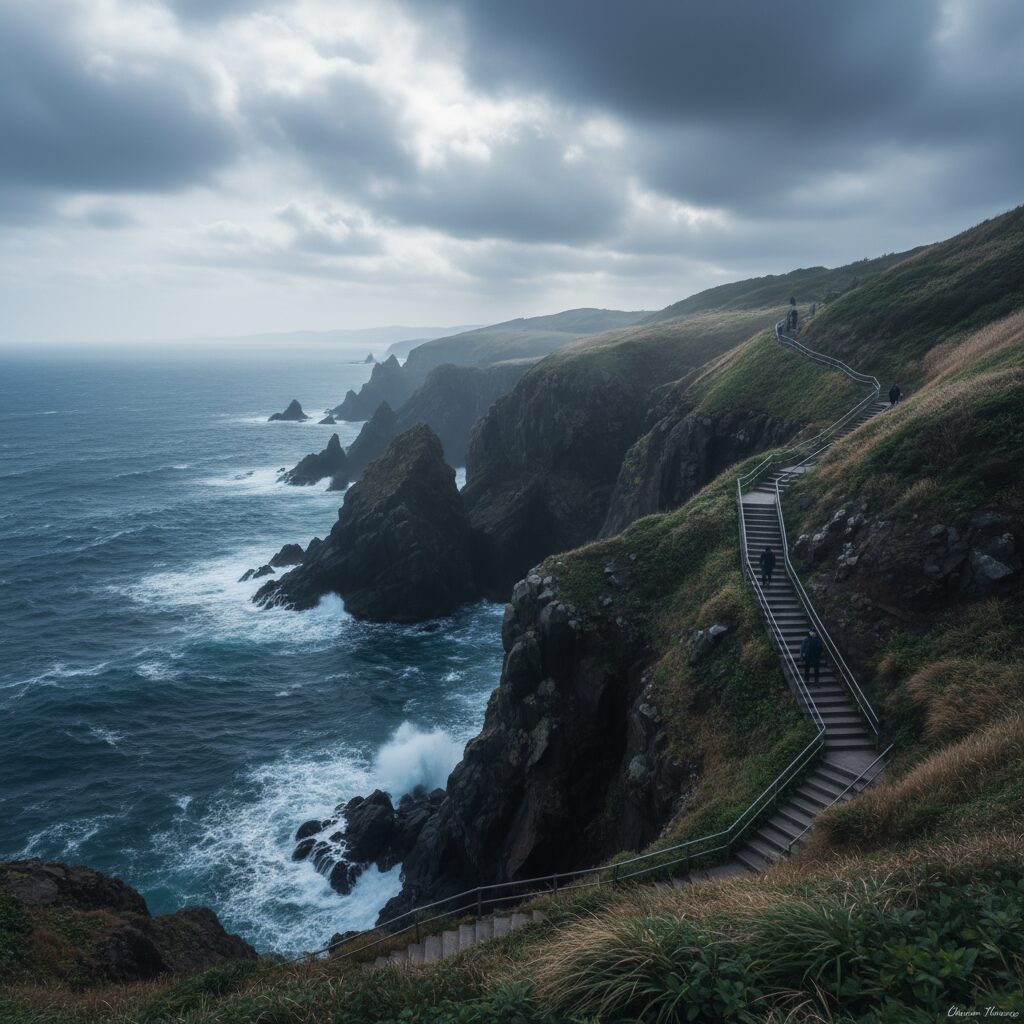
Before you even reach the stairs, you need to understand your surroundings. Cape Tappi, or Tappizaki, is far from a gentle, peaceful cape. This place is wild. It marks the final punctuation on the long, rugged Tsugaru Peninsula in Aomori Prefecture. The name Tappi is believed to derive from the Ainu word meaning ‘cape where the sea eagles fly,’ and you can sense that ancient, raw energy in the air. The defining element here is the wind. It’s not just a breeze; it’s a tangible force. It blasts up the cliffs from the Tsugaru Strait, a powerful channel separating Honshu from the northern island of Hokkaido. The wind is so iconic that there’s a button at the viewpoint that plays a recording of its roar during a winter storm. It’s intense, humbling, and perfectly sets the tone for the strange Stairway National Route.
The atmosphere is one of profound solitude and breathtaking natural beauty. You feel as though you’ve reached the very edge. The sea is a deep, dramatic blue, often topped with whitecaps even on calm days. Across the strait, on a clear day, the outline of Hokkaido appears like a distant, promised land. This view has inspired poets, songwriters, and countless travelers for centuries. There’s a subtle melancholy to it, a feeling of mono no aware, the classic Japanese awareness of the bittersweet transience of life. You’re standing where many have stood before, feeling small against the vastness of nature. This isn’t a polished, touristy viewpoint. It’s rugged, authentic, and makes the journey here entirely worthwhile, even without the stairs.
So, Why a Staircase? The Seriously Epic Backstory of Route 339
Alright, let’s dive into the main story. How on earth does a national highway—a kokudo, equivalent to a major federal highway—turn into a flight of stairs? This tale perfectly captures a slice of Japanese history, blending ambitious post-war planning with the challenges of unforgiving geography. National Route 339 was established in 1974 during Japan’s rapid economic expansion. The government aimed to link every part of the archipelago with a modern road network. The plan was to create a coastal route along the Tsugaru Peninsula, connecting villages and spurring the local economy.
The issue was a particular stretch near Cape Tappi. The terrain there is brutally steep, with a sheer cliff dropping down to the small fishing port of Minmaya below. Constructing a conventional road for vehicles would have required massive, costly engineering efforts—think huge tunnels or a complex series of switchbacks that the landscape couldn’t support. For years, this 388.2-meter section remained an impassable gap, a literal blank spot on the highway. However, locals had long relied on a narrow, winding footpath linking the cliff top to the village. It was their vital lifeline.
In a move of brilliant bureaucratic pragmatism, the authorities decided to officially incorporate this existing footpath into the national highway system. While building a road for cars was impossible, they could upgrade the path for pedestrians. So, they paved it, added concrete steps, and designated this pedestrian-only portion as part of National Route 339. Thus, the Kaidan Kokudo was born. It stands as a testament to a mindset that prioritizes connection at all costs—even if it means traveling on foot. It’s a solution so simple, yet so unusual, that it has become a destination in its own right. This is no mistake; it’s a deliberate, thoughtful, and uniquely Japanese piece of infrastructure.
The Vertical Trek: Your Step-by-Step Experience
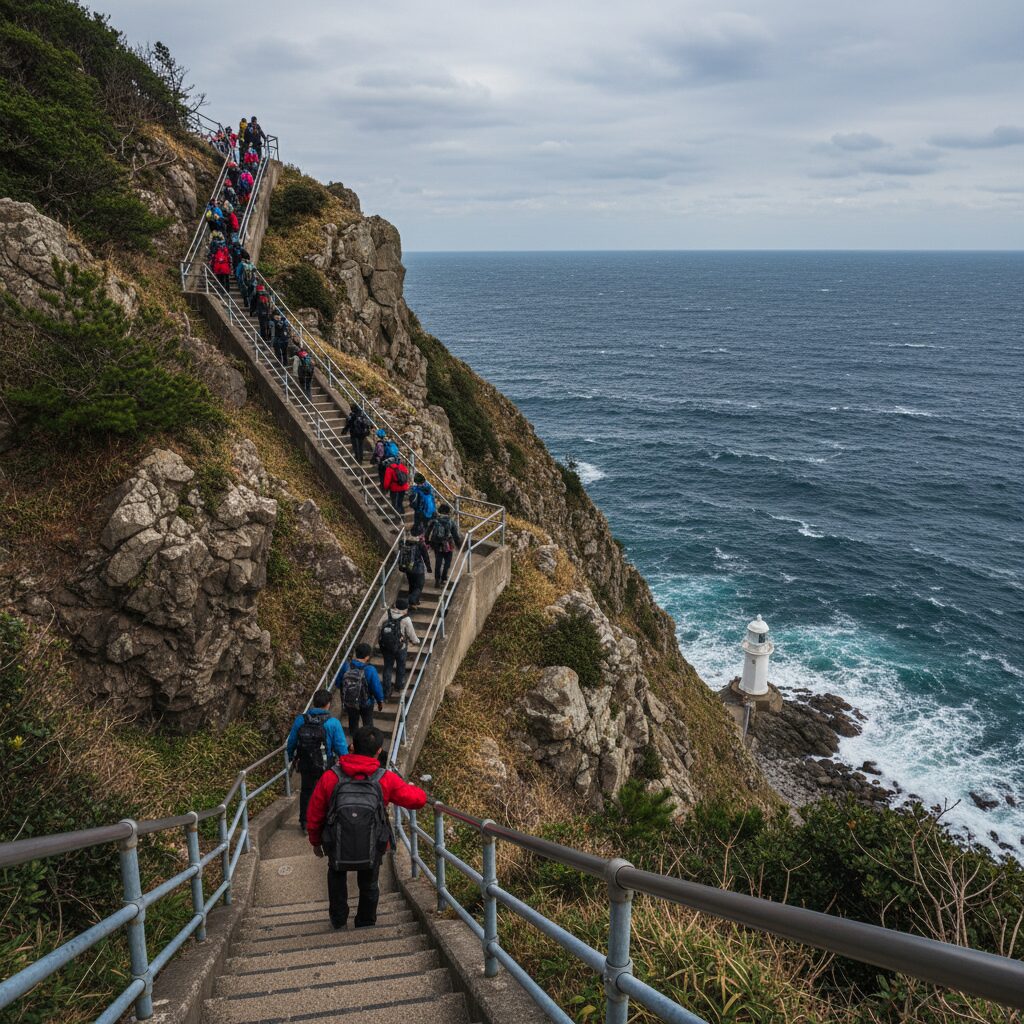
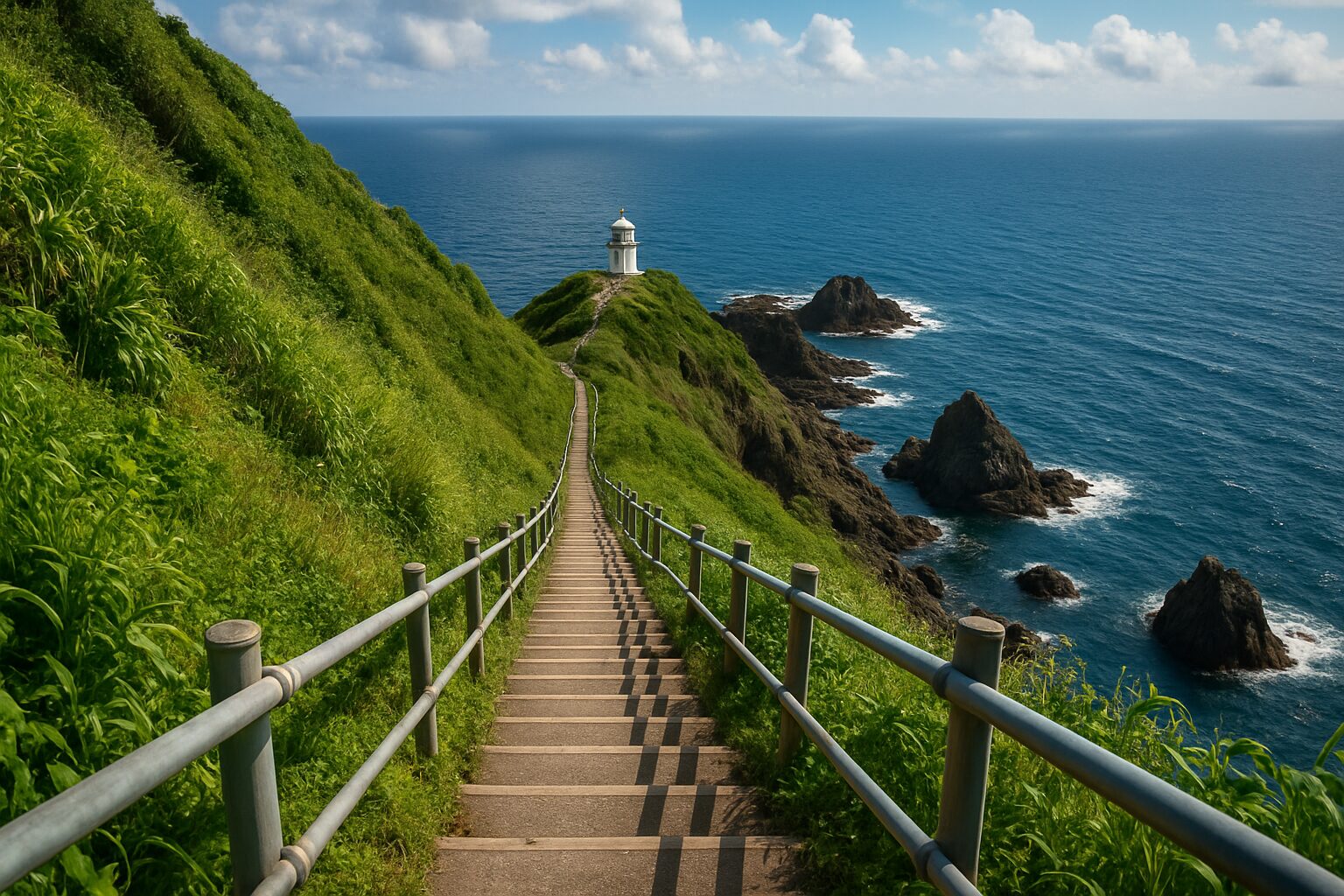
Conquering Route 339 is an experience you’ll always remember. The stairway section features 362 concrete steps. That might not seem like much, but trust me, when you’re on the edge of a windswept cliff, it feels like a monumental climb. You can begin at the top near Cape Tappi Lighthouse or at the bottom in the Minmaya fishing village. Most recommend starting from the top and walking down, as it’s easier on the knees and offers expanding views of the harbor during the descent.
Starting at the top, you’ll see a modest sign marking the beginning of the stairway section. The first steps lead you into a dense thicket of coastal greenery. For a moment, the roaring wind is muffled by the leaves, and you find yourself in a quiet, green tunnel. The air carries the scent of salt, soil, and wildflowers. The steps are solid but can be slippery when wet, so sturdy footwear is essential. As you continue downward, the trees thin out, and the view opens dramatically. Below, Minmaya village comes into view, with houses clustered around the protective harbor and fishing boats bobbing in the water. The scale of the cliff you’re descending becomes strikingly clear.
About halfway down, the path emerges into the open, fully exposed to the elements. Here, the wind returns—constant and powerful. You can hear the waves crashing against the seawall below, creating a rhythmic, deep percussion accompanying your footsteps. This is when it really hits you—you are walking down a national highway. Partway down, you’ll spot the official blue and white Route 339 sign, a perfect, surreal photo opportunity. It’s a sign designed for cars, standing proudly over a path where no vehicle could ever travel.
The descent takes roughly 15 to 20 minutes, depending on how often you pause to enjoy the views. When you reach the bottom, you find yourself in the quiet, narrow streets of Minmaya. The transition is striking in the best way possible. You move from the wild, elemental chaos of the cape to the calm, orderly life of a small Japanese fishing community. Looking back up at the cliff you just descended, the path nearly disappears, swallowed by the green hillside. It leaves you with a genuine sense of accomplishment, a feeling of having traversed a secret passage between two very different worlds.
More Than Just Stairs: Exploring the Tappi Zone
While the Stairway National Route takes center stage, the area surrounding Cape Tappi is filled with other captivating spots that are definitely worth your time. This place is far more than just one attraction; it’s an entire region rich in history, culture, and breathtaking views. Traveling all the way here just for the stairs would be a missed chance to explore so much more.
Tappizaki Lighthouse
Situated right at the cape’s summit, the Tappizaki Lighthouse stands as a timeless, steadfast beacon. Since 1932, it has been guiding vessels through the perilous Tsugaru Strait. Although entry to the lighthouse is not allowed, the surrounding area offers some of the most stunning panoramic views you’ll find. It’s the perfect spot to feel the full strength of the wind and gaze across the water toward Hokkaido. On a clear day, the city of Hakodate is distinctly visible. This is a place for quiet reflection, where you can truly appreciate the immense power of both ocean and sky.
The Seikan Tunnel Museum
Just a short distance from the cape lies one of Japan’s most remarkable engineering achievements: the Seikan Tunnel. For many years, it held the record as the longest and deepest rail tunnel globally, stretching 53.85 kilometers beneath the Tsugaru Strait to link Honshu and Hokkaido. The Seikan Tunnel Museum is a must-see attraction. It narrates the story of the tunnel’s challenging construction—a monumental effort spanning over two decades and marked by tragic loss of life. The highlight is riding Japan’s steepest cable car down to an observation gallery inside the tunnel, 140 meters below sea level. Here, you can watch shinkansen bullet trains speed by as they head toward Hokkaido. Standing beneath the ocean to witness this engineering wonder offers a jaw-dropping experience, creating a striking contrast with the nearby low-tech, practical stairway highway.
Monuments to Culture and Memory
Cape Tappi is deeply rooted in Japanese culture, especially through its ties to literature and music. A monument honors the renowned, melancholic writer Osamu Dazai, a native of Aomori who wrote about the Tsugaru region in his travelogue Tsugaru. The monument displays an excerpt from his work, anchoring this wild landscape in a profound literary heritage.
Even more famous is the monument dedicated to the iconic enka song “Tsugaru Kaikyo Fuyugeshiki” (Tsugaru Strait Winter Scenery) by Sayuri Ishikawa. This beloved ballad, a national treasure, tells the poignant story of a woman departing her lover and crossing the strait from Aomori to Hokkaido by ferry during winter. It beautifully conveys the sorrowful, dramatic, and romantic mood of the region. The monument features a button that, when pressed, sends the song’s powerful melody echoing across the cape on the wind. The effect is incredibly atmospheric—almost cinematic—providing a stirring soundtrack to the stunning scenery. For many Japanese visitors, hearing this song here is a profoundly moving, almost pilgrimage-like experience.
A Taste of Tsugaru: Fueling Your Adventure

The journey to the northern tip of Honshu is sure to build an appetite, and the Tsugaru Peninsula satisfies with some of the freshest, most delicious seafood you can imagine. This isn’t the place for elaborate fusion dishes; it’s all about honest, incredible ingredients harvested directly from the cold, nutrient-rich waters of the Tsugaru Strait. The fishing port of Minmaya, located at the base of the Stairway National Route, is an excellent place to begin. Look for small, family-run eateries, often called shokudo, that serve the catch of the day.
The true highlight here is sea urchin, or uni. Uni from this area is famous across Japan for its sweet, creamy, and briny taste. If you visit between June and August, you can often enjoy uni-don, a simple bowl of rice topped with a generous, decadent serving of fresh sea urchin. It’s a truly unforgettable culinary experience. Another local favorite is squid, or ika. You’ll often see squid hanging out to dry in the sea breeze, a common sight along coastal Aomori. Whether served as delicate sashimi, grilled, or fried, the local squid is exceptionally fresh and flavorful.
Beyond seafood, Aomori is known as Japan’s apple capital, so be sure to sample some local apple juice, cider, or apple-based sweets. The crisp, sweet-tart flavor perfectly complements the salty sea air. Eating here is part of the adventure—it’s about connecting with the local industry, the seasons, and the people who make their living in this harsh but abundant environment. Don’t hesitate to step into a small, unpretentious restaurant; the flavors you’ll discover will be as memorable as the stunning views.
The Practical Playbook: Getting There and Getting Around
Let’s be honest: Cape Tappi is quite remote. Getting there is part of the adventure and requires some careful planning. You can’t simply jump on a subway and arrive. However, the effort involved is a big part of what makes the experience so rewarding.
By Car
Renting a car is by far the most flexible and recommended way to explore the Tsugaru Peninsula. The drive from Aomori City, the prefectural capital, takes about two hours each way. The roads are well-maintained but become narrower and more winding as you approach the cape. The coastal drive itself is breathtaking, offering stunning views of the sea and quaint fishing villages along the route. Having a car lets you stop wherever you like and explore the sights around Cape Tappi at your own pace. Be sure to fill up on gas before heading up the peninsula, as gas stations are few and far between. Also, keep in mind that during winter—from late November to late April—the final stretch of road to the cape, including Route 339, is frequently closed due to heavy snowfall. Always check road conditions beforehand.
By Public Transport
It’s possible to reach Cape Tappi by public transport, but it takes patience and careful attention to schedules. This is truly a slow-travel experience. The journey begins with the JR Tsugaru Line from Aomori Station to its terminus, Minmaya Station. This train ride is scenic, running along the coast of Mutsu Bay. From Minmaya Station, you’ll need to catch a local bus—the Sotogahama Town Bus—to Tappizaki. The bus runs infrequently, with only a few round trips per day, so checking the timetable in advance is essential. Missing the last bus back could mean an unexpected overnight stay. The bus itself is an experience, winding its way up steep roads to the cape. This option suits travelers who appreciate the journey as much as the destination and are comfortable with a fixed schedule.
When to Visit
The best time to visit Cape Tappi and enjoy the Stairway National Route is from May through October. During these months, the weather is milder, the vegetation lush, and all facilities—including roads—are open. Summer (July and August) offers the warmest weather and sea urchin season, though it can also be the busiest period. Spring and autumn bring cooler temperatures, fewer crowds, and beautiful seasonal colors. Autumn, especially, can be spectacular but be ready for stronger winds. Winter is a different story. While the snow-covered landscape is strikingly beautiful, access is severely limited. Strong winds and heavy snow make it a challenging—and often inaccessible—destination. For first-time visitors, planning a trip between late spring and early autumn is definitely the best choice.
Final Thoughts from the Edge of Japan
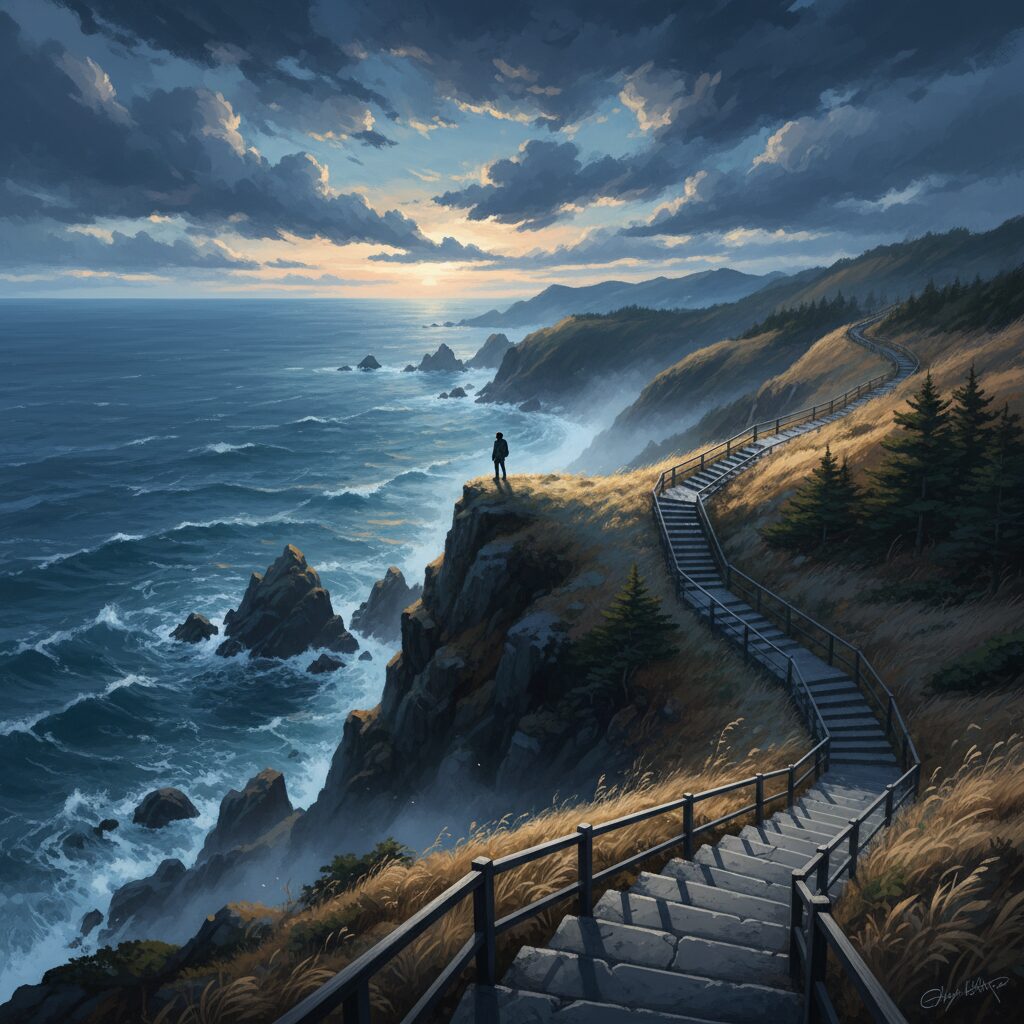
Standing at Cape Tappi, with the wind threatening to knock you off balance and the roar of the sea filling your ears, you sense a connection to something elemental. This place serves as a reminder of the raw, untamed power of nature. And amidst it all stands a wonderfully human, slightly humorous creation: a national highway made entirely of stairs. The Kaidan Kokudo is more than just an eccentric travel spot; it’s a symbol of resilience, adaptation, and the distinctly Japanese talent for finding elegant, practical solutions to seemingly impossible challenges.
It marks a moment in history when the desire to unite a nation met the harsh reality of a cliffside, and rather than surrendering, a compromise was forged. It’s a road that does not conquer nature but instead works harmoniously with it, encouraging you to slow down, walk, and feel the earth beneath your feet. A journey on National Route 339 is a journey away from the neon-lit cities and the predictable precision of the bullet train. It’s a pilgrimage to a place where the map gets strange, the wind tells stories, and a simple flight of stairs feels like the grandest highway in the world. It’s a whole experience, a trip that lingers with you long after you’ve brushed the salt from your hair.