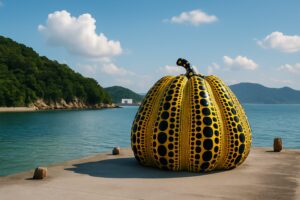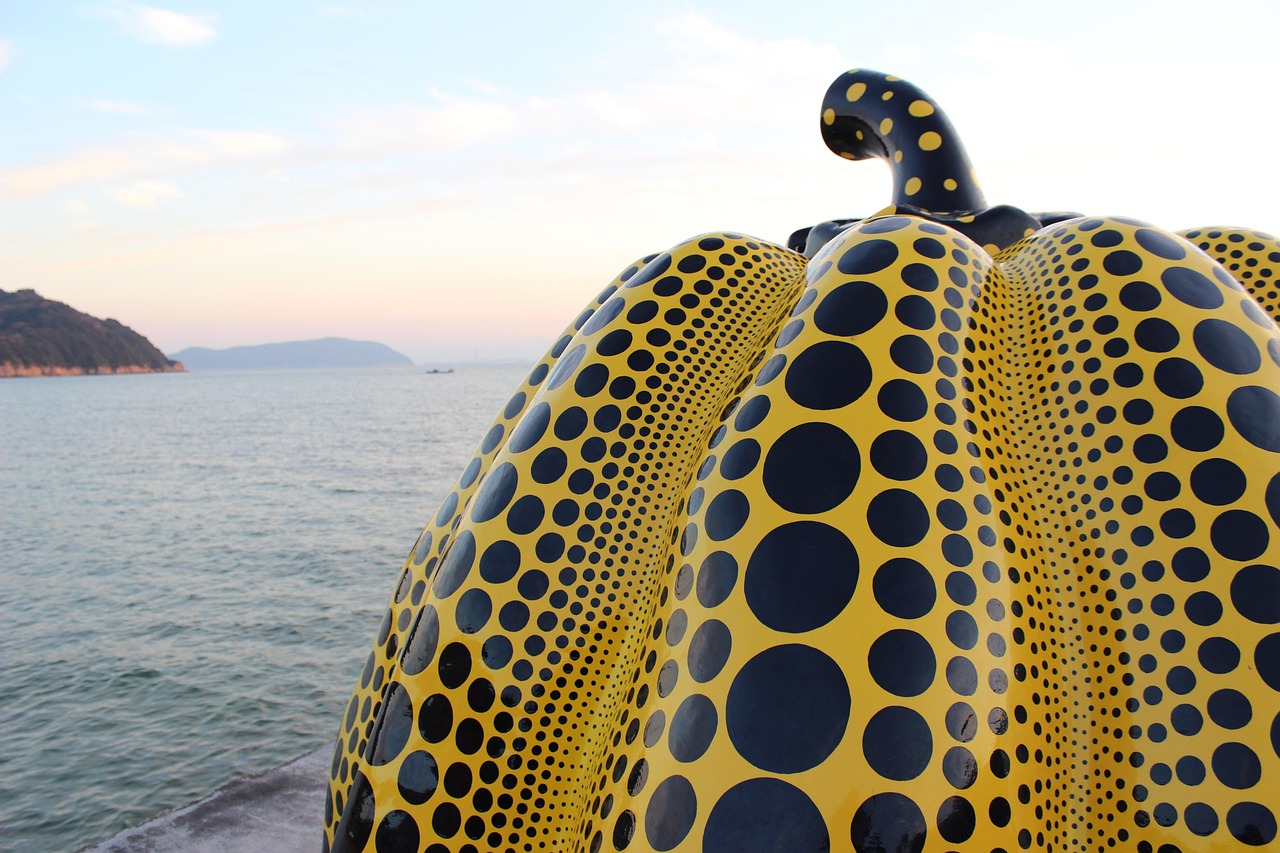
Yo, let’s get real for a sec. You’ve probably seen the pics flooding your feed—a giant, polka-dotted pumpkin sitting serenely on a pier, backdropped by an endless blue sea. That’s the signal, the calling card of Naoshima, Japan’s legendary art island. But lemme tell you, that pumpkin is just the opening act to a mind-blowing concert of art, architecture, and nature that you can only truly get by hopping on a bike and letting the island’s rhythm take over. This isn’t just a museum trip; it’s a full-blown pilgrimage for your creative soul, a place where the world’s most fire contemporary art collides with the chill, timeless vibes of Japan’s Seto Inland Sea. Tucked away from the neon chaos of Tokyo and the ancient temples of Kyoto, Naoshima offers a different kind of Japan—one that’s slow, deliberate, and jaw-droppingly beautiful. It’s a testament to the power of art to literally transform a landscape, turning a once-quiet island into a global destination. For real, this place rewires your brain and makes you see the world differently. And the absolute best way to plug into this island’s unique frequency? On two wheels, with the sea breeze as your guide and a world of artistic wonder waiting around every corner. Prepare to get your mind blown.
After exploring Naoshima’s art-filled landscapes, consider extending your Shikoku cultural journey by discovering the tranquil beauty of Ritsurin Garden in Takamatsu.
The Journey Begins: Ferry Vibes and Your Electric Steed
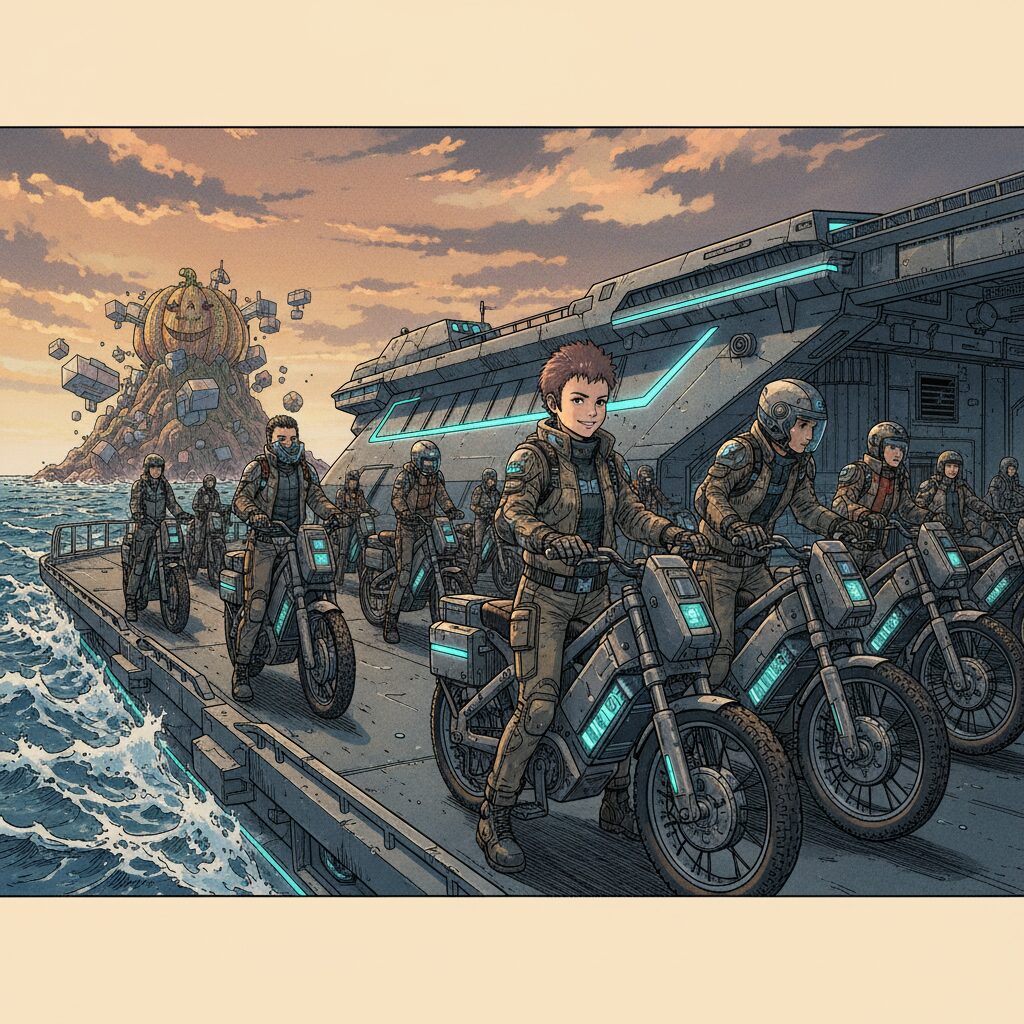
The adventure to Naoshima begins even before you set foot on its shores. The shift in atmosphere starts as soon as you board the ferry. You’ll most likely depart from one of two main ports: Uno Port in Okayama Prefecture on Honshu, or Takamatsu Port on Shikoku Island. Each offers a distinct but equally picturesque approach. The ferry ride itself is a vital part of the experience. Find a spot on the deck, feel the salty spray on your skin, and watch the urban skyline gradually fade away, replaced by the tranquil, island-speckled vista of the Seto Inland Sea. It’s a meditative moment, a slow unveiling of the world you’re about to enter. As Naoshima’s Miyanoura Port comes into view, the first thing you’ll notice is its famous welcome sign: Yayoi Kusama’s gigantic Red Pumpkin. It’s as if the island itself is greeting you—a colorful, playful beacon against the industrial port background, promising the strange and wonderful experiences ahead.
Once your ferry docks, your first task—if you choose to accept it—is to secure your transportation. Trust me on this: head straight to the bicycle rental shops clustered near the terminal. While you might be tempted to pick a standard city bike to live out your idyllic movie-montage fantasies, here’s the key pro tip: go for the electric-assist bike. Don’t hesitate. Naoshima may be small, but it’s deceptively hilly, and those inclines are no joke, especially under the Japanese sun. An e-bike, or dendo-jitensha, isn’t cheating—it’s unlocking “god mode” for exploring the island. It turns what could be a sweaty, exhausting challenge into a blissful, breezy ride. With the simple push of a button, you’ll conquer hills effortlessly, smiling all the way, leaving you with plenty of energy to enjoy the art and scenery. It’s the ultimate hack for a perfect day on Naoshima. The sense of freedom is incredible—you’re not bound by bus schedules, you can stop whenever you want for the ideal photo, and you can soak in the island’s unique vibe far more intimately. This bike is about to become your best companion.
Miyanoura Port: Your Psychedelic Starting Line
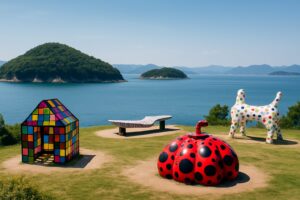
With your trusty e-bike ready to go, the Miyanoura Port area itself serves as your first gallery. Before heading off to the main museums, take a moment to absorb the art right at the entrance. The highlight is undoubtedly Yayoi Kusama’s “Red Pumpkin.” Unlike its yellow counterpart on the south coast, this one you can actually enter. Crawling through one of the black polka-dotted openings feels like stepping into another dimension. Inside, windows cast playful, trippy dotted light patterns all around you. It’s immersive, fun, and the perfect introduction to your upcoming art-filled journey. More than just an Instagram backdrop, it’s an interactive piece that sets the tone for the entire island—art here is meant to be experienced, not just observed.
Just a short ride from the pumpkin is another architectural marvel, the Naoshima Pavilion, designed by Sou Fujimoto. This structure contrasts sharply with Kusama’s organic curves. It’s a sleek, geometric creation made from white stainless steel mesh, reminiscent of a crystalline diamond or a futuristic polyhedron that has landed by the water. Lightweight and nearly transparent, it plays beautifully with light and shadow. You can explore inside and climb its internal framework, where your view of the port, sea, and sky continuously shifts and refracts. It’s a quiet, reflective piece that invites contemplation on space and form.
Then there’s something entirely different: the “I♥︎湯” public bathhouse, pronounced “I Love Yu” (a pun since “yu” means hot water). This isn’t just a sculpture; it’s a functioning sento (public bath) created by artist Shinro Ohtake. The exterior is a wild, vibrant collage of scrap materials, neon signs, and pop culture icons—like a retro Japanese scrapbook exploded into a building. It’s a place where locals and art-loving visitors alike can literally soak together in art. This blend of everyday life and high art lies at the heart of Naoshima’s philosophy. Even if you skip the bath, marveling at its bold design is an experience on its own. It’s a loud, spirited, and utterly unique statement that art belongs to everyone, woven into every aspect of life.
The Southern Coast Ride: Ando’s Concrete Kingdom Awaits
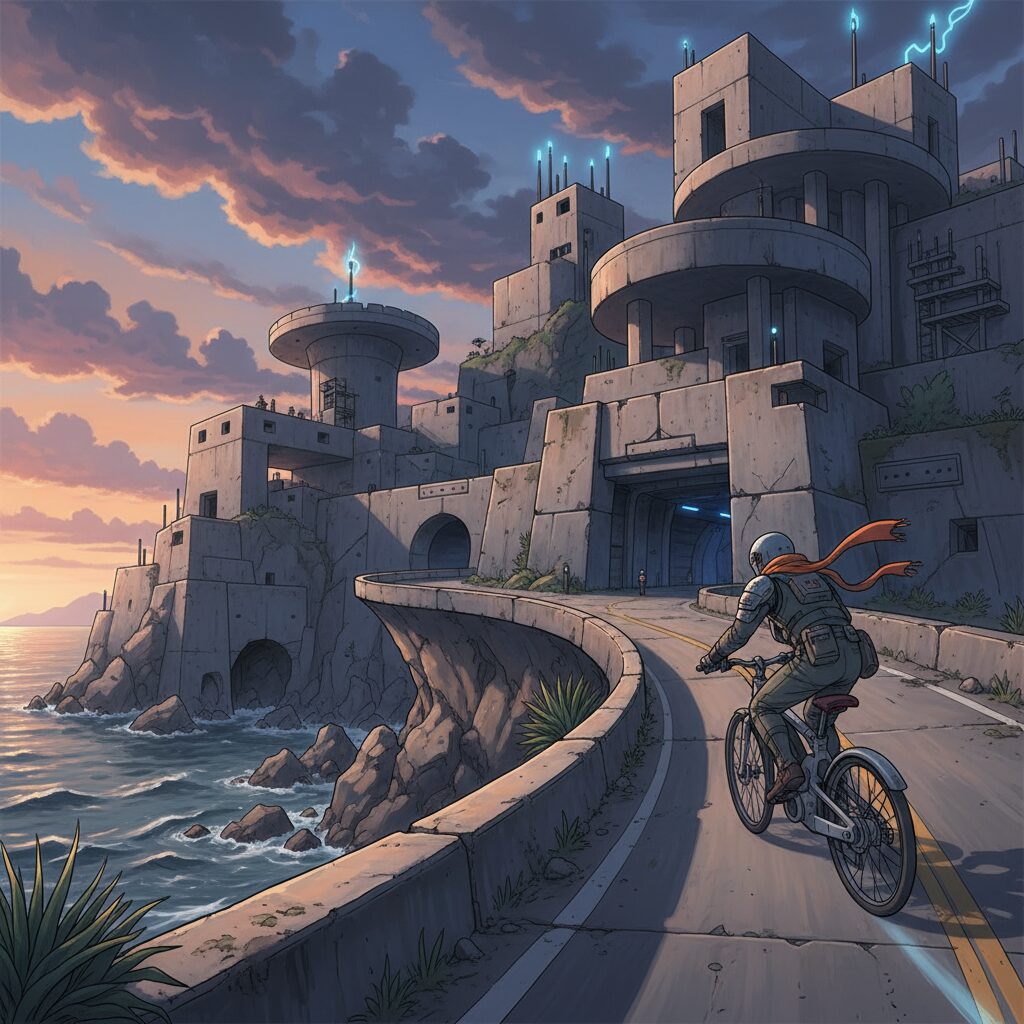
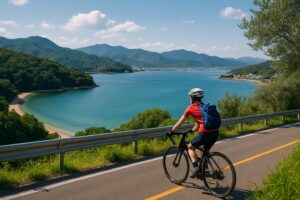
Now for the main event. The ride from Miyanoura Port to the southern coast, home to the island’s major museums, is truly breathtaking. This is where your e-bike comes into its own. The coastal road meanders along the sparkling Seto Inland Sea, offering stunning views at every bend. You’ll pass serene beaches, small fishing boats gently bobbing in the water, and verdant hillsides. The air carries the fresh scent of salt and pine. It’s a sensory delight that refreshes you before the intense artistic immersion ahead. This journey is more than just travel; it’s a vital part of the Naoshima experience, making you feel completely removed from the everyday world.
As you near the Benesse House area, there it is. Standing proudly at the end of a small, weathered pier, framed by sea and sky, is Yayoi Kusama’s “Yellow Pumpkin.” This piece is arguably the island’s most iconic artwork, a symbol of contemporary art in Japan. There’s a quiet strength in its placement, simply residing in the midst of nature—a bold, artificial form that somehow blends harmoniously with its surroundings. It also has a story. In 2021, a typhoon swept it out to sea, and the art community held its breath. Its restoration and return were a triumphant moment, symbolizing resilience. Sitting on the pier, watching the waves gently lap around it, you feel its magic—a moment of pure artistic calm.
This entire southern coast is shaped by one man: the master architect Tadao Ando. His hallmark style—smooth, exposed concrete, profound respect for nature, and masterful use of natural light—defines modern Naoshima’s aesthetic. Your first major stop is the Benesse House Museum, a groundbreaking concept merging a world-class museum with a luxury hotel. From the outside, the building is partially embedded into the hillside, a classic Ando technique to reduce its landscape impact. Inside, it is a triumph of spatial design. Long, sweeping ramps guide you through galleries featuring large windows that frame the Seto Inland Sea as a living piece of art. The concrete walls, which could feel cold or austere, instead come across as meditative and almost velvety, catching and reflecting light beautifully. The collection is impressive, showcasing major works by international artists like Jasper Johns, Jackson Pollock, and Bruce Nauman, alongside Japanese artists such as Yukinori Yanagi and Hiroshi Sugimoto. Many pieces are site-specific, crafted to exist in perfect balance with Ando’s architecture. It’s a seamless conversation between art, building, and nature. Be sure to explore the outdoor sculptures around Benesse House Park as well, where colorful and whimsical works by Niki de Saint Phalle and Karel Appel contrast playfully with Ando’s stoic modernism.
Chichu Art Museum: The Subterranean Masterpiece
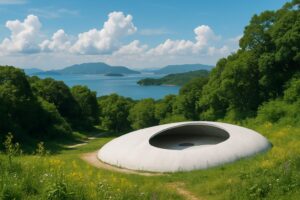
If Benesse House Museum serves as the overture, then Chichu Art Museum is the mind-bending, soul-stirring symphony. Be warned: the anticipation for Chichu is immense, and it is entirely deserved. This is not merely a museum; it is a pilgrimage. The name “Chichu” (地中), meaning “in the earth,” perfectly describes its setting. To protect the island’s untouched coastline, Tadao Ando designed the entire museum complex to be buried underground. From above, all that is visible are a few geometric openings carved into the green hillside, like portals to another realm.
Visiting Chichu demands preparation. You must book your tickets online, often weeks or even months ahead, for a specific time slot—there is no option for walk-in entry. Photography is strictly prohibited inside, which may initially seem disappointing, but you’ll soon see it as a gift. It encourages you to put your phone away and be fully, deeply present in the moment. The experience begins as you stroll through a simple garden and descend into cool, quiet concrete corridors. Ando is a master of procession, guiding you on a journey through light and shadow. The spaces are stark and geometric, yet never oppressive. Instead, they feel sacred, like a modern cathedral devoted to art.
The museum showcases the work of just three artists, each provided with a dedicated space created in collaboration with Ando. The first is Claude Monet. In a brilliantly bright, white-walled room illuminated solely by soft, diffused natural light from above, five of his enormous “Water Lilies” paintings hang. The floor consists of thousands of tiny marble cubes, and you exchange your shoes for soft slippers to enter. Seeing these impressionist masterpieces—usually displayed in dim, traditional galleries—bathed in natural light is revelatory. You witness the colors, brushstrokes, and essence of the paintings in an entirely new way. It’s a profoundly tranquil and moving experience.
From Monet’s light, you descend further underground to encounter Walter De Maria’s installation, “Time/Timeless/No Time.” You enter a vast chamber that feels like the heart of an ancient temple. A massive 2.2-meter polished granite sphere rests on a grand staircase, while 27 gilded wooden sculptures line the walls. The only illumination comes from a long skylight stretching across the ceiling. As the sun traverses the sky, the light inside the chamber shifts dramatically, altering the atmosphere moment by moment. It’s an epic meditation on time, scale, and the cosmos.
Lastly, you experience the work of James Turrell, an artist who sculpts with light itself. His pieces at Chichu are designed to challenge your perception in the most beautiful way. In “Afrum, Pale Blue,” a seemingly solid blue cube of light floats in the corner of a dark room. Approaching closer reveals it as an illusion—carefully projected light into a recessed space. The highlight is “Open Sky,” a room with a large square opening in the ceiling that perfectly frames the sky above. You sit on benches around the walls and simply watch. As clouds drift by or the sky shifts colors at sunset, the frame transforms the sky into a living painting—a tangible, flat canvas of color. It’s a simple concept with a profound impact, compelling you to slow down and simply observe. Leaving Chichu, you feel as if you’ve undertaken a spiritual journey. Emerging blinking into the sunlight, the world appears a little different, sharper, and filled with a renewed sense of wonder.
Honmura and the Art House Project: Art in the Veins of a Village
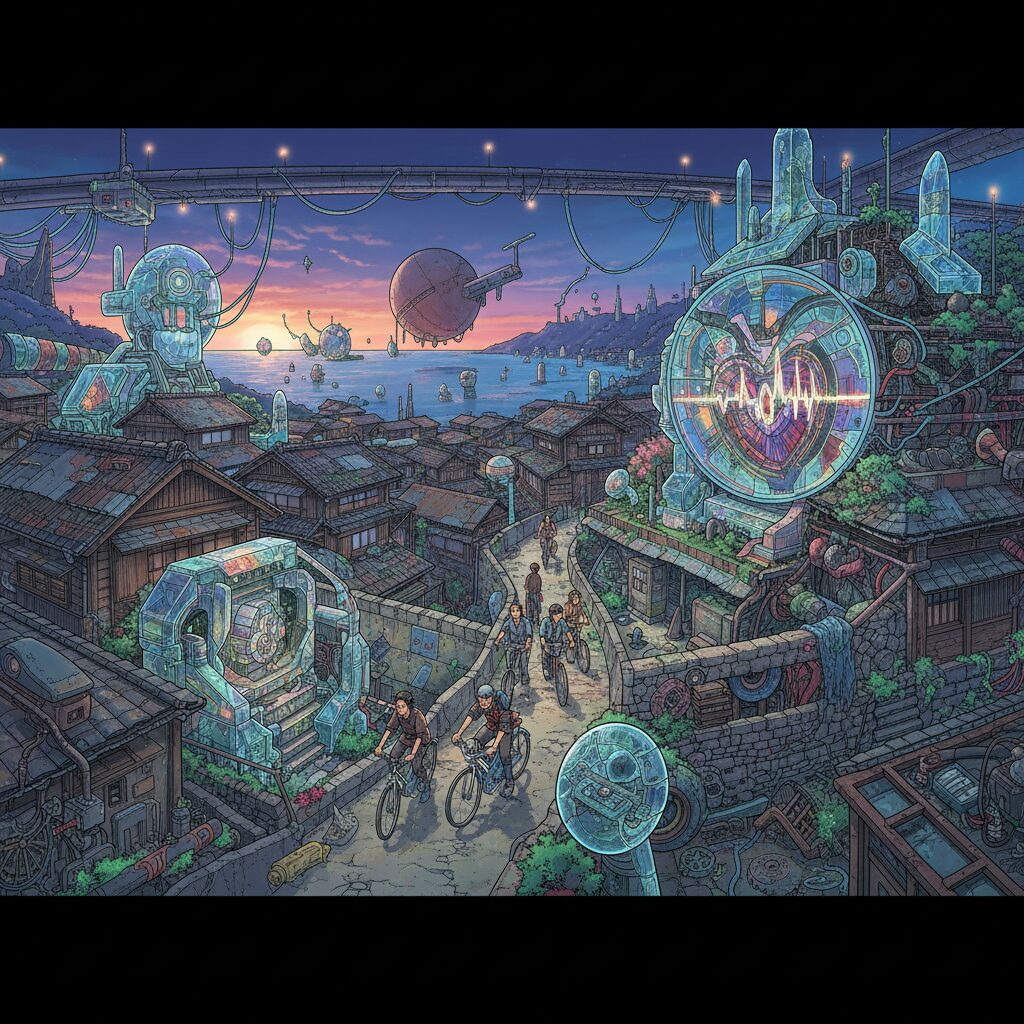
After visiting the monumental, purpose-built museums on the south coast, it’s time for a change of pace. Ride your e-bike to the eastern side of the island, to the port town of Honmura, which offers a completely different atmosphere. Honmura is a quiet, residential village characterized by narrow, winding streets and traditional wooden houses. Here, the Art House Project comes to life, and it stands as one of the island’s most brilliant concepts. The project transforms empty or abandoned houses scattered throughout the village into permanent, site-specific art installations. You purchase a multi-site ticket and receive a map, turning your visit into a sort of artistic treasure hunt.
This is where art on Naoshima feels most connected to the local community. Rather than being in a sterile museum environment, you walk through a living town, peeking into old buildings that have been given a fresh, creative lease on life. Each house is a unique world unto itself. One of the most unforgettable is Minamidera, a collaboration between Tadao Ando and James Turrell. From the outside, it appears as a simple, dark wooden structure designed by Ando in the style of a traditional Japanese temple. Upon entering, you are immersed in complete, utter darkness. An attendant guides you to a bench and instructs you to sit and wait. For the first few minutes, you see nothing as your brain starts to play tricks on you. But gradually, as your pupils dilate to their fullest, a faint, ethereal rectangle of deep blue light begins to materialize at the far end of the room. It’s an incredible experience that teaches patience and explores the nature of perception. It’s pure magic.
Another essential stop is Kadoya, the first house in the Art House Project. Inside this 200-year-old home, artist Tatsuo Miyajima has placed a pool of water filled with blinking LED counters, each set to a different speed by local villagers. The numbers cycle from 1 to 9, representing the eternal cycle of life and death, with the darkness between each sequence symbolizing the void. The installation is quiet, hypnotic, and deeply philosophical. Then there’s Go’o Shrine, where photographer Hiroshi Sugimoto has reimagined a crumbling Edo-period shrine. He linked the main hall to an underground stone chamber with a stunning staircase made of optical glass blocks. The glass appears to capture and channel light down into the earth, creating a mystical connection between the heavens and the underworld. It’s a perfect blend of ancient Shinto beliefs and sleek, modern design.
Exploring the Art House Project is a delight. Wandering through the charming backstreets of Honmura, occasionally getting a bit lost, stumbling upon a tiny café, and then finding your next artistic destination—all of this adds to the experience. It’s a slower, more intimate way to engage with art and offers a genuine sense of the island’s soul.
Winding Down: Island Flavors and Final Thoughts
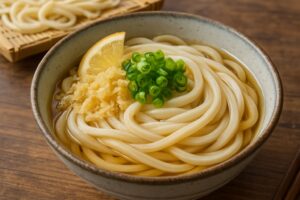
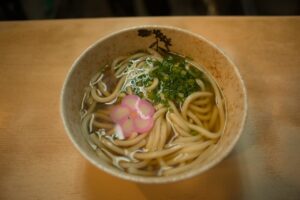
An art quest of this scale demands sustenance. Fortunately, Naoshima offers an increasing number of excellent dining options. Each major museum features its own cafe, all of which are well worth visiting. The Chichu Cafe, in particular, provides a simple menu alongside a terrace that boasts one of the most breathtaking panoramic views of the Seto Inland Sea you’re likely to encounter. It’s an ideal spot to sit back and absorb the artistic overload. In Honmura and Miyanoura, you’ll find smaller, more local eateries serving delicious udon noodles, fresh seafood curry, and other comforting Japanese dishes. Discovering a cozy little spot tucked away in a back alley for lunch is a quintessential part of the island experience.
A few final tips before you set off. First, always check the official Benesse Art Site Naoshima website beforehand. Many museums and art houses close on Mondays, and some operate on irregular schedules. Second, while a day trip is doable, it tends to be a hectic rush. To truly appreciate Naoshima and avoid art fatigue, an overnight stay is highly recommended. This allows for a more leisurely exploration and the chance to see the art in the different light of morning and evening. Bring sunscreen, a hat, and water, as you’ll be spending considerable time outdoors. Most importantly, savor the journey. Don’t just dash from museum to museum. Enjoy the bike ride. Stop at a random beach. Let the island’s slow rhythm permeate your being.
As you pedal back to Miyanoura Port to catch your return ferry, with the sun setting over the Inland Sea, a deep sense of satisfaction will wash over you. Naoshima is far more than a list of famed artworks. It’s a holistic experience. It’s the wind in your hair as you coast down a coastal hill on your e-bike. It’s the quiet reflection in a subterranean concrete hall. It’s the surprise of finding a world-class installation inside a humble village house. The island represents a powerful and inspiring dialogue between art and nature, past and present, global and local. It’s a place that demonstrates how vision and creativity can create worlds that are more beautiful, thoughtful, and connected. The memories of this bicycle adventure will linger long after you’ve left its shores, a permanent exhibit in the gallery of your mind.