You’ve seen the pics, right? Scrolling through your feed, you get the classic Japan aesthetic: serene temples with fiery autumn leaves, neon-drenched Tokyo intersections that look like a sci-fi movie set, and maybe a perfectly plated bowl of ramen. It’s a whole mood. But then, you see it. Something that totally breaks the algorithm. A building that looks like a stack of washing machines, or a concrete tree sprouting office pods, or some kind of megastructure that looks like it was ripped straight out of a vintage mecha anime. It’s not old-world traditional, and it’s not slick and modern. It’s… something else. It’s retrofuturistic, kinda weird, and honestly, a little bit intimidating. You probably paused your scroll and thought, “Okay, what is that? And why is it a thing?”
That question? It’s legit the key to unlocking one of the most extra, ambitious, and deeply revealing chapters in modern Japanese history. This isn’t just about weird architecture; it’s about a nation’s psyche being poured into concrete and steel. We’re talking about a movement called Metabolism. The name itself is a hint: it was all about creating buildings and cities that could live, breathe, and grow like a biological organism. It was a wildly optimistic, almost utopian dream of a future that never quite happened, born from the ashes of a past Japan was desperate to escape. These structures are the fossils of that dream. They’re not just buildings; they’re philosophical statements, time capsules of a moment when Japan looked at its destroyed cities and decided to rebuild not just bigger, but weirder and way more audaciously than anyone could have imagined. So, let’s get into it. Let’s unpack the whole story behind these concrete megastructures and figure out what they tell us about Japan’s obsession with renewal, impermanence, and dreaming up futures that are almost too wild to be real.
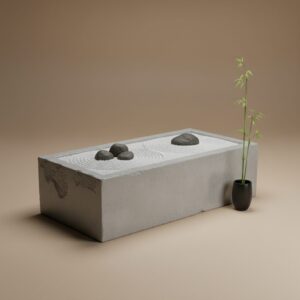
To understand how this philosophy of concrete as a living medium extends beyond Metabolism, consider the Zen-inspired works of Tadao Ando.
The Vibe Check: Post-War Japan Was on a Different Level

To truly understand why Metabolism emerged, you need to rewind to post-WWII Japan. The atmosphere was, to say the least, intense. Major cities like Tokyo and Hiroshima were completely devastated. The national identity was shattered, and the country was starting from absolute zero, both economically and psychologically. What followed was astonishing. Instead of merely rebuilding slowly and cautiously, Japan went into overdrive. This era, from the 1950s to the 70s, is known as the Japanese economic miracle, a remarkable transformation on an epic scale.
Picture a society collectively deciding to accelerate and never slow down. Technology, industry, and manufacturing surged. This was not just recovery; it was reinvention. Japan was racing to catch up with the West and, in many respects, surpass it. This energy fostered a unique cultural environment. There was a potent blend of trauma from the war and an almost manic optimism for the future. The past was something to learn from but also to decisively move beyond. The future was a blank canvas, and Japan was ready to create something radically new.
This national spirit of swift change and forward momentum provided the perfect environment for a new generation of architects. They weren’t interested in simply building dull, functional structures—that was old-fashioned thinking. They were thinkers, philosophers, and visionaries who felt the enormous responsibility and opportunity of their era. Observing Tokyo’s chaotic, sprawling growth, they believed, “We can do better. We can design a new way of living for a new Japan.” Charged with housing a booming population and developing infrastructure for a new age, they embraced the challenge and propelled it to extraordinary heights. The 1960 World Design Conference in Tokyo became their platform. There, a group of young, daring Japanese architects unveiled their manifesto, literally titled “Metabolism: The Proposals for New Urbanism,” making a global statement. They weren’t just constructing buildings; they were forecasting a new kind of city, a new relationship between humans and their environment.
So, What Even Is Metabolism? The Lowdown on Living Buildings
The name “Metabolism” sounds more like something from a biology textbook than an architectural movement—and that’s exactly the point. The core idea, the very DNA of the movement, was to stop viewing buildings and cities as static, lifeless objects. Instead, they imagined them as living, dynamic systems, constantly evolving and adapting, much like a plant, an animal, or the human body. It’s a pretty unconventional concept, but it made a certain kind of sense in a country changing at hyperspeed. If society is continually evolving, shouldn’t its cities evolve alongside it?
Think of it this way: your personal style isn’t fixed. You might change your clothes, get a new piercing, or switch your hair color, but your core self—your skeleton, your personality—remains the same. That was the Metabolist vision for a city. They divided the urban environment into two essential parts.
First, there’s the megastructure. This is the permanent, long-lasting element. It’s the skeleton or the trunk of the tree. Think massive concrete towers, extensive transportation networks, and large structural cores housing essentials like elevators, plumbing, and electricity. This formed the city’s infrastructure, designed to endure for centuries.
Then, there are the capsules. These were the exciting part. Capsules were the individual, prefabricated units that would “plug in” to the megastructure. They were the cells of the urban organism. A capsule could be an apartment, an office, a shop—anything. They were designed to be mass-produced, lightweight, and, most importantly, replaceable. The idea was that as your needs changed, or as technology advanced, you could simply unplug your old capsule and swap it for a new one. Your family grows? Replace your one-person pod with a family-sized unit. Your 1970s TV and stereo system are outdated? Get a new capsule equipped with a built-in holographic entertainment wall. The city could continuously renew itself at the cellular level without demolishing the entire structure. It was a vision of a city that remained forever young and perpetually modern.
This was more than just an architectural style; it was a philosophy about time and impermanence. In Japan, there’s a longstanding cultural and religious tradition—seen in places like the Ise Grand Shrine, which is completely rebuilt every 20 years—that honors cyclical renewal over permanent stasis. Metabolism embraced this ancient idea and gave it a radical, sci-fi reinterpretation. The architects behind it—figures like Kenzo Tange, Kisho Kurokawa, Kiyonori Kikutake, and Fumihiko Maki—weren’t just designers; they were the rock stars of their era, envisioning a future that was flexible, modular, and made for a society in constant motion.
The Main Character: Nakagin Capsule Tower
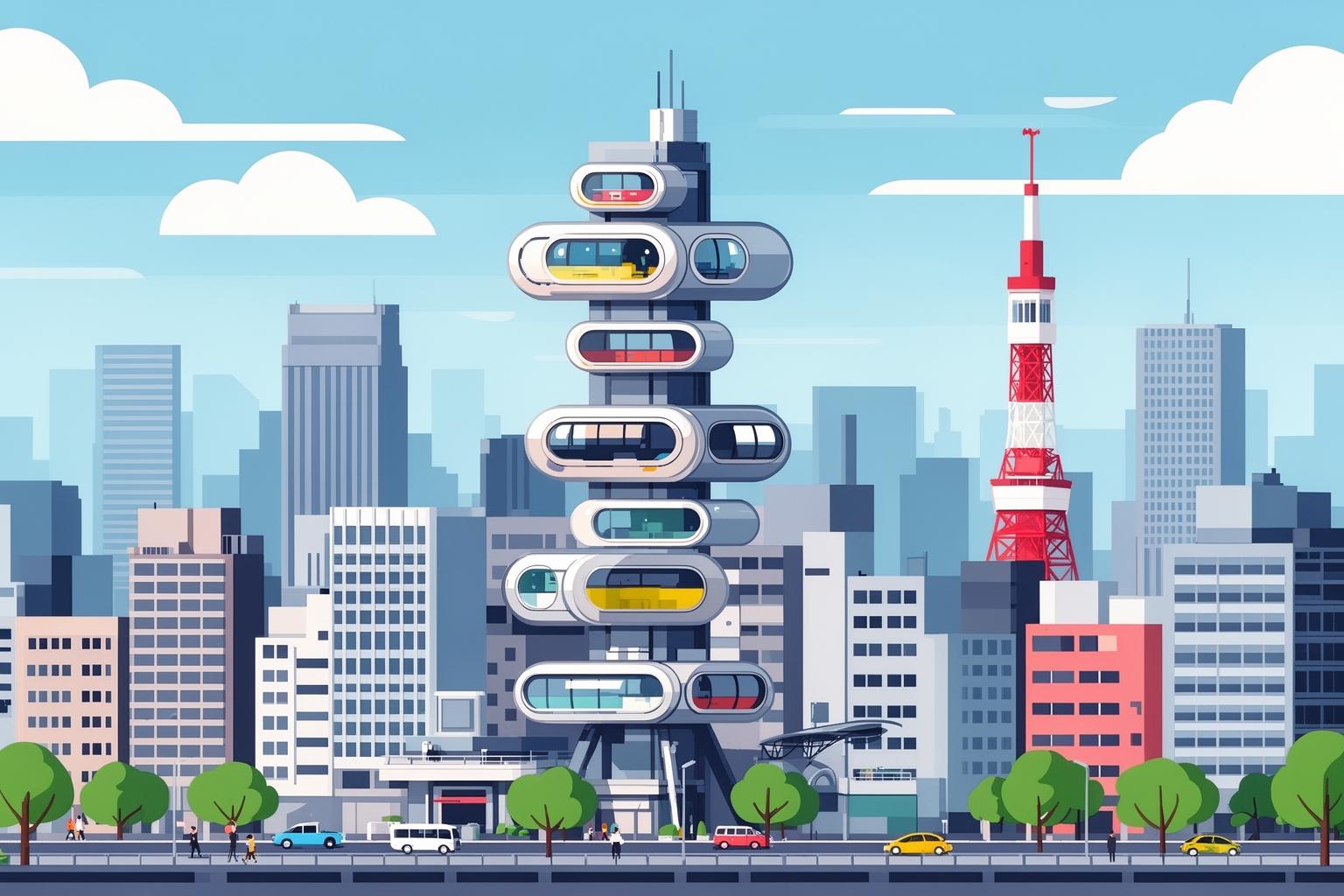
If the Metabolism movement had a flagship symbol, an icon instantly recognizable by all, it was the Nakagin Capsule Tower. Even if you don’t know its name, you’ve almost certainly seen its image. Designed by the charismatic Kisho Kurokawa and completed in 1972 in Tokyo’s Ginza district, it stood as the ultimate proof of concept for the Metabolist vision. For a time, it was the coolest building on Earth.
Visually, it was a complete showstopper. Two reinforced concrete towers formed the central megastructure, from which 140 individual capsules protruded, stacked and rotated at odd angles like a precarious heap of giant Lego blocks. Each capsule was a tiny, self-contained apartment, resembling a cross between a spaceship cockpit and a front-loading washing machine, complete with a signature round window framing views of the city. These capsules were prefabricated in a factory and then literally bolted onto the concrete cores. It looked just like the diagrams in the Metabolist manifesto brought to life.
The Utopian Promise
Nakagin embodied peak techno-optimism. It was designed for the quintessential modern Japanese professional—the globe-trotting “salaryman” or creative urbanite seeking a hyper-efficient base in the city. Kurokawa called it a “dwelling for moving man.” Inside, each capsule was a lesson in compact design. Within a space no bigger than a small parking spot, there was a bed, a tiny bathroom unit (shaped like an airplane lavatory), a fold-out desk, and built-in electronics including a TV, radio, and reel-to-reel tape deck. It was everything a bachelor needed: a futuristic pod of convenience plugged into the urban machine. The dream was that every 25 years, these capsules would be replaced by newer, more advanced models, allowing the building to continuously regenerate.
The Dystopian Reality
But here’s where the dream clashed with reality. The capsules were never replaced. Not a single one. The process proved astronomically expensive and logistically nightmarish. To swap out one capsule, you’d likely have to remove all those above it. The economics simply didn’t add up. Thus, the futuristic building began to age—and not gracefully. The 1970s vision of plug-and-play living froze in time.
Over the decades, Nakagin fell into decay. The sleek white pods grew stained and grimy. The signature round windows clouded over. Water leaks became ongoing issues, causing mold and rust. The centralized hot water system was shut off, and ventilation was poor. The once-cutting-edge built-in electronics turned into obsolete relics. Living in a Nakagin capsule shifted from a chic, forward-thinking statement to a cramped, uncomfortable, and somewhat damp experience. It became a vertical slum for a future that never arrived.
For years, residents and architecture enthusiasts fought to preserve it, championing its historical and cultural significance. They regarded it as a beautiful, flawed masterpiece. Yet maintenance costs were overwhelming, and the building was infested with asbestos. Ultimately, the battle was lost. In April 2022, demolition of the Nakagin Capsule Tower began. It was a heartbreaking moment for many—the physical dismantling of a potent cultural symbol. Nakagin’s story is Metabolism’s story in miniature: a brilliant, breathtakingly ambitious idea that ultimately couldn’t survive the messy practicalities of the real world. It stands as a bittersweet monument to the allure of a failed utopia, a very Japanese tale of magnificent ambition and inevitable decay, a perfect example of mono no aware—the gentle sadness of passing things.
Metabolism’s Ghost in the Machine: Where to See the Vibe Today
The demolition of Nakagin marked the end of an era, but the spirit of Metabolism remains alive. Although its most iconic creation is gone, other buildings still stand, carrying its bold, futuristic essence. These structures may be less well-known, but they powerfully express the movement’s core ideas and can still be seen today, standing like concrete survivors from another time.
Shizuoka Press and Broadcasting Center (Tokyo)
If you find yourself in Tokyo’s upscale Ginza district, you might come across a building resembling a massive, futuristic tree. This is the Shizuoka Press and Broadcasting Center, designed by Metabolism’s pioneer Kenzo Tange and completed in 1967. It represents one of the purest embodiments of Metabolist ideals. The building is anchored by a single, massive cylindrical core—the megastructure, or tree trunk. This core houses elevators, stairwells, and all the building’s essential infrastructure. Extending from this central spine are cantilevered glass-and-steel office modules, which look as if they’ve simply been plugged in. The clear distinction between the permanent core and interchangeable modules is immediately visible. It’s a striking, sculptural building that openly displays its structural system. Though it focuses less on flexible living spaces and more on adaptable corporate structures, its fundamental philosophy is fully present, expressed through imposing concrete and dark glass.
Yamanashi Press and Broadcasting Center (Kofu)
Another masterpiece by Kenzo Tange, located in Kofu, takes a more radical approach to Metabolist concepts. Instead of a single core, the Yamanashi center features a cluster of sixteen massive concrete cylinders as its megastructure. The office and studio spaces are inserted into the gaps between these towers. Designed in 1966, Tange intentionally left some areas empty, envisioning the building not as a finished product but as a system capable of growth. As the company expanded, new functional pods could be added and integrated into the open structural grid. This architecture embraces open-ended potential, designed to remain perpetually unfinished. Walking around it, one can sense this possibility for growth. It’s like a miniature Metabolist city, a cluster of concrete trunks waiting for new branches to grow.
The Sky House
Metabolism was not limited to towering corporate buildings or urban megastructures; it also applied on a human scale, as shown by the Sky House—architect Kiyonori Kikutake’s personal home and one of the movement’s earliest examples, built in 1958. The design is elegantly simple: a large square living space elevated high on four thick concrete piers. This main area—the “sky house” itself—served as the permanent core. Adaptability came from the space below and attached to this core. Kikutake created “move-nettes”—small capsule-like rooms for his children that could be attached, removed, or rearranged as the family’s needs evolved over time. The kitchen and bathroom were also designed as replaceable units. It’s Metabolism for family life—a home built to adapt throughout its inhabitants’ life cycle, proving that the principles of permanence and change can create spaces that are both intellectually stimulating and comfortably livable.
The Afterlife: How Metabolism’s DNA Spread
Metabolism’s influence extends far beyond the buildings that were completed. Its aesthetic and philosophy permeated global culture, especially science fiction. When you look at the dense, layered, chaotic yet ordered cityscapes in cyberpunk classics like Blade Runner, Akira, or Ghost in the Shell, you’re witnessing Metabolism’s imprint. The vision of a vertical city with multiple layers of transit, megastructures rising through polluted skies, and modular living units attached to their sides—all of this directly descends from the ideas and models of the Metabolists. They imagined the cyberpunk city decades before the genre was even named. This portrayal of a high-tech, low-life future—a sprawling, overwhelming urban organism—traces back to the proposals of Tange, Kurokawa, and their contemporaries. While Metabolism’s physical legacy may be limited, its imaginative impact is vast, shaping how we envision the future.
The Big “But”: Why Didn’t We All End Up in Capsules?

If the Metabolist vision was truly so impressive, innovative, and influential, why isn’t it ubiquitous? Why aren’t we all residing in plug-in pods connected to enormous megastructures? This skeptical question is entirely valid. Despite its brilliance, the movement largely failed to become the prevailing norm. Several key factors explain why the future the Metabolists envisioned never fully came to be.
The Economic Reality Check
The greatest obstacle was financial. The Metabolism movement emerged during Japan’s economic miracle, a period of seemingly endless growth and government investment in ambitious infrastructure projects, especially ahead of the 1964 Tokyo Olympics and Expo ’70 in Osaka. These grand national endeavors created the ideal opportunity for Metabolist architects to experiment with their visionary concepts. However, this era of rapid growth was not sustainable. The 1973 global oil crisis struck Japan’s energy-dependent economy severely. The economic boom faltered, and suddenly, funding for costly, experimental, and inefficient architectural projects dried up. The practical reality was that traditional skyscrapers were far cheaper and simpler to build than intricate megastructures with interchangeable modules. The utopian ideals of Metabolism couldn’t compete with straightforward cost-benefit logic. The dream proved too costly to uphold.
The Human Factor
There was also a fundamental disconnect between the architects’ top-down, systematic vision and the complex reality of how people actually want to live. The Metabolists excelled in system design, but perhaps overlooked the human element. While mass-produced, uniform capsules are efficient, they conflict with the fundamentally human yearning for individuality, personality, and a sense of place. People desire a home, not just a temporary living unit. They want to establish roots and feel a bond to a specific piece of land, rather than to be seen as replaceable parts within a vast urban machine. The stark, raw concrete aesthetic common to many Metabolist structures, shared with Brutalism, can feel alien and unwelcoming to many. Although intellectually compelling, the lived experience could seem sterile. The architects designed for a hypothetical, hyper-rational “modern man,” while real humans are often irrational, sentimental, and deeply attached to permanence—the very concept Metabolism sought to disrupt.
The Final Take: Is Metabolism a Vibe or a Flop?
So, what’s the ultimate conclusion on Metabolism? Was it a failure? If you evaluate it by its own proclaimed goals—to create endlessly regenerating, adaptable cities—then yes, it largely fell short. The plug-and-play future never materialized. The dream of living architecture mostly remained just that—a dream. But dismissing it as merely a failure misses the larger point entirely. Metabolism was, and remains, a significant cultural and aesthetic triumph. It’s a vibe that has never truly disappeared.
These buildings are far more than mere concrete and steel. They stand as monuments to a unique, unrepeatable moment in Japanese history—a time of overwhelming creative energy, profound national trauma, and boundless faith in the power of technology and design to solve humanity’s challenges. They embody an era when Japan dared to dream on an almost mythic scale, proposing solutions not only for a city block but for the entire future of civilization.
The Metabolist movement encapsulates the deep-rooted dualities within Japanese culture: the tension between collective welfare and individual expression, the deep appreciation for impermanence (mono no aware) alongside an unyielding pursuit of technological permanence, the embrace of radical futurism coupled with echoes of ancient traditions of renewal. It was a flawed, impractical, and stunningly beautiful vision. So the next time you see a photo of one of these strange, magnificent concrete beasts, don’t just regard it as an old, peculiar building. See it as a fossilized dream of a future that never arrived. See the physical embodiment of a nation’s soul at a crossroads. It’s a testament to a time when architects believed cities could be alive—a notion that remains profoundly iconic today.