You’ve seen it. That shot. The one with the impossibly green rice paddies climbing a misty mountain, a lone farmer in a conical hat tending the fields. Or maybe it’s the bus stop in the middle of nowhere, rain pouring down, with a giant, fuzzy creature waiting patiently. It’s the vibe you see all over social media, tagged #GhibliCore, #QuietLife, #JapanTravel. It’s the Japan that feels like a warm hug, a nostalgic dream of a simpler time. This is the world of My Neighbor Totoro, of Only Yesterday, a landscape steeped in a quiet, profound magic. And the big question everyone has, whether they say it out loud or not, is: Is any of this real? Can I actually go there? Or is it just an anime fantasy, a beautifully curated illusion for the tourists and the cameras?
Let’s be real for a sec. If you just hop on a train and get off at a random countryside station expecting to find Totoro, you’re probably going to be disappointed. What you’re more likely to find is a shuttered-down shopping street, a group of elderly people doing radio taiso exercises, and maybe a 7-Eleven that feels like the brightest thing for miles. You’ll see abandoned houses, or `akiya`, with collapsed roofs and weeds reclaiming the garden. You might see hillsides so overgrown with bamboo they look like they’re about to swallow the road. It can feel less like a fairytale and more like a ghost story. This is the mismatch, the gap between the online aesthetic and the on-the-ground reality that leaves a lot of visitors confused. They came for Ghibli but found something far more complicated.
The key to understanding this landscape, both the dream and the reality, is a single word: `satoyama` (里山). It’s a concept that doesn’t have a perfect English equivalent. It’s not “wilderness,” and it’s not exactly “farmland.” It’s the space in between, the borderland where the village (`sato`) meets the mountain (`yama`). But more than a place, it’s a system. It’s a centuries-old story of a partnership between humans and nature, a relationship that created the very scenery that Hayao Miyazaki immortalized on screen. And like any long-term relationship, it’s beautiful, it’s difficult, and right now, it’s going through a major crisis. To get Japan’s countryside, you have to get satoyama. It’s the code that unlocks everything, from the shape of the mountains to the taste of the food to the very spirit of the people. So let’s get into it, and figure out what’s really going on behind that perfect Ghibli shot.
To see how this spirit of place extends even to local infrastructure, look no further than the charming and ubiquitous train station mascots found throughout rural Japan.
What Even Is Satoyama? Spilling the Tea
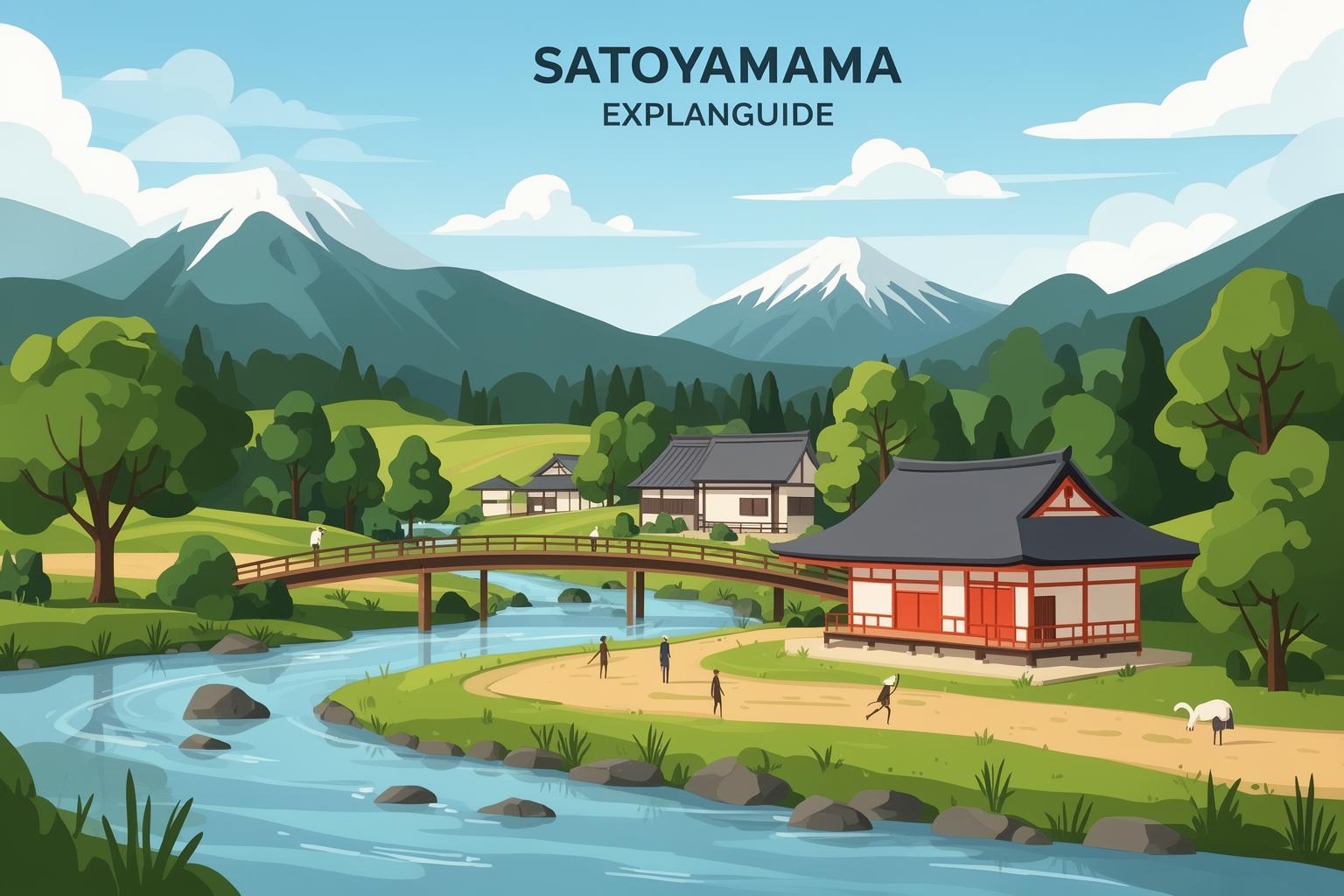
Before we can even discuss Ghibli or travel plans, we first need to unpack what satoyama truly is. From a Western perspective, your mind is likely wired to classify a landscape as either “city” or “nature.” And if it’s “nature,” you probably picture “wilderness”—an untouched, pristine, and perhaps somewhat dangerous place. A location you visit, hike through, and then leave behind. Satoyama completely reverses this idea. It’s not untouched. Rather, it has been shaped, managed, and influenced by human hands for thousands of years. It’s a human-made ecosystem, and that’s precisely the point.
It’s Not “Nature,” It’s a Vibe
The literal meaning—village-mountain—is your first hint. Satoyama isn’t a deep, dark forest where no one has ever ventured. It’s a buffer zone. It’s the patchwork of landscapes traditionally surrounding a rural village that supported the community’s livelihood. Imagine a mosaic: at the center lies the village and its houses (`kominka`). Radiating outward are vegetable gardens and shimmering, water-filled rice paddies (`tanada`). Beyond these paddies lie grasslands and meadows used for grazing livestock and gathering thatch for roofs. Finally, there are the forested hillsides—the `yama` itself. But the forest wasn’t left to grow wild. It served as the village’s hardware store, gas station, and pharmacy all at once.
The key idea that’s often difficult to grasp is this: the forest was a crop. Villagers practiced coppicing, regularly cutting back certain trees like oak and chestnut. This didn’t kill the trees but encouraged them to sprout new, straight shoots harvestable every 15-20 years. This wood was essential to the community—fuel for cooking and heating, charcoal (`sumi`), a valuable commodity, and timber for building homes and tools. The forest floor, or undergrowth, was equally important. People would gather fallen leaves mixed with grass and manure to make compost, a natural fertilizer for their rice paddies. This formed a perfect, closed-loop system: nutrients cycled from mountain to paddies to people and back again. Nothing went to waste. Every element had a purpose.
The OG Sustainable Lifestyle
This intensive management actually produced a far richer and more vibrant ecosystem than a so-called “untouched” forest. Regular tree cutting opened the canopy, letting sunlight reach the forest floor—creating ideal conditions for diverse wildflowers, insects, and small animals to flourish. Grasslands, maintained by routine cutting, supported various species. Rice paddies, with their intricate irrigation channels and ponds, became vital wetlands teeming with frogs, dragonflies, and fish. It was a biodiversity hotspot, not in spite of human intervention, but because of it. Humans were the keystone species here. Their constant efforts—mowing, cutting, raking, planting—created a patchwork of habitats that supported an incredible array of life.
This way of life did not stem from modern, romantic ideas about being “eco-friendly.” It was pure, practical survival. You cared for the mountain because it cared for you. Mismanaging the forest meant running out of fuel. Neglecting irrigation channels meant crop failure. Overharvesting wild vegetables (`sansai`) in spring meant scarcity the next year. This lifestyle favored a profound, almost bodily understanding of the environment. People didn’t just see the land as a pretty view but as a living partner. They knew which mushrooms were safe to eat, which plants had medicinal uses, and which parts of the mountain were home to specific animals. This intimate knowledge, passed from generation to generation, is the heart of satoyama. It’s a worldview where humans are not separate from nature but an integral part of its rhythm.
The Ghibli Glow-Up vs. The Real-Life Grind
Alright, so we have this image of a perfectly balanced, sustainable partnership between humans and nature. It sounds wonderful. And it’s precisely this feeling that Studio Ghibli, particularly Hayao Miyazaki, captures so brilliantly. When you watch a Ghibli film set in the countryside, you’re not just seeing a stunning illustration. You’re witnessing a deeply felt, almost spiritual tribute to the satoyama ideal. Yet, it’s also a lament—an elegy for something that has been largely lost. Grasping the tension between the Ghibli ideal and modern reality is essential to truly understanding the countryside.
Why Miyazaki’s Vision Resonates Differently
Hayao Miyazaki grew up during and after World War II, witnessing firsthand Japan’s rapid transformation from an agrarian society to an industrial giant. His films brim with a powerful sense of `natsukashii`—a Japanese word expressing nostalgia tinged with a bittersweet longing for a past that can never be fully reclaimed. My Neighbor Totoro exemplifies the satoyama story. Set in the 1950s, when the satoyama system was still mostly intact but its decline was beginning, the film masterfully shows, rather than tells, what that world felt like.
The Kusakabe family moves into an old, slightly rundown `kominka` house. The house itself acts as a character, with soot sprites (`susuwatari`) inhabiting its dark, forgotten corners—a perfect metaphor for the spirits of old traditions. Satsuki and Mei don’t simply observe nature; they actively engage with it. They chase frogs, gather acorns, and discover the giant camphor tree, which is not merely a tree but a sacred `kami`. Totoro and other forest spirits aren’t monsters; they embody the life force of the satoyama. They guard the mountain and appear only to children who retain that pure, unfiltered connection to the natural world. The film’s iconic scene where the girls and Totoros cause seeds to sprout and trees to grow instantly is fantasy, but one rooted in the real partnership of satoyama: humans plant, and the mountain’s spirit provides growth. The magic of Ghibli is the palpable presence of this relationship.
Even a film like Princess Mononoke, set in feudal Japan, centers on the battle for the soul of the satoyama. Lady Eboshi’s Irontown clear-cuts the forest to fuel industry, symbolizing unchecked modernization. San, the wolf princess, and the animal gods embody the wild, untamed spirit of the `yama`. Ashitaka, the protagonist, is caught in between, seeking a way for both sides to coexist. The film is a powerful and violent allegory for the destruction of satoyama balance. Miyazaki isn’t simply saying “nature is good, industry is bad.” He asks a much tougher question: How can we use the mountain’s resources without destroying its soul? This is a central question modern Japan continues to wrestle with.
The Twist: The System Fell Apart
So what happened? If this system was so ideal, why did it collapse? The answer is brutally straightforward: the post-war economic miracle. Beginning in the 1960s, Japan’s priorities shifted drastically. The allure of well-paying urban jobs sparked a mass exodus from rural areas. The generation with intimate, practical knowledge of the satoyama left for factories and offices in Tokyo and Osaka. Their children grew up in concrete cities, breaking the chain of traditional knowledge.
Simultaneously, technology transformed everything. Cheap imported fossil fuels like oil and gas replaced firewood and charcoal. Why spend weeks making charcoal when you can simply turn on a gas stove? Chemical fertilizers and pesticides became widespread. Why labor over compost when you can spray chemicals? Tractors and machinery replaced communal planting and harvesting. The intimate, closed-loop satoyama system was shattered by globalization and industrialization.
The consequences were severe. With no one to tend them, satoyama landscapes decayed. Coppiced forests once bright and open turned dark and overgrown with thick, impenetrable underbrush. Bamboo, once a valuable resource, became an invasive menace, spreading rapidly and choking out native trees. Terraced rice paddies, which required constant, backbreaking care, were abandoned. Their stone walls crumbled, turning into weed-choked swamps or were replaced by cedar plantations. The human half of the partnership had vanished. The landscape didn’t “return to wild nature”—it became a degraded, unbalanced, and neglected shadow of its former self. The biodiversity that once characterized working satoyama collapsed. This is today’s reality: a landscape haunted by the ghost of a lost system. The Ghibli aesthetic captures the moment just before that fall.
So, Is It a Ghost Town or a Vibe? Finding Satoyama IRL
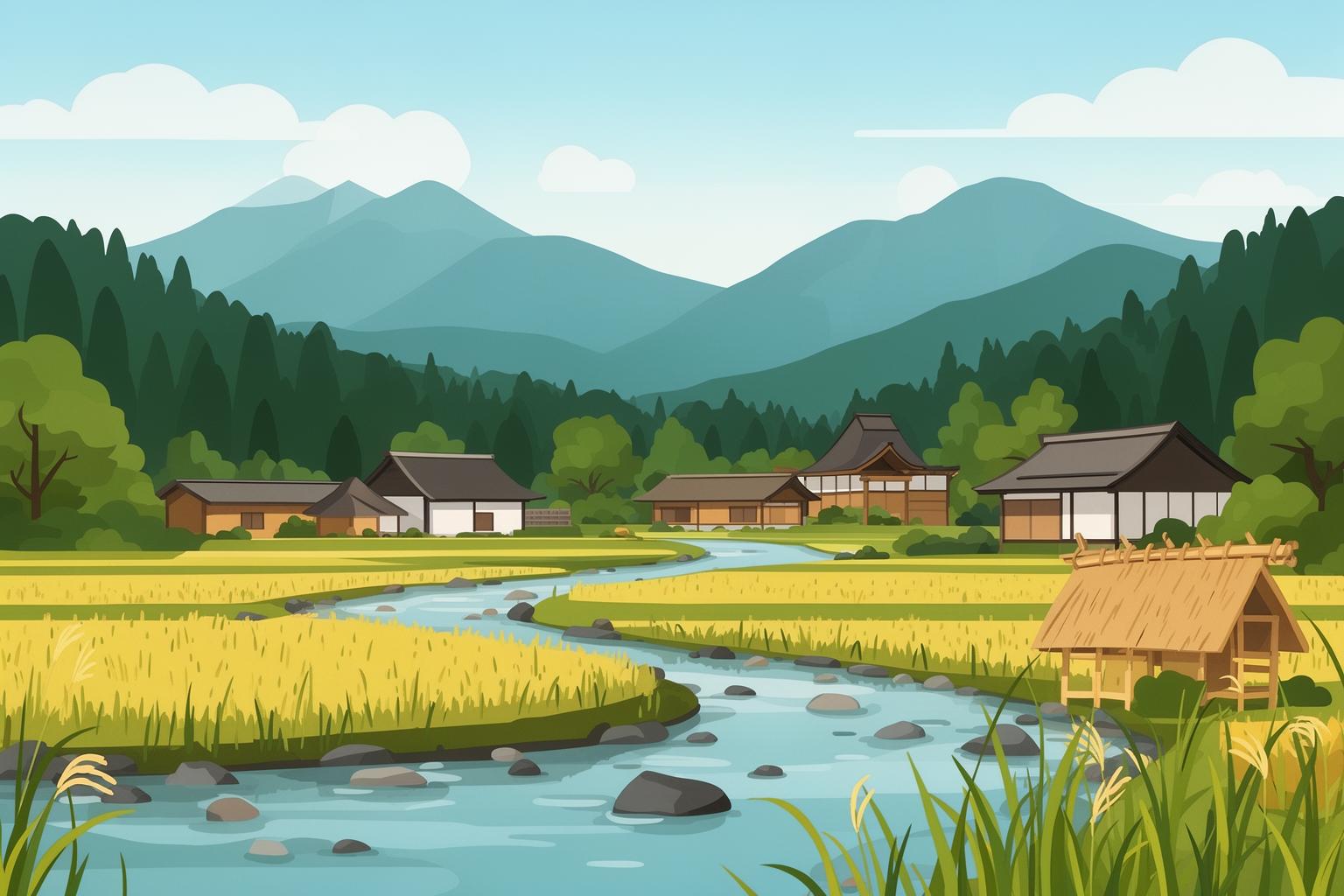
This all sounds quite grim, and in many respects, it is. The obstacles facing rural Japan are enormous: an aging and declining population, economic stagnation, and the erosion of traditional knowledge. However, that’s not the entire picture. To claim the satoyama is dead would be a vast oversimplification. It’s more accurate to say it’s in a state of suspended animation, with pockets of remarkable vitality and a growing number of people striving to revive its essence. For a traveler, this creates a complex but captivating experience. You’re not merely a tourist observing a static museum exhibit. You’re witnessing a culture undergoing a vast, painful, yet sometimes beautiful transformation. The key is not to search for a perfect Ghibli movie setting, but to learn to read the landscape, seeing both its scars and signs of new life.
Reading the Landscape: What to Observe
Rather than providing a checklist of “Top 5 Ghibli Towns,” it’s far more rewarding to understand the essential architectural and agricultural features of the satoyama. Once you recognize what to look for, you’ll start noticing them everywhere—from well-known tourist spots to the unnamed villages you casually pass through.
Terraced Paddies (`Tanada`)
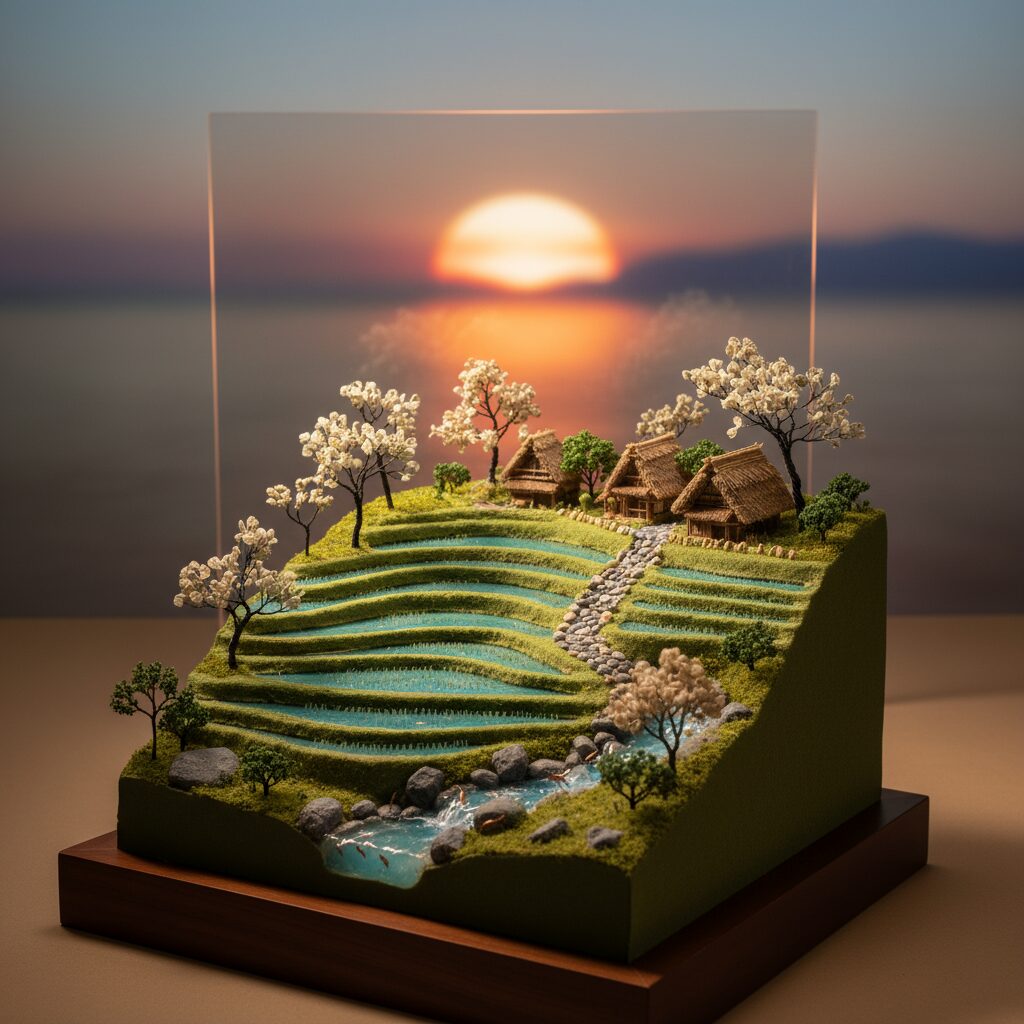
These are perhaps the most iconic features of the satoyama. They are not only visually appealing but also masterpieces of civil engineering and water management, crafted by hand over centuries. Each terrace is supported by carefully constructed stone or earth walls (`ishigaki`). This design not only pleases the eye but also slows the flow of rainwater down the mountainside, preventing landslides and allowing water to seep into the soil, replenishing groundwater. The network of channels and ponds feeding the paddies creates an entire aquatic ecosystem. When you see a well-maintained `tanada`, such as the remarkable Maruyama Senmaida in Mie Prefecture with over 1,300 individual paddies, you are witnessing a living monument to generations of collective effort. Yet you will also notice abandoned paddies, with crumbling walls and overgrown surfaces. The contrast between the two tells a powerful story of a community’s past and present.
Thatched Roof Houses (`Gassho-zukuri` and `Kominka`)
Those storybook-like houses with thick, thatched roofs found in places like Shirakawa-go and Gokayama are called `gassho-zukuri`, which means “hands in prayer,” referring to their steep rooflines. This design is a clever adaptation to the heavy snowfall in the region. The steep angle allows snow to slide off easily, preventing roof collapse under its weight. The spacious, multi-level interior was a self-contained world: the family lived on the ground floor while the large attic spaces were often used for sericulture—raising silkworms. Heat rising from the living quarters created the perfect warm, dry environment for the silkworms to prosper. Re-thatching one of these roofs is a huge, costly project that requires the entire community’s labor, a practice known as `yui`. That is why seeing one is so special; it represents community interdependence in physical form. While `gassho-zukuri` houses are rare, `kominka`—traditional farmhouses—can be seen throughout Japan. Look for their tiled roofs, dark wooden beams, and mud-plastered walls. Many are falling into neglect, but an increasing number are being beautifully restored and transformed into cafés, galleries, and guesthouses by those seeking to breathe new life into them.
Shrines in the Woods (`Chinju no Mori`)
Traveling through the countryside, you’ll notice nearly every village, no matter how small, has a Shinto shrine, almost always nestled within a small, dense forest patch. This is the `chinju no mori`, or guardian forest of the village. These groves hold immense importance. In a landscape where nearly every tree was part of managed, coppiced forest, shrine forests were often preserved untouched. They were regarded as sacred spaces, homes to the local `kami` or deity. As a result, they often harbor ancient, massive trees and represent precious remnants of the region’s original primary forest. These are not merely religious sites; they are vital ecological reservoirs and biodiversity sanctuaries within a human-managed landscape. They serve as the spiritual and ecological foundation of the satoyama.
The Modern Satoyama Renaissance: A Complex Reality
Amid the stories of decline, a counter-narrative is taking shape. A new generation of Japanese, often exhausted by the relentless urban grind, is turning to the countryside not to flee but to create a new kind of life. This is not a simple romantic return to the past but an effort to forge a modern, sustainable version of the satoyama ideal. Young entrepreneurs are moving into `akiya` (vacant homes), renovating them, and launching organic farms, craft breweries, or tech startups. NPOs and volunteer groups collaborate with the remaining elderly villagers to clear overgrown forests, repair irrigation channels, and revive local festivals. Artists and artisans are drawn by affordable rents and inspiring surroundings. This movement is often termed the “U-turn” or “I-turn” phenomenon (`U-tān`, `I-tān`), referring to people returning to their rural hometowns or relocating to the countryside for the first time.
However, this renaissance is not a fairy tale. The work is physically demanding. Integrating into small, close-knit, aging communities can be socially challenging, with their own intricate rules and unspoken hierarchies. Newcomers, no matter how well-meaning, are often regarded as outsiders for years. Economic viability is a continuous struggle. Yet for those who persevere, the rewards are profound: a stronger connection to their food and environment, a deeper sense of community, and the opportunity to live a life that feels more genuine and meaningful. As a traveler, you can support this movement by staying in a `nouka minshuku` (farm-stay inn), purchasing produce at local markets, and dining at small restaurants run by these pioneering rural residents.
The Satoyama Mindset: Why This All Matters
Satoyama is simultaneously a place, a system, and a site of cultural struggle. But perhaps most importantly, it represents a mindset. Living in close harmony with nature’s cycles and relying deeply on your community shapes your worldview. Understanding this mindset is the key to unlocking a deeper appreciation of Japanese culture overall, as many cultural concepts that appear abstract or confusing to outsiders are rooted in the practical, lived reality of satoyama.
Beyond the Scenery: A Different Perspective
When you watch a Ghibli film, it pulses with animism—the belief that everything, from rivers and rocks to ancient trees, possesses a spirit or `kami`. In the West, this might seem like a quaint folktale. Yet within the satoyama context, it is a profoundly practical perspective. Respecting the mountain’s `kami` wasn’t mere abstract reverence; it was essential because your survival depended on the mountain’s resources. Rituals and festivals were held to appease the water `kami`, ensuring a fruitful rice harvest. This belief fostered a relationship of respect and reciprocity rather than domination. Nature was not a lifeless resource to exploit but a living entity, a community of beings with whom one needed to negotiate.
This deep bond also cultivates an incredibly refined awareness of the seasons. While most cultures recognize four seasons, traditional Japan divides the year into 24 `sekki` (micro-seasons), further broken down into 72 `kō` (smaller five-day periods). These are not merely poetic labels; they serve as precise agricultural calendar markers. There’s a time for “The First Peach Blossoms,” a time for “Frogs Start Singing,” and a time for “The First Frost Descends.” This isn’t just trivia; it represents a way of being highly attuned to subtle changes in the natural world. This sensitivity permeates Japanese culture, from seasonal ingredients in `kaiseki` cuisine to haiku poetry themes. It emerges from a life where survival depends on noticing and paying close attention.
Lastly, community takes precedence over the individual. Western ideals often celebrate the rugged individualist striking out alone. In the satoyama, that approach leads to failure. Survival required cooperation. Planting rice, tending forests, repairing roofs—all were group efforts. This fostered a strong sense of collective responsibility and mutual obligation, the foundation of the Japanese emphasis on group (`dan-tai`) and harmony (`wa`). Of course, this can stifle individual expression and impose social pressure to conform, but its benefits include a powerful social safety net and a shared belief that everyone is in it together. When you witness a village festival with residents young and old collaborating to carry a heavy `mikoshi` (portable shrine), you see the satoyama mindset alive and well.
Your “Is It Worth It?” Moment
So, after all this, is seeking out the satoyama worthwhile? Absolutely. But adjust your expectations. Don’t expect a flawless, picture-perfect anime setting. Approach it with curiosity. Seek the beautiful, messy, and complex reality. The most fulfilling experience isn’t about capturing perfect photos. It’s about slowing down to observe the details—the small stone `jizo` statue at the roadside, adorned with fresh flowers; the contrast between a meticulously maintained rice paddy and an abandoned one nearby; tasting a mountain vegetable you’ve never encountered, prepared by the elderly innkeeper.
The true “Ghibli magic” lies not in any one location but in the feeling that arises when you begin to understand the story the landscape tells. It’s the “aha” moment realizing that the forest’s shape, the curve of the rice paddy, and the shrine’s placement are no accidents. They are the culmination of a millennium’s dialogue between people and place. The magic resides in the relationship itself. To see the satoyama is to witness the beauty of an ongoing, often challenging relationship—seeing the resilience of both the land and those striving to carve out its future.
The Final Take: It’s Not a Fairytale, It’s a Future
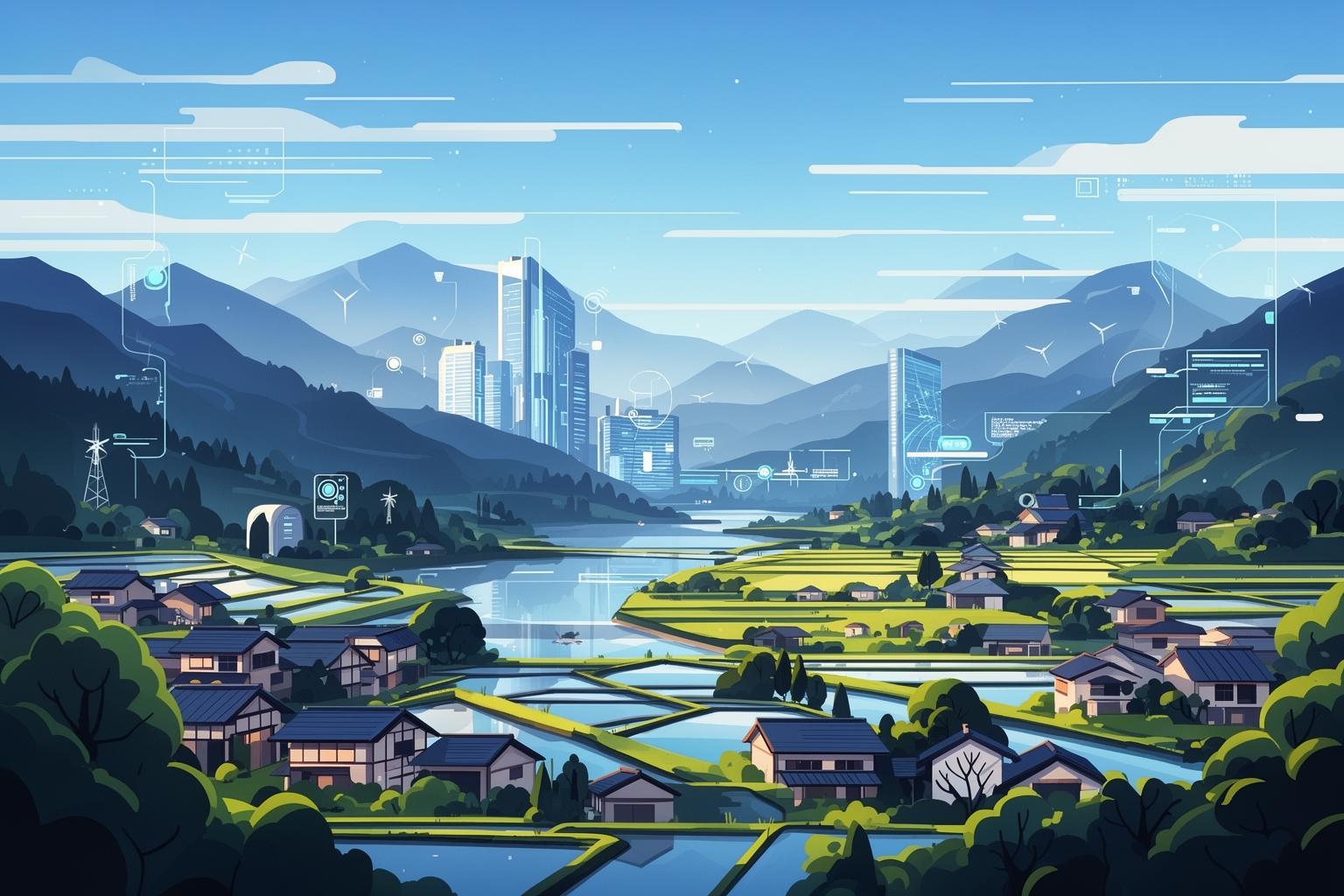
Ultimately, it’s easy to romanticize the satoyama, viewing it as a lost Eden that we should strive to perfectly restore. But that’s a misconception. It was a system born out of necessity, marked by immense hardship and labor. Preserving it as a static living museum would betray its core nature, which has always been about adaptation and change. The satoyama is not merely a relic of the past; it is a living, dynamic, and highly relevant concept for our future.
The factors that caused its decline—urbanization, globalization, and reliance on fossil fuels—are precisely the global challenges we now face. The satoyama, in its idealized form, presents a compelling blueprint for an alternative path forward. It offers a model for localized food systems, renewable energy, community resilience, and a way of life that prioritizes biodiversity and human well-being over endless growth. The efforts of young farmers and entrepreneurs to revitalize their local communities are not just a charming Japanese tale; they stand at the forefront of a worldwide movement to redefine our relationship with the planet.
So, when you visit Japan’s countryside, try to look beyond the Ghibli-tinted lens. Recognize the complexity. Notice the empty houses alongside the lively new cafes. Observe the ancient traditions interwoven with modern struggles. The satoyama landscape is not inviting you to find a fantasy. It’s posing a much deeper question: What does it mean to live well in a place? What do we owe to the land that nourishes us, and what do we owe to one another? Discovering the answer to this question is a far greater journey than chasing the shadow of a cartoon cat.