Alright, let’s get into it. When you picture Japan, your brain probably floods with a highlight reel of a thousand TikToks and travel blogs. You’ve got the serene, moss-covered temples in Kyoto, the electric, neon-drenched scramble of Shibuya Crossing, the almost aggressively perfect bowl of ramen that looks more like art than food. It’s a country of wild contrasts, a place where ancient traditions and futuristic tech seem to share a chill, respectful nod on the street. It’s all part of the package, the reason so many of us are obsessed. But then, you hear about something that just completely short-circuits your expectations. You hear whispers of ‘haunted’ coffee shops. And not in a spooky, Halloween-pop-up kind of way. We’re talking about cafes where the staff, the very people taking your order, are described as… ghosts. Instantly, the carefully curated image in your head shatters. Is this some kind of extreme theme restaurant? A performance art piece that’s gone way over my head? Or is Japan really just on another level of weird I can’t even comprehend? It’s a classic “why is Japan like this?” moment. The truth is, these places are real, but the story behind them is a million times more interesting, more human, and more profound than any ghost story you’ve ever heard. It’s not about the supernatural; it’s about the super-natural resilience of the human spirit, powered by some seriously clever tech. This isn’t a gimmick. It’s a glimpse into a future where connection and community can transcend physical barriers. Forget everything you think you know about ghosts, because this is a story about the living. It’s about people who are present in spirit, even when they can’t be in person. And it all goes down in the cozy, nostalgic setting of a classic Japanese kissaten. So grab a brew, get comfy, because we’re about to unpack one of the most innovative and heart-wrenching-in-a-good-way concepts to come out of modern Japan. This is the real tea on the ghostly patrons of Japan’s most unique cafes.
To fully appreciate this modern twist on presence and connection, it helps to understand Japan’s deep-rooted cultural context of seeing spirits in the everyday, a concept explored in our guide to Japan’s ancient animistic beliefs.
The Vibe Check: What Even is a ‘Kissaten’?
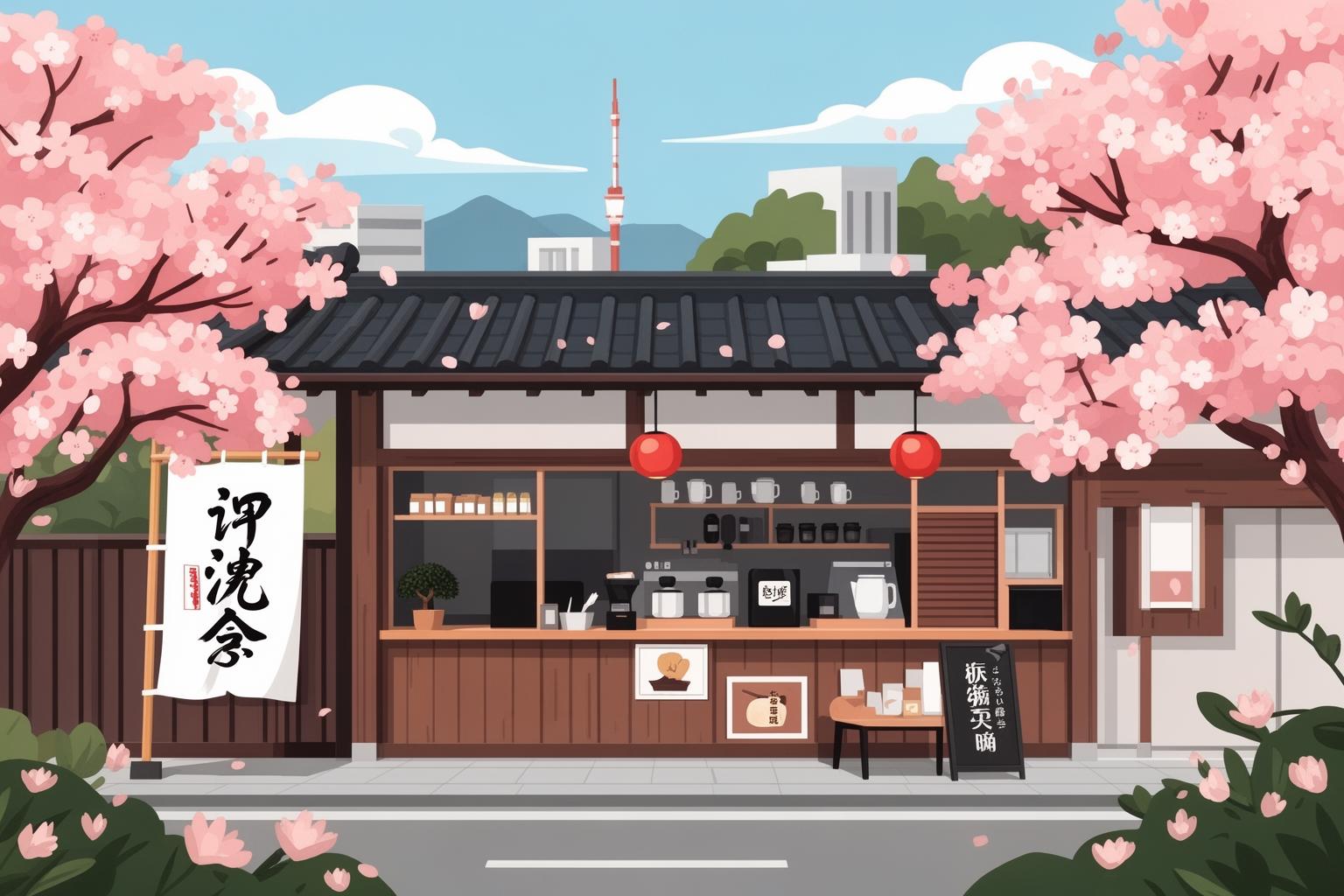
Before we plunge into the world of robot avatars and existential musings, we need to establish the setting. The foundation for this entire phenomenon is the unassuming kissaten (喫茶店), and if you think it’s just the Japanese term for “café,” you’re overlooking a vital piece of the story. A kissaten is not Starbucks. It’s not your local trendy spot with oat milk lattes and exposed brick walls. A kissaten is a time capsule. It’s an ambiance. It’s an institution that occupies a unique place in Japanese social life.
Picture stepping off a bustling Tokyo street and pushing open a heavy wooden door with a small brass bell that softly chimes your arrival. The air inside is thick with the intense, rich aroma of dark-roast coffee, perhaps faintly mingled with a subtle, sweet trace of tobacco from an era when indoor smoking was commonplace. The lighting is dim and warm, casting a golden glow on dark wood paneling and well-worn velvet chairs in shades of burgundy or forest green. There’s no booming pop music—only the gentle murmur of conversation, the clinking of ceramic cups on saucers, and maybe some quiet, thoughtful jazz drifting from a vintage sound system. This is the world of the kissaten.
A Journey Back to the Showa Era
Most kissaten feel as if they’ve been tenderly preserved from the Showa Period (1926–1989), a time marked by vast economic growth and social transformation in Japan. They originated as havens for intellectuals, artists, and students to meet, converse, and savor carefully crafted coffee. The coffee itself is a serious matter. You won’t find a pumpkin spice latte on the menu. Instead, you’ll find siphon coffee, a theatrical brewing technique using glass bulbs and open flames that resembles a science experiment and yields an exceptionally smooth cup. Or nel drip (flannel drip) coffee, a meticulous pour-over method that is slow but results in a rich, full-bodied brew. The commitment to the craft is unmistakable.
And the food? It’s pure nostalgic comfort. Think of a thick slice of fluffy toast, known as shokupan, topped with a pat of melting butter. Or a towering Melon Cream Soda, a fluorescent-green soda crowned with a perfect scoop of vanilla ice cream and a maraschino cherry. For something heartier, there’s the iconic Napolitan spaghetti—a distinctly Japanese twist on pasta with a sweet ketchup-based sauce, onions, peppers, and sausage. It’s the kind of food that feels like a warm embrace from within. It’s not gourmet; it’s history served on a plate.
The Social Haven
More than a spot for coffee and food, the kissaten served—and continues to serve—a vital social role. In a country where homes are often small and public spaces can feel overwhelmingly crowded and hectic, the kissaten is a “third place.” It’s a refuge. It’s a sanctuary where you can escape the stresses of work and the hustle of the city. You’ll spot a salaryman in a suit, with his tie loosened, reading a newspaper. You’ll see friends catching up quietly. And most importantly, you’ll see people who are perfectly at ease alone. The kissaten is one of the rare places in Japan where solitude is not only accepted but cherished. It’s a space for quiet reflection, for losing yourself in a book, for simply being without the need to perform or engage. This deeply ingrained cultural role as a peaceful, contemplative, and intensely personal environment serves as the ideal, if unexpected, backdrop for a story about connection and presence.
Okay, So Where Do the ‘Ghosts’ Come In?
This is the moment we must completely redefine the meaning of the word “ghost.” If you entered one of these cafes expecting to see floating sheets or hear eerie chains rattling, you would be very disappointed. The “haunting” here isn’t paranormal—it’s technological, and deeply human. The “ghosts” are not spirits of the dead; they are the digital presences of living people.
Let’s be clear: the “ghosts” are small, unassuming robots. But importantly, these robots are not AI. They are not pre-programmed machines performing set tasks. Each robot serves as an avatar, a physical representation controlled remotely by a real person from their home, a hospital, or a care facility. These pilots are individuals who, for various reasons—such as severe physical disabilities, chronic illnesses, or mental health conditions like extreme social anxiety—cannot leave their homes to engage in society in a conventional way.
Meet Your Server: The Avatar
Imagine sitting at a table. A small, sleek, white robot about a foot tall glides toward you, boasting a minimalist, friendly design, often with large, expressive digital eyes. Mounted on its “head” is a tablet displaying a live video feed of a smiling human face. “Konnichiwa! Welcome,” a voice sounds from the robot’s speaker. “My name is Yumi. What can I get for you today?”
This encapsulates the core of the experience. You are having a real-time, face-to-face conversation with Yumi, who may be hundreds of miles away, controlling the robot’s movements, speech, and gestures through a computer, tablet, or even eye-tracking technology. She can turn the robot’s head to look at you, nod, wave a small robotic arm, and take your order. The robot becomes her body in the café—it is her proxy, her physical presence in a world she otherwise cannot access. She is the ghost in the machine, but in the most beautiful and literal sense possible. The term “ghost” isn’t intended to be frightening; it’s a poetic, almost poignant way to describe being present while absent. It speaks to existence itself, illustrating how a person’s consciousness and personality can “inhabit” a space even when their physical body is elsewhere.
This singular, brilliant concept turns the usual narrative about automation on its head. In the West, there is often a subtle anxiety about robots taking jobs and making human interaction obsolete. This project does the opposite: it uses technology not to replace people, but to include those who have been excluded. It creates jobs, encourages communication, and builds bridges between worlds that would otherwise never connect. It is about humanity, not efficiency or convenience.
A Case Study: The Avatar Robot Cafe DAWN
To make this concrete, let’s focus on the pioneer of this idea: the Avatar Robot Cafe DAWN in Nihonbashi, Tokyo. The name DAWN stands for “Diverse Avatar Working Network,” perfectly capturing its mission. This is not just a café; it’s a social enterprise, a research lab, and a profound statement on the future of work and community.
Stepping into DAWN feels like entering a warm, optimistic, deeply human vision of the near future. The space is bright, airy, and modern, but your attention is immediately drawn to the small robots moving about. These are the OriHime robots, the flagship product of Ory Laboratory, the company behind the café. Some are small tabletop models designed to sit with you and chat, while others are larger, waist-high models capable of carrying trays of food and drinks.
When seated, a robot approaches your table, and its pilot introduces themselves. You might speak with someone living with ALS (amyotrophic lateral sclerosis) who pilots their OriHime using only their eye movements. You might be served by someone managing severe depression who finds this way of interacting both manageable and rewarding. You can ask them where they are, how their day is going, or simply chat about the menu. The interaction is what matters. The coffee is excellent, the food delightful, but the true nourishment is the connection.
There is a beautiful friction in the experience. Service might be slower or less perfectly synchronized than at a typical Japanese establishment. A robot might hesitate briefly when placing a cup down. But these small imperfections are the point—they remind you that this isn’t a flawless automated system, but a human on the other side, learning, adapting, and doing their best. It cultivates empathy and patience often missing from today’s fast-paced service industries. You are not just a customer; you are part of their work, their social life, their reentry into a world that had shut them out. It is quietly one of the most moving experiences you can have in Tokyo.
Why Japan? The Cultural Sauce Behind the Concept

This remarkable idea didn’t emerge out of nowhere. The Avatar Robot Cafe is a concept that feels distinctly Japanese, arising from a unique blend of societal challenges, technological expertise, and a particular mindset about community and presence. To truly understand it, you need to grasp the cultural environment from which it originated.
Loneliness and Social Connection
It’s well known that Japan, like many advanced modern countries, faces a serious issue with loneliness and social isolation. The hikikomori phenomenon—people who withdraw from society for long stretches—is a well-documented, extreme case of this. Beyond that, there’s a wider trend of social fragmentation linked to urban living, long work hours, and an aging population. A core cultural value is placed on not causing trouble for others (meiwaku o kakenai), which fosters harmony but can also make it hard for individuals to ask for help or admit difficulties. In this light, the Avatar Cafe presents an innovative model for connection. It offers a safe, mediated way for isolated people to participate in society on their own terms. It’s a low-pressure social setting where the pilots maintain control, easing the anxiety that direct face-to-face interaction might provoke while still providing authentic human contact.
Redefining Work and Disability
Work holds immense importance in Japanese society, being central to identity and social value. Contributing productively to a group is highly valued. For those with severe disabilities, this often results in a deep feeling of exclusion and loss of purpose. The traditional job market frequently remains inaccessible, and societal attitudes can sometimes be less than welcoming. The DAWN cafe addresses this issue head-on. It fundamentally redefines what it means to “go to work.” It separates labor from physical presence, emphasizing that a person’s value comes from their skills, personality, and intellect—not merely their body’s capacity to perform tasks onsite. It offers meaningful, paid employment for a largely overlooked group, empowering them and restoring a sense of purpose and belonging. This sends a powerful message: disability does not equal inability.
Tech as a Bridge, Not a Barrier
Japan has a long, rich relationship with robotics. From Astro Boy to Gundam, robots have been embedded in the cultural imagination for decades, often depicted as helpers and partners rather than threatening job-takers seen in Western sci-fi. There is broad societal acceptance of integrating technology into daily life in ways that enhance wellbeing. The OriHime robot exemplifies this philosophy. It is not designed to be the most efficient server but to act as a medium for human connection. Its purpose is explicitly social. This approach—creating technology driven by empathy and social benefit—is characteristic of a certain kind of Japanese innovation. It views technology not as a cold, isolating force, but as a warm, connecting tool to address deeply human challenges.
The Importance of ‘Ba’ (場所)
Ba is a Japanese concept that loosely translates as “place” or “space,” but it signifies much more than just a physical location. A ba is a shared context, a sphere of interaction where relationships develop and knowledge is generated. It can be a team meeting, a family dinner, or a community center. The kissaten (traditional coffee shop) has long been a classic example of a ba. The Avatar Cafe creates a new kind of ba—both physical and virtual. The cafe itself is the physical anchor, a tangible location where people gather. At the same time, it serves as the hub for a distributed, virtual community of pilots who can connect with one another and the broader world. It offers a shared space that transcends physical constraints, enabling the formation of new relationships and a renewed sense of community. The magic lies in how it uses a real, physical place to give grounding and authenticity to a network of virtual connections.
The Real vs. The Expectation: Busting the ‘Weird Japan’ Myth
A concept like a ‘ghost’ robot cafe can easily be reduced to a clickbait headline. You can already picture something like, “Wacky Japan’s New Robot Cafe!” paired with a cute robot image that overlooks the full context. This is a common pitfall when viewing Japan from the outside—its most innovative and thoughtful ideas are often dismissed as mere novelties or eccentricities. However, it is essential to recognize that the Avatar Robot Cafe is neither a theme restaurant nor a gimmick. It stands as one of the most serious, sincere, and forward-thinking social initiatives anywhere in the world.
It’s Not a Performance, It’s a Job
When you visit, you’re not witnessing a show; you’re entering someone’s workplace. The pilots aren’t actors playing a part—they are employees earning a living, developing skills, and building careers. For many, it’s the first job they’ve ever held. This distinction is key. It shifts your role from a passive spectator to an active participant in a new kind of economy. The money you spend on your coffee directly supports this inclusive employment model. Social impact is deeply embedded in the business structure. It’s a quiet revolution disguised as a coffee shop.
Expect Emotion, Not Spectacle
The emotional impact of the experience might surprise you. You could enter expecting a fun, futuristic novelty but leave feeling profoundly moved. Having a casual conversation about the weather with someone who then reveals they’re piloting the robot from their hospital bed is a deeply humbling and perspective-altering moment. It bridges the gap between your world and theirs. It makes issues like disability and social isolation feel immediate and personal. You might form a sincere, if brief, connection with your server. This space fosters empathy on a radical scale. The real “attraction” isn’t the technology itself but the human stories that technology enables.
The Broader Vibe: Other Forms of ‘Ghosting’ in Japanese Culture
Interestingly, the use of a proxy or avatar to navigate social situations is not unique to this cafe—it reflects a wider cultural trend in Japan around managing social presence and connection. Take, for example, the phenomenon of Virtual YouTubers, or VTubers. These online entertainers use detailed, animated digital avatars instead of showing their real faces. They build large communities and cultivate deep parasocial relationships with fans while keeping a boundary between their public persona and private self. The avatar grants a different kind of freedom of expression, free from the physical limits or social anxieties of the real world. It’s another form of ‘ghosting’ into a community—being present through a proxy.
Or think about the more controversial ‘rent-a-family’ services, where people hire actors to play the role of a friend, spouse, or family member at social events. While this may seem strange from a Western viewpoint, it arises from a desire to manage social appearances and meet societal expectations without burdening one’s real social network. It’s another, though very different, example of using a stand-in to fulfill a social role. These phenomena, while distinct, all highlight a culture actively exploring new ways to define presence, identity, and connection in the modern era. The Avatar Cafe is arguably the most positive and socially constructive expression of this trend.
So, Is It Worth a Visit? A Traveler’s POV

After all that, the big question still stands: should you actually go? The answer is a definite yes, but with some important caveats. This isn’t a drop-in-and-go kind of place. It’s a destination that demands the right mindset.
Go for Connection, Not Convenience
If you’re in a hurry and just need a quick caffeine boost to keep going on a day of sightseeing, this isn’t the spot. The service, by nature, can be slow and intentional. The focus isn’t speed; it’s interaction. Visit when you have time to sit down, chat, and listen. Come with an open heart and genuine curiosity about the person on the other side of the screen. Your patience and willingness to engage are what make the experience magical for both you and the pilot.
How to Be a Good Customer
Your role here is a bit different. Be friendly. Ask questions. Show interest in the pilot. Simple questions like “Where are you piloting from today?” or “How long have you been working here?” can spark wonderful conversations. Keep in mind that English skills will vary, but just like anywhere in Japan, a positive attitude and being willing to use translation apps when needed will go a long way. The pilots are often as curious about you as you are about them. Don’t just stare at the robot; look into the eyes of the person on the tablet. Smile. This is fundamentally a human exchange, just facilitated by some very cool technology.
The Real Takeaway
Visiting a place like the DAWN café is more than just a cool travel story. It’s an education. It will challenge your perceptions of work, ability, and the role of technology in our lives. You’ll walk away with a much deeper, more nuanced understanding of some of the significant social issues Japan faces and the incredibly creative, empathetic ways people are seeking to address them. You’re not just buying a coffee; you’re investing in a more inclusive vision of the future. In a city filled with stunning temples and incredible food, this quiet little café might be one of the most genuinely unforgettable and meaningful experiences you can have. It’s where you’ll encounter the most resilient, inspiring, and present ‘ghosts’ you could ever hope to meet.