You’ve seen it. Scrolling through your feed, wedged between minimalist cafes and ancient temples, it hits you: a building that looks like a stack of washing machines, a concrete beehive, a relic from a sci-fi movie you’ve never seen. Your first thought is probably, “What even is that?” Your second is likely, “Only in Japan.” And you’re not wrong. But that building, likely the iconic Nakagin Capsule Tower, isn’t just some random architectural flex. It’s a ghost. A ghost of a wildly ambitious, brilliantly flawed, and utterly fascinating idea about the future that Japan dreamed up half a century ago. This wasn’t just about cool-looking buildings; it was a whole philosophical movement called Metabolism, and its story is one of the best ways to understand the cycle of radical creation and ruthless pragmatism that defines modern Japan. It’s the story of a nation that decided to build the future, and then, just as decisively, decided to tear it down. Why did Japan, a country so deeply rooted in tradition, produce some of the most outlandish, futuristic architecture the world has ever seen? And why are these concrete masterpieces, these dreams made tangible, now meeting the wrecking ball? The answer tells you so much about the country’s psyche—its soaring ambitions, its anxieties, and its unsentimental relationship with its own past. It’s a story of a future that was, a future that wasn’t, and why the line between them in Tokyo is always, always blurry.
To see how this architectural ambition also shaped the everyday lives of millions, explore the story of Japan’s danchi apartments.
From Ashes to Megastructures: The Birth of a Vibe
To understand why Metabolism emerged, you must mentally erase the Tokyo you know. Forget the neon-lit, densely packed cityscape of today. Instead, envision a landscape of devastation. In 1945, much of urban Japan lay in ash and rubble. The physical and psychological impact was complete. An entire world had vanished, along with the ideologies that shaped it. This absolute reset was more than a crisis; it was a strange, terrifying, and exhilarating opportunity. For a generation of young architects growing up in this context, there was no “old way” to return to. The slate had been violently, forcefully wiped clean. This was the fertile, radioactive soil from which Metabolism grew.
This movement wasn’t merely about rebuilding homes and factories. It was about rethinking the very notion of the city, of society itself. Leading this intellectual movement was Kenzo Tange, a giant of modern architecture already renowned. But he served as a mentor and central figure for a group of young, brilliant, and restless architects drawn irresistibly toward the future. This circle, including figures such as Kiyonori Kikutake, Kisho Kurokawa, Fumihiko Maki, and the critic Noboru Kawazoe, rejected the rigid, static forms of Western modernism. They believed cities—especially in rapidly growing, ever-changing Japan—could not be designed as fixed, finished entities. They needed to be dynamic, adaptable, alive.
In 1960, Tokyo hosted the World Design Conference, a major event aiming to restore Japan’s place on the global cultural stage. This was their opportunity. The young architects seized the spotlight, releasing a manifesto titled “Metabolism: The Proposals for New Urbanism.” The very name was a declaration. Borrowing from biology, they suggested that buildings and cities should function like living organisms—capable of growth, regeneration, and renewal. The central concept was dividing structures into two parts: a permanent, durable primary framework (the “skeleton” or “tree trunk”) and temporary, replaceable secondary units (the “cells” or “leaves”). This approach allowed, in theory, a city to be updated without complete destruction. Individual apartments, offices, or modules could be attached or swapped out as needs and technologies evolved. It was a philosophy of ongoing, dynamic transformation—an answer to the unstable, unpredictable world they had inherited.
Philosophies Shaping the Concrete
Each member contributed their unique perspective to this core idea. Kiyonori Kikutake was the maritime visionary. His unbuilt project, “Marine City,” imagined entire cities floating on the ocean—massive cylindrical towers into which individual housing units could plug. He viewed the sea as Japan’s next frontier, a way to escape the limitations of a mountainous island nation. His own residence, the Sky House (1958), was a pilot project for these concepts: a single enormous concrete slab elevated on four massive pillars, creating an open living space beneath. The kitchen and bathroom were designed as movable units—a small-scale demonstration of the Metabolist ideal of replaceable parts. It was a radical statement about living—seeing the home as urban infrastructure rather than a static container.
Then there was the prodigious Kisho Kurokawa, the youngest and perhaps most media-savvy member of the group. He was deeply engaged with Buddhist philosophy and information theory, combining ancient ideas of impermanence with futuristic technological optimism. He spoke of an “age of the individual,” where people would be nomadic, traveling among cities and homes. His vision was an architecture supporting this transient lifestyle, offering plug-in pods equipped with the essentials for temporary stays. This was not about creating cozy family homes; it was about efficient nodes within a vast urban network. His theories were intellectually rich, complex, and perfectly aligned with a nation obsessed with progress.
Fumihiko Maki, who had spent considerable time studying and teaching in the United States, offered a more nuanced approach. He was interested in what he termed “group form”—the concept that the collective shape of buildings and the spaces between them mattered as much as the individual structures. He advocated for a “megastructure” that could contain an entire community’s functions—housing, commerce, transportation—within a single, expandable framework. This was visionary thinking on a scale almost unimaginable at the time, proposing not just new buildings but entirely new forms of urban life. These were more than blueprints; they were socio-political manifestos etched in concrete and steel, envisioning a future where society was as fluid and adaptable as the architecture sheltering it.
The Expo ’70 Dream: When the Future Felt Real
The 1964 Tokyo Olympics marked Japan’s official return to the global stage. It was a statement that the nation had been rebuilt, was stable, and open for business. However, the 1970 Osaka World Exposition, or Expo ’70, offered something entirely different. This event signaled Japan’s shift from merely catching up with the West to poised to surpass it. With the theme “Progress and Harmony for Mankind,” the Metabolists were given control. Expo ’70 became the movement’s grand, expansive, and tragically fleeting masterpiece. It was the moment when their wildest theoretical visions were brought to life, if only for six unforgettable months.
For visitors entering the site, it must have seemed like stepping onto another planet. This was the future, fully realized and functional. The master plan, led by Kenzo Tange, was itself a Metabolist idea. At its center stood the enormous Symbol Zone, a colossal space frame roof—the largest in the world at that time—that served as the central plaza. It was the megastructure’s core, the permanent trunk from which everything else extended. Tange described it as a festival plaza, a flexible space designed for people to gather. It was a piece of urban hardware intended for software—the people, the events, the interactions.
Rising from the heart of this extraordinary roof, piercing through it with chaotic vitality, was Taro Okamoto’s Tower of the Sun. This strange, totemic sculpture with its three faces—one golden and futuristic at the top, one stern and present on its torso, and one somber and backward-facing—served as a deliberate contrast to the sleek, technological perfection around it. It was a primal scream amid a utopian dream, a reminder of the messy, unpredictable human spirit that technology was meant to serve. Its presence was a stroke of brilliance, preventing the Expo from becoming a sterile tribute to engineering and imbuing it with a wild, almost spiritual energy.
A Walk Through a Utopian Playground
The pavilions themselves represented a compendium of architectural futurism. Kikutake’s Expo Tower formed a vertical lattice of steel balls and pipes, resembling a molecular model scaled to immense proportions—a viewing platform overlooking the future below. The Takara Beautilion, designed by Kurokawa, consisted of prefabricated steel capsule units joined in a jagged, crystalline configuration. It looked as if it had been constructed from a giant’s toy set, perfectly illustrating his plug-in concept. Inside, visitors encountered exhibits of future living, showcasing a world of automated everything.
The entire site functioned as a living experiment in urban systems. Moving sidewalks glided visitors between attractions, a monorail silently wound above the crowds, and even a pneumatic tube system transported mail across the grounds. The air buzzed with the hum of machines, the sleek design of polished metal and molded plastic, and an almost overwhelming air of optimism. This was the peak of Japan’s economic miracle, a moment of profound national pride. The country had transformed from a defeated nation into an economic powerhouse, and Expo ’70 was the victory lap. It proclaimed to the world, and to Japan itself, that the future was not to be feared but to be constructed. The Metabolist architects were its prophets, and for that brief time in Osaka, their vision of a dynamic, technology-infused world seemed not only possible, but inevitable. It was, of course, a fantasy—a temporary city erected to be dismantled. Yet for those who experienced it, it offered a glimpse of a future that felt irresistibly tangible.
IRL Check: The Nakagin Capsule Tower Saga
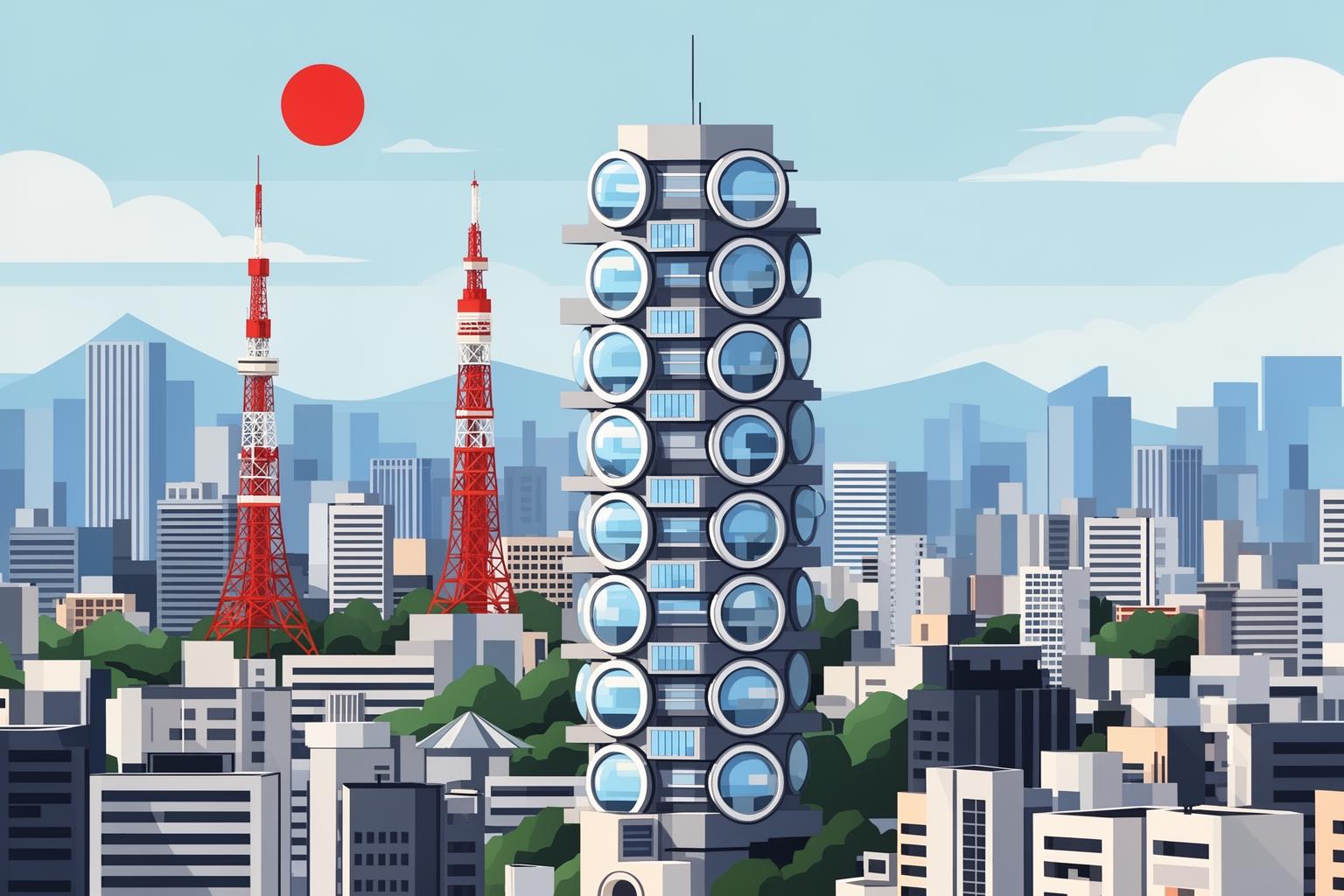
If Expo ’70 was the dazzling yet fleeting music festival of Metabolism, the Nakagin Capsule Tower Building was its hit single that broke into the mainstream. Completed in 1972 in Tokyo’s bustling Ginza district, this was Kisho Kurokawa’s audacious effort to transform the movement’s high-minded ideals from a temporary exposition into the dense, chaotic reality of permanent urban life. Today, it remains the most famous, most photographed, and most tragic representation of the Metabolist vision. It’s the building everyone immediately pictures—a concrete icon whose story perfectly embodies both the brilliance and the fatal flaws of the entire movement.
From the outside, it was a striking sight, a total departure from its surroundings. Two central concrete shafts, housing elevators and utilities, rose like twin tree trunks. Connected to them, almost haphazardly, were 140 prefabricated capsules, each a self-contained micro-apartment. They resembled giant dice, each featuring a single round window like a Cyclops’s eye staring out over the city. The effect was, and remains, incredibly powerful. It didn’t look constructed; it seemed to have accreted. This was Metabolist philosophy in its purest form: a permanent core with interchangeable cells.
The concept was revolutionary. Kurokawa designed these pods for a new type of urban dweller: the nomadic “homo movens,” or moving man. He imagined bachelor salarymen constantly on the move who didn’t need a traditional home, but rather a hyper-efficient base of operations. Each capsule was a marvel of prefabricated design, delivered fully furnished. Measuring just 2.5 by 4 meters, each contained a bed, a compact bathroom unit (similar to those on planes or ships), a fold-out desk, and cutting-edge electronics for the era: a built-in TV, radio, and reel-to-reel tape deck. The idea was stunning: capsules were designed to be replaced every 25 years. As technology evolved, you wouldn’t renovate your apartment; you’d simply unplug the old unit and plug in a new, upgraded model. Your home could evolve. It was architecture as hardware, ready for a software update.
The Future Begins to Decay
But here’s the catch: that software update never happened. Not a single capsule was ever replaced. The utopian dream clashed head-on with the harsh realities of maintenance, finances, and human nature. The logistical challenge was huge. To swap out a capsule in the middle of the stack, all capsules above it had to be removed first. It was an architectural Jenga with no easy fix. Moreover, the cost was prohibitive. Who would foot the bill—the individual owners or a collective association? Kurokawa’s vision demanded a level of financial and social cooperation that simply wasn’t there.
As years turned to decades, the future began to crumble. The iconic round windows, which weren’t designed to open, trapped heat and humidity, causing mold. The building’s central hot water system was shut off in the 2010s, forcing residents to rely on gym showers. Leaks became frequent, marring the once-pristine white interiors. The cutting-edge 1970s technology first became charmingly retro, then utterly obsolete. The building gradually shifted from a vision of the future to a relic—a vertical slum in one of the world’s most expensive neighborhoods.
Still, it gained a cult following. Architects, designers, and creatives worldwide were captivated by its rebellious oddity. A dedicated group of residents and supporters fought for years to save it, launching campaigns to raise the enormous funds needed for a full restoration—detaching, repairing, and reattaching each capsule. They saw it not as a failure, but as an invaluable cultural treasure. But they were battling time, decay, and Tokyo’s relentless real estate market. Ultimately, the land’s value was too high. The fight was lost, and demolition began in April 2022. The iconic capsules were carefully removed one by one, a slow, painful reversal of their futuristic assembly. The Nakagin Capsule Tower, the ultimate symbol of a plug-in future, was unplugged for good.
Why Did the Dream Die? It’s Complicated.
The slow, painful decline of the Nakagin Capsule Tower was not an isolated event. By the mid-1970s, the entire Metabolist movement had lost its drive. The future it so confidently envisioned failed to come to fruition. This outcome stemmed from a combination of global economic factors, cultural changes, and the practical, inconvenient realities of how people actually prefer to live. The death of the dream was not sudden but rather a gradual fading—a recognition that the utopian blueprint didn’t quite align with the real world.
The most immediate and harsh blow came from abroad. The 1973 Oil Crisis sent shockwaves through the global economy, hitting resource-poor Japan particularly hard. The era of cheap, limitless energy that had powered the post-war economic boom came to an abrupt halt. Suddenly, the Metabolists’ enthusiasm for massive, energy-hungry concrete megastructures appeared less visionary and more like reckless excess. The national mood shifted almost overnight from boundless optimism to cautious conservation. Large, society-changing projects were shelved, replaced by a new emphasis on efficiency, sustainability, and practicality. The cultural ground that had supported Metabolism’s radical ideas turned barren.
However, the challenges also lay within the philosophy itself. There was a fundamental disconnect between the architects’ top-down, systematic vision and the messy, bottom-up reality of human life. The concept of living in a tiny, standardized pod, no matter how technologically advanced, ultimately lacked appeal for many people. While the movement celebrated transience and flexibility, most people desire stability, personalization, and a sense of place. You couldn’t knock down a wall, repaint, or even hang a heavy picture in a capsule. The design was prescriptive, leaving limited room for the individual quirks and comforts that turn a house into a home. It was a system crafted for a theoretical “modern man,” but that man often preferred more space and a window that actually opened.
The Inevitable Cycle of Scrap and Build
Perhaps the most critical factor—and key to understanding modern Japan—is the country’s prevailing attitude toward the built environment: the culture of “scrap and build” (スクラップアンドビルド). Unlike many Western cultures that highly value preserving old buildings, Japan typically regards structures as having a finite lifespan. This is partly due to practical reasons, such as the constant threat of earthquakes, which necessitates frequent updates to building codes and structural technology. It is also economic. In hyper-dense cities where land is extraordinarily expensive, the land itself is the primary asset, not the structures on it. It often makes more financial sense to demolish an aging, inefficient building and replace it with a larger, more modern one that maximizes the land’s value.
This mentality applies even to architectural landmarks. There is not the same widespread public outcry to save a 50-year-old building as there might be in Europe or America. While ancient temples and castles are fiercely protected as cultural heritage, 20th-century buildings occupy a far more precarious position. They are often seen merely as “old,” not yet “historic.” Metabolist buildings, with their complex maintenance demands and unconventional designs, were especially vulnerable to this logic. To property developers and city planners, they were not irreplaceable works of art but inefficient, deteriorating assets sitting on prime real estate. The decision to demolish the Nakagin Capsule Tower, though heartbreaking for architecture enthusiasts, was regarded by many in Japan as the natural, logical, and unsentimental course of action. The city, in a very real sense, was simply metabolizing its own past.
The Legacy: Is Metabolism Dead or Just Evolving?

The original buildings are disappearing, and the utopian social project has fizzled out. Case closed, right? Metabolism was a failed experiment, a strange blip in architectural history. Well, not quite. To declare Metabolism dead misses the point. While the physical structures may be decaying, the ideas—the ghost in the machine—are more vibrant and influential than ever. The movement’s legacy isn’t just in the handful of remaining concrete buildings; it lives on in the way architects think, how our cities evolve, and the powerful aesthetic absorbed and reinterpreted by global pop culture. The dream didn’t die; it simply went viral and transformed.
The clearest influence is within architecture itself. The Metabolists’ focus on prefabrication, modularity, and systems-based thinking has become standard practice. Constructing components in factories and assembling them on-site for efficiency and quality control stems directly from the capsule concept. Modern skyscrapers with standardized curtain walls and modular floor plans bear the DNA of Metabolist ideas. The notion of the “megastructure”—a vast framework housing diverse functions—appears in today’s sprawling mixed-use developments, airports, and mega-malls. Architects like Rem Koolhaas and the Archigram group in the UK were working along similar lines and were profoundly influenced by the Japanese group’s bold scale and theoretical depth.
Although many iconic works are gone, some giants remain, offering a powerful glimpse of the movement’s ambitious spirit. Kenzo Tange’s Shizuoka Press and Broadcasting Center in Ginza (1967) exemplifies this. A massive central cylinder houses elevators and infrastructure, with cantilevered, glass-walled office blocks radiating outward. It’s a striking embodiment of the core-and-capsule concept—a vertical street that still feels futuristic today. His Yamanashi Press and Broadcasting Center in Kofu is even more dramatic: a cluster of sixteen concrete cylinders resembling the engine of a colossal, buried spaceship. Then there’s Sachio Otani’s Kyoto International Conference Center, whose dramatic, sloping concrete forms and intricate internal logic evoke an ancient temple reimagined by an alien civilization. These surviving buildings are not mere relics; they remain active, functional parts of the urban fabric, symbols of a time when architects dared to think on a planetary scale.
The Dream’s Second Life in Fiction
Perhaps Metabolism’s most lasting legacy is its aesthetic. The image of dense, layered, almost chaotic cities filled with megastructures and plug-in pods became the foundational visual language of cyberpunk. When you watch Blade Runner and see towering, smog-filled cityscapes, you’re witnessing the ghost of Metabolism. When you read William Gibson’s Neuromancer and picture sprawling Chiba City, that’s the Metabolist vision pushed to a dystopian extreme. The influence is even more direct in Japanese anime and manga. The crumbling, impossibly complex Neo-Tokyo in Katsuhiro Otomo’s Akira is a direct critique and amplification of Tange’s Tokyo Bay plans. The layered, vertical cities of Ghost in the Shell are pure Metabolist fantasy.
Today, the Metabolist style is a full-fledged aesthetic movement online. It satisfies a nostalgic craving for a future that once seemed more ambitious and visually compelling than our current sleek, glass-box world. It forms the core of #brutalism on Instagram, serves as the backdrop for moody synthwave music videos, and inspires video game level design. The original movement was born from post-war optimism—a belief in technology’s power to solve humanity’s problems. Its second life online is driven by a different emotion: melancholic nostalgia, a longing for a future that was promised but never realized. Ironically, the Metabolist vision may be more powerful and influential today as a fictional dream than it ever was as a tangible reality.
So, What Does This Tell Us About Japan?
Ultimately, the story of Metabolism is more than just an architectural lesson. It serves as a lens through which we can grasp the complex, often contradictory nature of modern Japan. It acts as a case study in the nation’s ability for radical reinvention, its relationship with technology, and its unsentimental progression into the future. Tracing the rise and fall of these concrete dreams helps answer the fundamental question: “Why is Japan like this?”
First, it reveals a remarkable capacity for radical, almost violent, change. The Japan that envisioned floating cities and plug-in apartments was the same nation of quiet temples and subtle traditions. This isn’t a contradiction; it’s a duality. The culture possesses an extraordinary ability to hold two opposing ideas simultaneously. Metabolism demonstrates that when faced with a crisis—in this case, total wartime destruction—Japan’s response is not merely to repair but to completely rethink. It has the cultural confidence to wipe the slate clean and propose a future that looks nothing like its past. This readiness to jettison tradition in pursuit of a new ideal is a powerful driver of Japanese innovation, evident not only in architecture but also in technology, fashion, and art.
Second, the story highlights a deep-rooted technological optimism balanced by an equally strong pragmatism. The Metabolists genuinely believed that technology and systematic planning could solve the complex problems of urban life. It was a beautiful, rational dream. Yet when that dream proved inefficient, costly, and socially awkward, the culture adapted without much sentimentality. The “scrap and build” cycle is not just about economics; it’s a philosophical approach. If something no longer serves its purpose, it is replaced. This can seem ruthless to outsiders who witness beautiful, historic buildings being demolished, but from an internal perspective, it’s simply the logical process of urban evolution. The city is an organism, just as the Metabolists said—but its metabolism is governed by the hard realities of land value and seismic codes, not architectural theory.
Finally, the lasting influence of the Metabolist aesthetic, even as the buildings themselves vanish, reveals the power of a national dream. That brief, radiant period from the 1960s to the early ’70s was a time when Japan believed it was inventing the future for the entire world. The confidence was limitless. The architecture of Metabolism is the physical embodiment of that confidence. Even in its decay and demolition, it remains a potent reminder of that ambition. Looking at a photograph of the Nakagin Capsule Tower or standing in the shadow of the Shizuoka Press building evokes the echo of that extraordinary optimism. The dream itself may have failed, the specific future it envisioned may have been a dead end, but the boldness to dream on such a scale is a defining trait of the nation’s journey. It was a failed utopia, yes, but its ghostly presence reminds us that the sleek, hyper-modern Japan of today was built on the foundations of some of the wildest dreams ever cast in concrete.