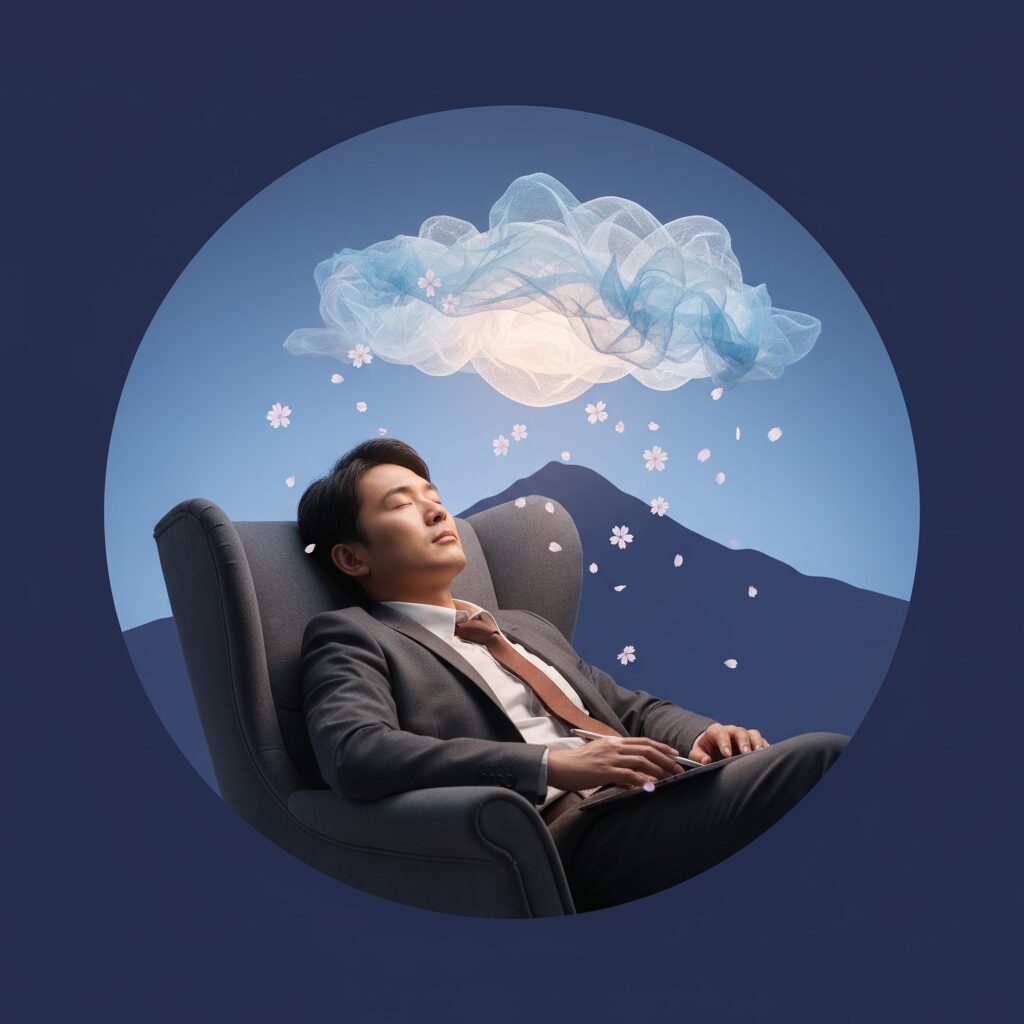
Yo, what’s the deal with Japan? For real. You see it online, the vibey temples, the next-level food, the anime pilgrimage spots. It’s a whole mood. You might even book a ticket, land in Narita, and get hit with this wave of… polite, organized chaos. It’s sick. But then you start noticing the little things, the glitches in the matrix that don’t quite sync with the hyper-efficient, super-polite image. And the biggest, most recurring glitch you’ll see is this: people are asleep. Everywhere. On the train, heads lolling, mouths agape. In a Starbucks, slumped over a laptop. And the most mind-blowing of all? In a meeting. A legit, corporate, PowerPoint-on-the-screen meeting, where a dude in a suit is just straight-up snoozing. And nobody. Says. A thing. Back home, that’s a one-way ticket to a chat with HR. Here? It’s just… Tuesday. This phenomenon, this public act of dozing, has a name: Inemuri. And trying to get your head around it is trying to get your head around Japan itself. It’s not just about being tired. It’s deeper, weirder, and way more complicated than that. It’s a performance, a social contract, and maybe, just maybe, a kind of modern-day ghost story. We’re not talking about a simple nap. We’re talking about a temporary exorcism of the soul from the body, a ritual of exhaustion played out in the open. It’s the art of being gone while you’re still there. Welcome to the surreal world of the Japanese salaryman, where the line between dedication and dissociation gets real blurry, real fast.
To truly understand this cultural paradox, you should explore the deeper reasons behind why sleeping on the job is a vibe in Japan.
The Unwritten Rules of Inemuri: It’s Not Just a Nap
First, let’s clarify the semantics, because in Japan, the details matter greatly. Inemuri is not the same as taking a nap. A nap, or hirune, is a conscious decision: “I’m tired, I’ll lie down for twenty minutes.” You withdraw from your social duties, retreating to a break room or bedroom, mentally and physically off the clock. Inemuri is the complete opposite. It’s an involuntary surrender that occurs while you continue fulfilling your social role. By definition, it’s a public act. The key lies in the kanji: 居 (iru), meaning “to be present,” and 眠り (nemuri), meaning “sleep.” To be present while sleeping. It’s a paradox, a living contradiction. You’re not fully there mentally, but your body is. In a society where physical presence and fulfilling one’s group role are paramount, simply being in the right place—at your desk, on the train seat, at the meeting table—is what counts. It’s the ultimate loophole in the social contract. You’ve nodded off, but you haven’t walked away.
The Art of Being “Present While Absent”
There’s an intricate choreography to socially acceptable Inemuri. You can’t just flop onto your desk and sleep. That’s lazy, disrespectful. A proper Inemuri is a nuanced performance of fatigue. The ideal posture is upright, seated, maybe with your head slightly bowed as if deep in thought. Your hands might rest on the table or in your lap. You must sustain the illusion that you could awaken and engage at any moment. It’s a state of being on standby. Those who’ve mastered this art lightly doze off, head bobbing, then snap awake exactly when their name is called, blinking and nodding as if they caught every word. This skill is developed over years of grueling work hours and soul-sapping commutes. Context matters greatly. You can’t do it anywhere, anytime. In a critical negotiation with a new client? Absolutely not. That’s career suicide. But during a three-hour internal weekly progress meeting where the same manager drones on about KPIs? That’s prime Inemuri territory. Everyone tacitly acknowledges the meeting is a corporate ritual meant to be endured. Your physical presence signals respect for hierarchy, but full mental engagement isn’t expected. So you doze. Your body fulfills the ritual, even as your mind checks out. It’s a quiet, personal rebellion that the system tacitly permits.
Who Gets a Pass? Status and Situation
Here the nuance deepens. The right to Inemuri isn’t equal. It’s often a perk tied to seniority and perceived effort. If a kacho (section chief) or bucho (department head) dozes in a meeting, the unspoken message is: “He must have worked late last night. He’s so dedicated, literally giving his life to the company.” His exhaustion is a badge of honor, proof of sacrifice. He’s earned the right to let his energy drain in public—a corporate warrior with visible battle scars. But if a shinsotsusei, a fresh-faced new graduate, does the same, the reaction is very different: “What a lazy kid. No motivation. No respect for superiors. Does he even want to be here?” For juniors, sleep signals laziness, not sacrifice. They haven’t endured years of hardship to claim the right to show fatigue openly. They must appear alert, even running on three hours of sleep and coffee. The train is a more democratic space. During the commute, all are equal in exhaustion. The salaryman in his crisp suit, the student in her uniform, the grandmother heading to the department store—all join in this collective, swaying ritual of slumber. The train is a liminal zone, a non-place between work’s demands and home’s responsibilities. It’s a socially sanctioned timeout where rules relax, and everyone agrees to look the other way. It’s a silent pact among millions of commuters: we’re all tired, and this is our only refuge.
The Ghost in the Machine: Inemuri as a Liminal State
Alright, so we’ve established that Inemuri is a complex social performance. But I want to take it a step further. What if it’s more than just a social norm? What if we view it through a more ancient, more spiritual perspective? Consider this: for a few minutes, the person is absent. Their consciousness has left the premises. The body functions on autopilot—breathing, sitting upright, occupying space—but the person, the self, is missing. In traditional Japanese folklore and religion, the idea of the body as an empty vessel is significant. There’s a concept called hyoi, meaning spirit possession. It occurs when a spirit—whether a kami (god), a yokai (demon), a ghost, or even the intense emotion of another person—takes control of someone’s body. When possessed, the individual isn’t fully accountable for their actions. It wasn’t truly them; it was the fox spirit or the vengeful ghost. They were merely the container. Now, I’m not suggesting that salarymen in Marunouchi are possessed by nine-tailed foxes. But what if Inemuri is a form of secular, modern hyoi? The spirit that takes over isn’t supernatural. It’s the overwhelming, all-consuming spirit of contemporary corporate life. It’s the ghost of Overwork. The demon of Exhaustion. This force is so strong that it literally pushes the person’s consciousness out of their own body. The individual is momentarily possessed by their job.
The Body as an Altar
This perspective makes an unusual kind of sense when considering the importance of physical presence in Japanese culture, rooted deeply in Shintoism. In Shinto, a physical object—a rock, a tree, a mirror—can become a yorishiro, a vessel for a kami to inhabit. The object itself isn’t the god, but it’s where the god resides. What matters is the physical presence of the object in a sacred space. Similarly, the body of someone engaging in Inemuri becomes a kind of yorishiro. The office is the sacred space; the company is the deity. By staying physically present at their desk, the employee’s body performs as an offering. It acts as an altar dedicated to the god of Productivity. The conscious mind, the honne or true self, has fled, but the body—the tatemae or public facade—remains. It carries out the ultimate act of tatemae by simply being there. It’s a testament to dedication so extreme that it amounts to self-erasure. The company has consumed the individual’s time and energy so completely that it now claims their unconscious body too. The employee isn’t merely working for the company; they are inhabited by it.
The Social Trance and Collective Dissociation
This trance-like state isn’t just individual; it’s collective. Walk into any quiet office in the mid-afternoon, and you’ll sense it—a low hum of keyboards, the soft whir of the air conditioner, and several people in a state of Inemuri. It’s a collective dissociation. Everyone is physically present, but how many are truly there? This fits perfectly within the Japanese cultural value of placing group harmony, the wa, above all else. Complaining about fatigue, asking to leave early, admitting you can’t handle the workload—all are seen as selfish acts that disrupt the wa. They place personal needs above those of the group. So, what’s the alternative? You don’t complain. You don’t leave. You stay. And your body, as a last refuge, simply shuts down the part of you that is suffering—your consciousness. Inemuri becomes a form of passive resistance. It’s a silent, non-disruptive protest. It says, “I am so devoted to this group that I won’t leave, but my individual self has reached its absolute limit and is now taking a temporary absence.” It’s a system crash tolerated because the fault lies in following the system’s impossible demands. Others in the office see it, understand it on a primal level, and ignore it. To highlight it would be to shatter the collective trance, to confront the unsustainability of the system they’re all trapped in. And that would be the greatest disruption of all.
Why is This a Thing? The Social and Economic Engine of Exhaustion
This entire wild phenomenon didn’t just emerge out of thin air. It’s a ghost haunting the machinery of modern Japanese history. To understand why a guy sleeping at his desk is viewed as a model hard worker, you need to rewind to the post-World War II period. Japan was, to say the least, devastated. The national mission was to rebuild, to catch up with the West, to achieve an economic miracle. And they succeeded. But that miracle was powered by human energy. A whole generation of men became “salarymen,” corporate warriors who committed lifelong loyalty to their companies. In return, the company offered lifetime employment, security, and a sense of identity. The pact was clear: you give us your time, your energy, your life, and we will rebuild Japan. And they followed through. Long hours weren’t merely expected; they were a patriotic obligation. The longer you stayed at the office, the more you contributed. Sleep was a luxury, a sign that you weren’t trying hard enough. The ideal employee worked until the last train, drank with his boss to foster relationships, got home at 1 AM, and was back on the 6 AM train the next morning. This culture produced a generation of people who were perpetually and profoundly exhausted. Inemuri became the visible proof of this sacrifice. It was a battle scar from the economic struggle.
Commute Hell and the Urban Landscape
Now, layer that intense work culture onto the geography of a megacity like Tokyo. The cost of housing in the city center is astronomical, so most workers live in the suburbs — deep in Saitama, Chiba, or Kanagawa. This means their daily commute is often a grueling one-to-two-hour journey each way, crammed into a train so packed you can’t even lift your arms to read a book. This daily migration is a soul-crushing ordeal. The train becomes a strange, suspended reality — neither work nor home. It’s a limbo of motion and recycled air. For many, it’s the only chance to reclaim a few precious moments of sleep. The sight of an entire train car full of people, heads bobbing in rhythm with the train’s rocking, is one of the most iconic and tragic scenes of Tokyo life. It’s a silent, collective admission of defeat. The city demands so much from them that the only way to survive is to shut down briefly during the journey. It’s a shared experience that bonds millions of strangers daily. They may not speak, but they are all participants in the same ritual of public exhaustion.
The Double-Edged Sword of “Gambaru”
At the core of all this lies a single, powerful cultural concept: gambaru. This word is notoriously difficult to translate directly into English. It means “to do your best,” “to persevere,” “to hang in there,” “to tough it out.” It’s a virtue instilled from childhood. If you fail an exam, the answer is to gambaru and study harder. If your sports team is losing, you gambaru until the final whistle. In many ways, it’s a beautiful and admirable trait that drives incredible resilience and dedication. But it has a dark side. In the corporate world, the pressure to always appear to be doing gambaru can become toxic. It creates an environment where saying “I can’t,” or “this is too much,” is impossible. It means staying late not because you have work to do, but to show you’re working hard. It means taking on impossible tasks without complaint. When people are pushed to gambaru beyond their physical and mental limits, their bodies eventually betray them. Inemuri is the physical sign of someone who has gambarued to the point of system failure. It’s the glitch that proves how hard you were trying. And because it’s a symptom of a core cultural virtue, it’s almost untouchable. Criticizing someone for Inemuri is like criticizing them for being too dedicated, for trying too hard. And in Japan, that’s simply not done.
The Modern Glitch: Is Inemuri Fading or Evolving?
So, is this culture of exhaustion and public dozing a permanent aspect of the Japanese landscape? Not necessarily. Things are changing, gradually but surely. The younger generation—my generation—is beginning to view the salaryman lifestyle of our parents and grandparents and think, “Nah, that’s not for us.” We grew up in a different Japan, one no longer rebuilding from ruins but facing economic stagnation. The promise of lifetime employment no longer holds. Company loyalty is reciprocal. We prioritize our personal time. The current buzzword in corporate Japan isn’t “dedication”; it’s seisansei—productivity. The government is even promoting “work style reform,” aiming to limit overtime hours and encourage employees to take their vacation days. In this newer, efficiency-centered environment, the meaning of Inemuri is starting to change. For an increasing number of people, spotting a colleague asleep at their desk isn’t a sign of a hard worker. It’s a sign of poor time management, someone unable to complete their tasks within a reasonable timeframe. The badge of honor is gradually being seen as a mark of inefficiency. The ghost of the corporate warrior is slowly fading, replaced by the ideal of the smart, efficient, and balanced worker.
Remote Work and the Vanishing Presence
The global pandemic threw a major wrench into the machinery of Japanese work culture and significantly disrupted the concept of Inemuri. With the abrupt shift to remote work, the fundamental element of Inemuri—physical presence in the office—disappeared. If you’re working from your living room, the whole performance of “being present while sleeping” loses relevance. If you’re tired, you can simply turn off your camera during a Zoom call and rest on your sofa for 15 minutes. No one needs to know. The social ritual vanishes. This has had a peculiar effect. On one hand, it’s liberating. People gain more control over their time and energy. The pressure to display exhaustion is eased. On the other hand, the boundaries between work and life have blurred even further. The pressure hasn’t vanished; it’s just become less visible. Now it’s not about physical presence but digital presence. It’s the pressure to reply to a Slack message at 10 PM or answer an email on a Sunday. The exhaustion remains, but its most visible symptom, Inemuri, has been pushed underground, into the private realm of our own homes. The ghost no longer haunts the office machine; it now lingers in our personal laptops.
A New Form of Possession: The Smartphone Trance
If traditional Inemuri is in decline, perhaps it’s not disappearing but transforming. I believe the new Inemuri is the smartphone trance. Look around any meeting room, train car, or café—you’ll see people physically present but mentally a million miles away, their focus completely absorbed by the glowing screen in their hands. They scroll through Instagram, watch TikToks, play games. Their bodies are in the room, but their minds are elsewhere, in the cloud. This, however, is a very different kind of possession and far less socially acceptable. Inemuri is a passive surrender to exhaustion. It’s viewed as involuntary; you can’t help it—you’re simply that tired. The smartphone trance, by contrast, is an active choice. You deliberately disengage from the reality before you and immerse yourself in a digital one. It is seen as rude, disrespectful, and a sign of boredom. It communicates, “What’s happening here is less important than what’s on my phone.” This distinction is critical. It reveals that Inemuri’s acceptability lies in its perceived helplessness. It is a state of honorable defeat, not a conscious act of rebellion. The phone is a doorway you willingly step through; Inemuri is a void you fall into.
So, What Do You Do When You See It?
So here you are, in Tokyo, riding the Yamanote Line, when the person next to you slumps over and their head softly rests on your shoulder. What’s the protocol? First, stay calm. This is not a strange advance. It’s rarely a sign of a medical emergency. It’s simply someone who is extremely tired. The usual local reaction is to do absolutely nothing—just let them sleep. They will almost certainly wake up with uncanny timing as the train reaches their stop, offer a small, embarrassed apology, and quickly exit. Don’t stare. Don’t snap a photo for social media—that’s really uncool. Just recognize you’re witnessing a small, intimate cultural moment. You’re seeing the physical proof of a society that pushes its people to the absolute limit for the collective good. You’re seeing a person whose body is finally cashing a check their mind wrote hours earlier. When you notice Inemuri in an office or café, try to reconsider your initial impression. Don’t jump to the Western assumption of laziness, disrespect, or boredom. Instead, view it as what it truly is: a complex cultural signal. It’s a sign of a system demanding extraordinary endurance and a person doing their utmost to meet those demands. It’s the briefest truce in a long battle against exhaustion. It’s a moment of quiet, socially accepted surrender, where the spirit takes a break while the body holds steady. It’s the ghost in the corporate machine, a fleeting possession by the spirit of fatigue. And in its own strange, deeply human way, it proves that even in the strictest systems, there’s a small space for the human spirit—or its absence—to find a loophole.