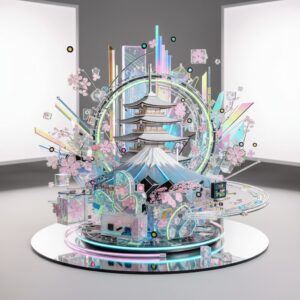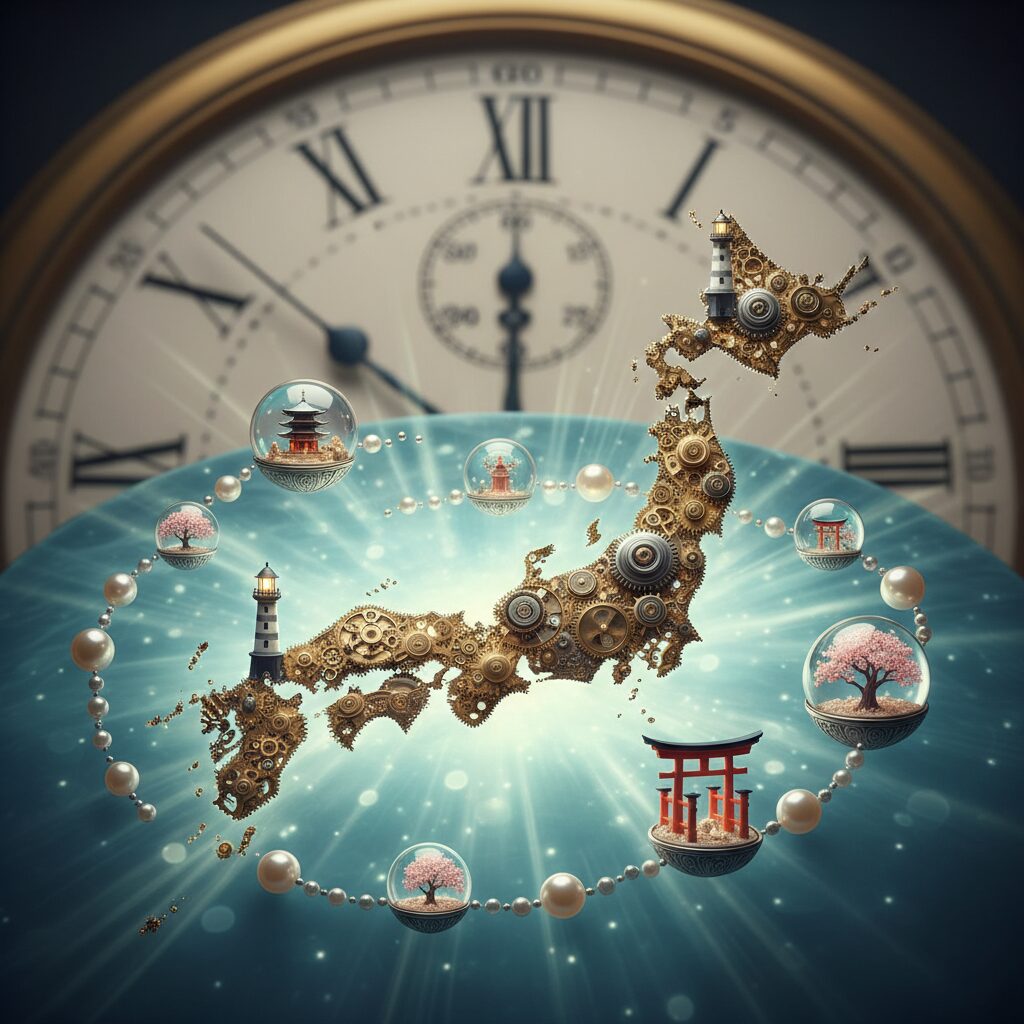
Yo, what’s the deal with Japan? One minute you’re on a Shinkansen that’s so punctual it’s borderline psychic, getting blasted into a future of neon-drenched cities and robot cafes. The next, you see these posts online—#slowliving, #islandlife—showing some serene, sun-bleached coastline where time seems to have just… given up. It’s a total vibe shift, and honestly, it can feel like cultural whiplash. You’re left wondering, is that chill island thing even real, or is it just a carefully curated aesthetic for the ‘gram? Is Japan the capital of hyper-efficiency or a master of doing absolutely nothing? The short answer is, it’s both. And the key to understanding this paradox is a concept that doesn’t really translate but you can totally feel: Shima-Jikan (島時間), or Island Time. But let’s get one thing straight. This isn’t your typical “I’m on vacation”-mode slow. It’s not about laziness or inefficiency. Shima-Jikan is a whole different operating system for life. It’s an immersive art form, a conscious, breathing philosophy shaped by the sea, the sky, and the deep-rooted connections of a community. It’s about recalibrating your entire being to a rhythm dictated by tides and tradition, not by train schedules and deadlines. To get it, you can’t just observe it; you have to step inside and let it rewire you. This is the lowdown on why Japan’s island time hits different, and how it’s a living, breathing masterpiece of cultural expression.
To truly appreciate how Japanese islands cultivate unique artistic philosophies, one can explore the legacy of Gutai’s experimental art parks.
The Vibe Check: What Shima-Jikan Actually Feels Like
So, what does it truly mean to live on Shima-Jikan? Forget everything you think you know about time management. This isn’t about productivity tips or optimizing your day. It’s about completely letting go of the schedule. The first thing you notice is the silence—not an empty or awkward quiet, but a rich, textured calm filled with the natural sounds around you. In the city, your ears are bombarded by a constant mix of artificial noises: the chime of the train station, the polite yet firm automated announcements, the endless drone of countless air conditioners. On an island, the soundtrack shifts. It’s the steady hush of waves on a pebble beach, the rhythmic drone of cicadas in the heavy, humid summer air, the faint chugging of a fishing boat heading out at dawn. These aren’t mere background sounds; they serve as the clock. They tell you the time of day, the season, and the mood of the sea. The buzzing of cicadas grows louder in the midday heat, signaling a time to retreat indoors. The evening tide, drawing away from the shore, marks the close of the day’s work and the start of a peaceful evening.
Your day begins not with an alarm, but with the unique quality of light filtering through a paper screen. It’s a gentler, more gradual waking. The idea of being ‘late’ starts to seem absurd. Late for what? The ferry to the next island is the only fixed appointment, and even that depends on the weather. If a typhoon is approaching, the ferry simply doesn’t run. No exceptions. No detours. You just wait. This yielding to forces beyond your control is the first lesson of Shima-Jikan. It’s humbling and ultimately freeing. Your carefully crafted schedule falls away, and in its place, space opens up. Space just to be.
A visit to the island’s sole store isn’t a quick errand. It’s a significant social occasion. You’ll bump into Oba-chan (an affectionate term for an older woman, like ‘auntie’) tending her daikon radishes. She’ll ask where you’re from, what you’re up to, and insist you take a bag of slightly imperfect cucumbers from her garden. You’ll spend twenty minutes chatting with the shopkeeper about the quality of this year’s seaweed harvest. This isn’t a bother; it’s the essence of life here. These encounters, which would be seen as inefficient distractions in a Tokyo convenience store, are precisely the point. They are the exchanges that matter, reinforcing the community ties that bind the island. Time isn’t a currency to be spent wisely; it’s a medium for connection.
Lunch isn’t snatched on the run. It’s often determined by what the fishermen have brought in that morning. You eat with the seasons and the day’s catch. The menu at the local 食堂 (shokudo, a casual eatery) isn’t fixed but shifts to reflect what’s fresh and available. This close link to the source of your food fosters presence, a mindfulness that’s difficult to attain when meals come from a distant, anonymous supply chain. You’re not just fueling your body; you’re engaging with the island’s ecosystem. The afternoon might be spent simply sitting on a seawall, watching clouds drift by. It feels radical—almost rebellious—to an urban mind trained to believe every moment must be busy. But on island time, this ‘doing nothing’ is a powerful act. It’s when your mind finally quiets enough to notice the little things: how the wind rustles ginkgo leaves, the delicate moss patterns on an old stone wall, the shifting colors of the sea as the sun sets. It’s embracing main character energy in the most understated way possible. It’s an IYKYK moment; the deep satisfaction is hard to put into words—you just have to experience it.
The Blueprint: Why Does Island Time Even Exist?
This entire vibe is no coincidence, nor is it a lifestyle trend crafted for Instagram. Shima-Jikan is the natural, deeply rooted cultural result of centuries of geographic isolation, historical circumstance, and social necessity. It’s a system built for resilience and harmony in a very particular environment. To truly understand why island time operates as it does, you need to examine its blueprint.
Geography is Destiny
Above all, discussing Japan’s islands means discussing the sea. Japan is an archipelago comprising over 6,800 islands. While the four main islands receive most of the attention, it is the smaller, remote islands—especially those in the Seto Inland Sea and the Ryukyu chain of Okinawa—that are the genuine bearers of the Shima-Jikan spirit. For these islands, the ocean is both a provider and a prison. It supplies food—fish, seaweed, pearls—yet it also controls the conditions of life. The ferry isn’t like a bus you can catch any time; it’s a lifeline, and an unpredictable one. Storms can isolate an island from the mainland for days. Supplies may dwindle. Medical emergencies become critical. This constant underlying vulnerability cultivates a different mindset. You learn to be resourceful, to plan ahead, and most importantly, to be patient. You can’t push through a typhoon. You can’t rage against a canceled ferry. Instead, you accept, adapt, and wait. This enforced patience is not passive; it’s a survival skill. It teaches you to live within nature’s limits, not to force your own will upon it. This fundamentally reshapes your relationship with time. Time is no longer a linear resource to be conquered or optimized, but a cyclical, potent force to be respected and harmonized with.
Historical Echoes
The history of many of these islands is also crucial to their distinctive culture. For centuries, remote islands served as places of exile for political dissidents, fallen nobles, and troublesome monks. Emperor Go-Toba was banished to the Oki Islands in the 13th century. The Buddhist monk Nichiren was exiled to Sado Island. These islands became pockets of refined culture and intellectual activity, yet they remained fundamentally detached from the mainland’s central powers. They developed their own dialects, traditions, and customs. They had to rely on themselves. This history of isolation nurtured a powerful sense of independence and unique identity. Moreover, some islands served as pirate (wako) bases, secret sanctuaries for persecuted Christian communities during the Edo period, or sacred spiritual sites for pilgrims. Each of these histories shaped a culture that prized internal cohesion and self-reliance over outside approval and integration. The rhythms of life followed the island’s own history and needs, not the shifting whims of the capital. This legacy endures today. Though connected by modern technology, a tangible sense of separateness remains—a place functioning on its own terms and its own time.
Community Over Individual
Perhaps the most vital element in Shima-Jikan’s blueprint is its community structure. On a small island where your family has lived for generations and everyone knows your name, your history, and your affairs, social dynamics differ markedly from urban anonymity. The guiding principle is maintaining wa (和), or social harmony. While this concept exists throughout Japan, on an island it is intensified. You can’t simply avoid someone after a disagreement; you’ll run into them at the post office, the festival, and the PTA meeting. Reputation and relationships mean everything. Hence, interactions are rarely transactional; they are relational. Efficiency often yields to ensuring everyone feels respected, heard, and included. A decision that might take five minutes in a corporate boardroom could require weeks of informal consensus-building (nemawashi) on an island, involving countless cups of tea and long, winding conversations. This isn’t viewed as wasted time. It is the work itself—the process of strengthening communal bonds essential for survival. This collective focus slows life’s pace to match the community’s rhythm. You move together, decide together, celebrate together at local matsuri (festivals), and grieve together. The individual’s desire for speed is subordinate to the group’s need for harmony. This is the heart of Shima-Jikan. Time is measured not in seconds and minutes, but in the quality of human connection.
Shima-Jikan as an Art Form: It’s Not Laziness, It’s a Choice
It’s easy for a Western, productivity-driven mindset to view this slow pace as inefficiency or a lack of ambition. However, this is a fundamental misunderstanding of the culture. Shima-Jikan is not about laziness; it’s an active, often subconscious, artistic and philosophical statement. It serves as a form of resistance against the relentless, dehumanizing speed of modern industrial life. It treats time as an art form rather than a resource to be exploited.
The Art of “Ma” (間)
To truly grasp this, one must understand the Japanese aesthetic concept of ma (間). Often translated as “negative space,” ma is far more nuanced. It is the pause in conversation that lends emphasis to words. It is the empty space in a Zen rock garden that directs focus to the stones. It is the silence between musical notes that shapes rhythm and emotion. Ma represents the interval, the gap, the space in between, which is considered as important—if not more so—than the tangible objects or sounds. Shima-Jikan is essentially the temporal expression of ma. It is the art of nurturing and valuing the time between events. Waiting for the ferry is not wasted time; it’s ma. It offers space for contemplation, observation, and quiet conversation. A long, unstructured afternoon is not time lost; it’s ma, a canvas for serendipity. In a world intent on filling every second with content, stimulation, and productivity, deliberately cultivating ma is a radical act. The islanders who live by this rhythm are time artists, shaping their days not by adding more, but by cherishing the spaces in between.
The Island as Immersive Installation
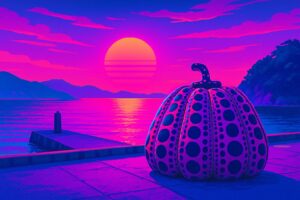
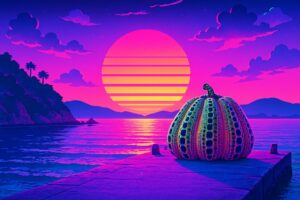
Consider an island not merely as a place, but as a vast, living art installation. You don’t simply observe it; you enter it and become part of it. The landscape, architecture, people, and food all compose a cohesive artwork designed to alter your perception. This notion is brilliantly embodied by the Setouchi Triennale, a contemporary art festival held every three years across a dozen islands in the Seto Inland Sea. Here, world-renowned artists don’t confine their work to galleries. They weave it into the very fabric of the islands. An abandoned house becomes a canvas for a captivating light installation by James Turrell. A giant, polka-dotted pumpkin by Yayoi Kusama sits on a pier, transforming into an iconic part of the landscape. An old ticket booth is converted into a multidimensional piece of art. But the art extends beyond the objects themselves. The “art” is the entire experience. It encompasses the slow ferry ride from island to island, watching the sea and sky shift. It involves walking or cycling through small villages, following a roughly drawn map to discover hidden installations. It includes conversations with elderly volunteers who lovingly staff each artwork and eagerly share island stories. The festival enforces Shima-Jikan. You cannot hurry it. You must surrender to the ferry schedules, the walking distances, the waiting. The ma—the travel and the waiting—becomes as essential to the experience as the art itself. It offers a masterclass in experiencing time differently, using art as the catalyst. The Setouchi Triennale didn’t invent this concept; it simply reflects the art form already present: the art of island life itself.
Reading the Room: How to Vibe with Island Time
So, you’re convinced by the concept, but as a visitor conditioned for speed and efficiency, how do you actually align with this slower rhythm without feeling frustrated? It’s a process of unlearning. It demands a conscious effort to release your mainland mindset. Here’s a guide to catching the vibe.
First and foremost, you need to abandon the strict minute-by-minute itinerary. Planning your island visit like a military campaign is the quickest path to frustration. It’s fine to have a list of sights to see, but keep it flexible. Your goal should be to have one or two objectives for the day. That’s all. Maybe it’s “reach that beach on the far side of the island” or “find a small café you saw a photo of.” The true magic lies in the journey between these points. If you miss a bus, don’t immediately check the next schedule. Look around. Is there a small shrine nearby? A local shop selling handmade snacks? A cat napping on a warm patch of asphalt? A missed connection is not a failure in planning; it’s an invitation from the island to discover something unexpected. Heed that invitation. The best Shima-Jikan experiences are those you cannot plan.
Next, actively engage with what your city-trained mind might dismiss as “unproductive.” This is the essential practice. See an old man mending his fishing nets? Don’t just take a photo. Pause and watch. Give him a nod and a “Konnichiwa.” He might ignore you or might start telling you about the giant squid he caught in 1978. Either way, you’ve participated in island life rather than merely observing it as a spectacle. Spend an hour at the port watching ferries arrive and depart. It’s the island’s Grand Central Station, a theater of hellos and goodbyes, of goods arriving and products being shipped out. It tells the story of the island’s connection to the outside world. Buy a drink from a vending machine and sit on a bench. Don’t scroll through your phone. Watch life unfold. These moments of deliberate stillness help recalibrate your internal clock. It’s like tuning yourself to the island’s frequency until you begin to resonate with it.
Finally, use your senses to attune to the non-human clocks. The human-made clock is an abstraction; the natural clock is tangible. Make a point to watch the entire sunset arc. Notice how the water’s color shifts from turquoise to sapphire to indigo. Listen to the evening chorus of frogs in the rice paddies. Feel the temperature drop and the sea breeze pick up as night falls. When you start to measure your day through these sensory cues instead of by the numbers on your watch, you’re beginning to grasp Shima-Jikan on a visceral level. You’re allowing the island to tell you what time it is, and you’re learning to listen.
The Real vs. The ‘Gram: Is It All Just an Aesthetic?
Now, let’s be candid for a moment. It’s important to understand that Shima-Jikan is not a utopian fantasy or a perfectly curated Kinfolk magazine spread. The slow, quiet life that seems so idyllic on social media is also the lived reality of some of Japan’s most urgent social and economic challenges. To overlook this is to romanticize a situation that, for many residents, is deeply difficult. The biggest issue is kaso (過疎), or severe depopulation. Young people have been leaving the islands for decades in search of education and jobs in big cities. What remains is a rapidly aging population. Walk through any island village, and you’ll see the signs: beautifully traditional houses with boarded-up windows, a closed elementary school with a rusted playground, a main shopping street where more than half the storefronts are shuttered. The quiet you enjoy as a visitor can be, for residents, the sound of a community slowly disappearing.
This reality means that the slowness isn’t always an intentional, philosophical choice. It often results from economic stagnation and limited resources. The infrequent bus service isn’t a charming quirk; it reflects a shrinking tax base unable to support more routes. Having only one grocery store might feel quaint, but it means fewer choices and higher prices for essentials. The close-knit community can be wonderfully supportive, but it can also feel limiting, with little privacy and pressure to conform. The very elements that create the serene Shima-Jikan atmosphere are deeply intertwined with these profound challenges. It’s a paradox: the islands are priceless cultural treasures and communities on the brink of extinction. Initiatives like the Setouchi Triennale are brilliant because they attract funding and attention without turning the islands into generic tourist resorts. They leverage the islands’ unique character—the slow pace, old houses, beautiful scenery—as an asset, not a problem to be solved. But it remains a delicate balance. As a visitor, it’s crucial to appreciate the aesthetic of Shima-Jikan while recognizing the complex realities beneath it. This isn’t a theme park. It’s someone’s home, and that home is fighting for its future.
The Takeaway: Why Shima-Jikan Hits Different in the 21st Century
Why, then, are we so captivated by this concept today? In an era marked by digital burnout, global anxiety, and an unyielding obsession with productivity, Shima-Jikan feels less like a charming cultural oddity and more like a bold, essential act of resistance. It presents a framework for living differently—one that values depth over speed, connection over transaction, and being over doing. The world is finally beginning to appreciate the wisdom preserved on these small Japanese islands for centuries. Global conversations about mindfulness, digital detox, and the anti-hustle movement are all seeking what Shima-Jikan embodies. It offers a time-honored model for a more sustainable and humane pace of life, challenging the central assumption of modernity: that progress is linear and faster is always better.
Shima-Jikan advocates for a cyclical, rhythmic view of time, aligned with the natural world. It reminds us that efficiency is neither the only nor the most important measure of a life well lived. What is the return on investment for watching a sunset? What key performance indicator applies to a long, winding conversation with a village elder? Such questions make no sense in the logic of Shima-Jikan, for the value of these moments is intrinsic. This isn’t about escaping reality—in fact, it’s quite the opposite. It’s about breaking free from the frantic, artificial world we’ve created and connecting with something more fundamental, more authentic. It’s about rooting yourself in a particular place and community. In a world that increasingly feels placeless and disconnected, this may be the most profound act of all. Experiencing Shima-Jikan isn’t about retreating into the past; it’s about uncovering a timeless approach to living that is more relevant and necessary than ever. It is the ultimate statement in a world that never stops: the deliberate, artful, and unapologetic decision to slow down.