Alright, let’s get real. You’ve seen the photos, right? The ones that pop up on your feed and make you wonder what rabbit hole you’ve just fallen down. A dimly lit room somewhere in Tokyo, maybe Shinjuku or a quiet backstreet in Kichijoji. There’s a wall of vinyl, a hulking silver-faced amplifier with glowing meters, and maybe a lone figure, silhouetted, listening intently as a record spins. It’s a whole mood. It feels impossibly cool, deeply serious, and profoundly… Japanese. And your first thought is probably, “Is this for real?” followed quickly by, “And why are they so obsessed with audio gear that looks like it belongs in my grandfather’s basement?”
It’s a fair question. In a world that sprinted towards disposable tech, MP3s, and invisible streaming algorithms, Japan fostered these incredible time capsules. Places where technology from the 1970s and 80s isn’t just preserved; it’s worshipped. This isn’t about a fleeting hipster trend or a simple love for retro aesthetics. Digging into Japan’s vintage audio scene is like peeling back layers of the country’s modern history—its post-war ambition, its bubble-era excess, and its deep-seated cultural reverence for craftsmanship and dedicated hobbies. It’s a world of unspoken rules, intimidating shop masters, and sonic experiences that can feel almost religious. This isn’t just about shopping for old stereos. It’s about understanding a mindset that chose to perfect the past rather than discard it. So, grab a metaphorical cup of coffee, settle into the sweet spot, and let’s drop the needle on why these audiophile havens are one of the most fascinating subcultures in Japan. It’s a journey into the soul of the Showa Era, one vacuum tube at a time.
To truly appreciate this reverence for curated listening, one must also understand the culture of Japan’s jazz kissas.
The Showa Ghost in the Machine: Why Old Tech Never Died Here

To understand why a pristine 1978 Sansui amplifier commands both a high price and a place of honor in a Tokyo shop, you need to grasp the era that produced it. The Showa Era (1926-1989) was a time of extraordinary transformation for Japan, shifting from militarism and devastating war to an astonishing economic recovery and a phase of dazzling wealth. Audio equipment from the latter half of this era—especially the 60s through the 80s—is more than just a collection of circuits and knobs; it physically embodies Japan’s post-war identity and ambition.
Post-War Boom and the Rise of the “Audio Maniac”
In the aftermath of World War II, Japan rebuilt itself with fierce determination. By the 1960s, the nation was experiencing an economic miracle. This fostered the emergence of a new class of urban professionals known as the “salaryman.” These men, working long, demanding hours for corporations, had growing disposable income. Hobbies became an essential outlet, a way to reclaim a sense of individuality beyond the rigid corporate structure. For a generation that witnessed Japan rise as a global leader in technology and manufacturing, high-fidelity audio became the ultimate pastime.
This passion was about more than just listening to music; it was about appreciating the machinery itself. The concept of monozukuri—literally “the making of things”—lies at the heart of the Japanese mindset. It represents a philosophy of craftsmanship, infusing manufacturing with artistry, pride, and relentless pursuit of perfection. Companies such as Sansui, Pioneer, Kenwood, Luxman, and Accuphase weren’t simply manufacturing electronics; they were engaged in a fierce competition for engineering excellence. The “Made in Japan” label on a receiver was a badge of national pride, symbolizing Japan’s ability not only to compete with the West but to surpass it in quality and innovation.
For the salaryman, his home audio system was his castle, his refuge. In a society that prioritizes the group over the individual, the listening room was a private domain where he ruled. He could carefully arrange components, fine-tune settings, and curate the audio experience. It was a world he controlled completely—a sharp contrast to the conformity of his work life. The audio system served as a status symbol, but not in a flashy, ostentatious manner. Rather, it quietly testified to his taste, technical knowledge, and financial success. These men weren’t just consumers; they became “audio maniacs” (ōdio mania), passionate enthusiasts who debated amplifier topologies and speaker materials with the same intensity that others reserved for sports or politics.
The Bubble and the “Cost-No-Object” Era
If the post-war boom laid the groundwork, Japan’s economic bubble of the late 1980s propelled the audio industry to new heights. Money seemed limitless. Stock market and real estate values soared, and supreme confidence swept the nation. Flush with cash and ambition, Japanese audio companies entered a “cost-no-object” design phase—their golden age.
Engineers were granted free rein to create the finest products regardless of cost. This led to legendary, over-engineered equipment unlikely to be replicated today. Think massive power transformers, copper-plated chassis to reduce interference, volume knobs milled from solid aluminum blocks, and capacitors the size of soda cans. This gear was built with an enduring quality alien to our modern world of planned obsolescence. It was designed as a lifelong companion, even an heirloom, capable of decades-long maintenance and repair. It is this very equipment—the pinnacle of analog audio design—that now fills the shelves of vintage audio shops in Tokyo and Osaka. When you see a massive amplifier from 1988, you’re not merely viewing old technology; you’re holding a relic from an era of boundless optimism and economic power.
The “Galapagos Effect” in Audio
The phrase “Galapagos syndrome” often describes Japanese products, like certain cell phones, that evolved uniquely and in isolation for the domestic market, making them incompatible with the rest of the world. A similar phenomenon occurred in the audio industry. While the West rapidly embraced digital formats like CDs and later compressed MP3s, a significant and influential Japanese subculture stubbornly refused to abandon analog. They did not see vinyl as obsolete but as a format with untapped potential.
This loyalty to physical media is a crucial part of the story. Even now, Japan remains one of the world’s largest markets for CDs. There is a tangible respect for the physical object—the album art, liner notes, the ritual of placing a disc in a tray or a record on a turntable. This cultural preference meant that vinyl sections in Western music stores diminished and disappeared, while in Japan they remained vibrant. Consequently, the demand for high-quality turntables and phono preamplifiers never truly vanished. This sustained an ecosystem where vintage gear could be repaired, traded, and treasured, enabling these specialized shops not only to survive but to flourish.
Decoding the Vibe: The Aesthetics of a Japanese Audiophile Shop
Stepping into one of these shops for the first time is an experience that can feel both confusing and captivating. It offers a full sensory immersion guided by a very specific, unspoken cultural code. Forget the bright, open, and customer-friendly atmosphere of an Apple Store—this is something entirely different. It’s like entering another world.
Not Just a Shop, But a Sanctuary: Layout and Ambiance
Your journey usually begins with simply finding the place, which can be tricky. These shops rarely appear on main commercial streets. Instead, they’re often hidden away on upper floors of nondescript buildings, down narrow staircases to basements, or tucked into quiet residential alleys. There’s an immediate feeling of discovery, as if stepping into a secret realm reserved for insiders. Opening the door, you’re not welcomed with a cheerful “Irasshaimase!” Instead, you encounter either a flood of sound or a respectful silence.
The first thing that strikes you is the smell. It’s a distinctive, evocative mix of aged wood from speaker cabinets, the faint sharpness of ozone from warmed electronics, the dry scent of old record sleeves, and perhaps a trace of solder and cleaning fluid. It stands in stark contrast to the new-plastic scent of modern electronics—it’s a smell of history, of lasting presence.
If there’s sound, it’s never mere background music. A system is always playing but it’s a carefully curated demo. The shop master selects a particular piece of music—often jazz or classical—that best highlights the qualities of the equipment on display. The volume is moderate, set to a natural listening level, not to draw attention from outside. It’s an invitation to pause and listen deeply.
Lighting is consistently dim and warm, with spotlights carefully positioned to showcase the craftsmanship of the gear. Sunlight is treated as an unwelcome intruder. The focus falls on the metallic gleam of a turntable platter, the soft glow of a vacuum tube, or the captivating motion of a VU meter’s needle. The space feels less like a retail shop and more like a museum or shrine devoted to the deities of sound.
The layout may appear chaotic. Amplifiers piled to the ceiling. Shelves bowing under turntables missing their platters. Speakers standing rigidly in rows like a robotic army. Boxes of obscure vacuum tubes and cables crammed into every corner. Yet it’s a carefully curated chaos. The owner knows the exact location, history, and tonal character of every piece. It’s an overwhelming, awe-inspiring testament to a lifetime’s dedication and passion.
The Gatekeeper: Meeting the Shop Master
The most critical, and often most intimidating, part of the experience is the shop master. The owner of a Japanese vintage audiophile shop is not a typical salesperson. Treating them as such is the quickest way to have a disappointing and unproductive visit. They are curators, archivists, technicians, and above all, gatekeepers of the culture.
Their behavior can seem aloof, gruff, or even unwelcoming to Western visitors. They might not acknowledge you upon entry and may observe you silently from behind a counter cluttered with technical manuals and half-disassembled amplifiers. This is not rudeness; it’s a cultural filter. Their world is one of deep, niche passion, and they have little patience for casual browsers or uninformed looky-loos. They are quietly assessing your intent. Are you a serious enthusiast or merely a tourist seeking a cool photo?
The key to entering this world is to show respect and genuine interest. Don’t start handling the equipment right away—that’s a major breach of etiquette. Instead, move slowly, observe, and absorb everything. Let your eyes adjust to the dim light. Demonstrate appreciation for the space. The master is watching your body language.
If you want to engage, it’s best to display some knowledge. Ask a specific question if you can. For example, pointing at a handsome Kenwood turntable and asking, “Is that the direct-drive KD-500? I’ve heard the synthetic marble base is excellent for vibration damping,” will earn you far more goodwill than a vague, “How much is that?” This shows you’re not a novice, that you’ve done your homework, and that you deserve their attention. It tells them you speak their language.
Passing this silent test triggers a magical change. The once gruff gatekeeper becomes a passionate, endlessly knowledgeable guide. They will share stories about an amplifier’s history, offer green tea or coffee, and happily spend hours discussing the nuances of audio design. The interaction transforms from a potential sale into a shared enthusiasm between kindred spirits. You’re no longer a customer—you’re a guest in their sanctuary.
The Ritual of the Audition
In this world, requesting to listen to equipment is a formal, ritualized act called shichou. You can’t simply ask to “try things out.” You must have a specific setup in mind. For instance, “I’m very interested in the sound of this Luxman tube amplifier. Would it be possible to hear it with those Tannoy speakers?”
The master then begins a careful, deliberate process. They connect components with high-quality cables, checking polarity meticulously. They power up the amplifier, allowing the vacuum tubes to warm to their ideal temperature, which can take several minutes. They choose a record—often one of their personal reference discs—and gently lower the needle. It is a performance of skill and care.
Your role follows. You will be seated in a carefully chosen “sweet spot,” and you’re expected to listen silently and attentively. This is not the moment to check your phone, make small talk, or tap your feet. It is an act of focused, deep listening—a practice deeply rooted in Japan’s jazz kissaten (jazz café) culture. You’re there to evaluate the sound, to savor the subtle details the system reveals in the music. After a song or two, you share your thoughts with humility. This shared, concentrated experience lies at the very heart of the audiophile tradition.
The Holy Grails: A Field Guide to the Gear You’ll See

Entering one of these shops feels like walking into a living museum of audio history. You’re surrounded by legendary names and iconic designs. While every piece tells a story, certain brands and models stand as the pinnacle of the Showa-era audio scene. Understanding them is essential to truly appreciating what you see.
Amplifiers: The Heart of the System
The amplifier is often regarded as the emotional core of a vintage setup, shaping its fundamental character and sound. These shops are filled with them—from small, elegantly integrated amps to massive, heavy-duty power amplifiers.
Sansui: The Quintessential Showa Sound
If any brand embodies the classic Japanese hi-fi sound of the ’70s, it’s Sansui. Instantly recognizable by their satin black faceplates, satisfyingly chunky knobs, and robust construction, Sansui amplifiers are legendary. Known for a sound that is powerful, warm, and deeply engaging—often described as “meaty” or “muscular”—they command strong presence in the low frequencies with a slightly romantic, non-fatiguing character, making them ideal for long listening sessions. Built like tanks with massive transformers and high-quality internal components, a classic like the AU-717 or the AU-9900 is akin to seeing a vintage muscle car—exuding power and purpose. The truly devoted chase after god-tier models like the AU-X1 or the colossal BA-5000 power amp, which were engineering statements and corporate pride.
Luxman & Accuphase: The Aristocrats
While Sansui was the people’s champion, Luxman and Accuphase represented the audio aristocracy. These two brands mark the zenith of Japanese audio engineering, each with distinct philosophies. Accuphase, founded by a former Kenwood engineer, excels in precision and neutrality. Famous for its elegant champagne-gold faceplates and large, beautiful power meters, their equipment is crafted for uncolored, accurate sound reproduction with a fit and finish rivaling luxury watches—embodying pure, unadulterated fidelity.
Luxman, meanwhile, is the romantic poet of the group. Although they produce excellent solid-state gear, Luxman is particularly celebrated for its vacuum tube amplifiers. Their sound is often described as lush, golden, and holographic, infusing recordings with life and spatial depth. A Luxman tube amp doesn’t just reproduce music; it beautifies it. Seeing a vintage Luxman CL-35 preamp paired with an MQ-60 power amp is a breathtaking sight—a perfect harmony of classic style and sublime sound.
Pioneer & Kenwood (Trio): The Brilliant Everyman Brands
Pioneer and Kenwood (known as Trio in Japan) were giants who brought high-fidelity audio to the masses. But don’t let their popularity fool you; they also made some spectacular high-end equipment. Pioneer’s “Series 20” components, such as the C-21 preamplifier and M-22 power amplifier, were minimalist engineering masterpieces. The brand is also famous for its “monster receivers” from the late ’70s, like the SX-1250 and the legendary SX-1980—receivers so large and powerful they seem capable of powering a small city. Kenwood/Trio crafted beautifully designed integrated amplifiers and tuners, while their high-end models, like the L-07M monoblock amplifiers, stood toe-to-toe with the world’s best.
Turntables: The Art of Spinning Vinyl
In Japan, the turntable was never just a device for playing records; it was a work of mechanical beauty and precision engineering. The quest for perfect, vibration-free rotation became an obsession for many manufacturers.
Micro Seiki: The Innovators
No brand better symbolizes the artistic and engineering heights of Japanese turntable design than Micro Seiki. Their turntables are often breathtakingly beautiful, resembling sculptures more than consumer electronics. Tireless innovators, they experimented with exotic materials and designs to eliminate resonance and vibration. Renowned for massive, heavy platters made of gunmetal or glass, air-bearing systems, and thread-drive mechanisms, models like the DDX-1000 with its three arms, or the esoteric SZ-1 featuring an air-bearing platter weighing over 20 kilograms, are pure audiophile dreams. They represent an era when engineering was truly an art form.
Denon: The Broadcast Legends
Denon comes from a different heritage—professional broadcasting. For decades, Denon’s direct-drive turntables powered Japan’s radio stations, including the national broadcaster NHK. This lineage means turntables like the classic DP-3000 or the later DP-80 were built for extreme reliability, accuracy, and durability. While lacking the sculptural elegance of a Micro Seiki, they epitomize function-first engineering, designed to extract music from grooves with unwavering precision day after day.
Technics: The DJ Icon and Beyond
Globally, Technics is synonymous with one product: the SL-1200 turntable, the undisputed king of DJ booths. Yet within Japan’s audiophile shops, there’s another side to the brand. Technics invested heavily in perfecting direct-drive technology, resulting in some of the finest audiophile turntables ever crafted. The Technics SP-10, a motor unit sold without a plinth or tonearm, was a reference-level product used in recording studios and by serious enthusiasts alike. Spotting an SP-10 MKII or MKIII mounted in a custom, multi-layered plinth is a reminder that Technics was a high-fidelity powerhouse well before becoming a DJ legend.
Speakers: The Voice of the Music
The final piece of the puzzle—the speakers—transform electrical signals back into the magic of sound. Japanese speaker design often followed its own unique path, producing a distinctive sonic character.
Yamaha: The Studio Monitors
Yamaha, a giant conglomerate manufacturing everything from motorcycles to grand pianos, holds a unique advantage in audio: an intimate knowledge of what real instruments sound like. This heritage is embodied in their most famous speaker, the Yamaha NS-1000M. Introduced in 1974, it was revolutionary, featuring tweeter and midrange drivers crafted from beryllium—a rare, challenging material prized for its exceptional stiffness and lightness. The result is sound that is ruthlessly clear, detailed, and honest. The NS-1000M became a staple in recording studios worldwide because it reveals everything in the recording—good or bad. This isn’t a warm, cozy speaker; it’s a precision instrument.
Diatone (Mitsubishi): The Domestic Champions
Almost unknown outside Japan, Diatone was Mitsubishi Electric’s speaker division. Within their homeland, however, Diatone was legendary. Speakers like the massive DS-5000 were common fixtures in Japanese listening rooms. Known for advanced driver technology using exotic materials, they delivered sound that was powerful, dynamic, and incredibly detailed. Discovering a pair of large, vintage Diatone speakers is one of the defining experiences of exploring the Japanese audio scene—a rare glimpse into a high-end world seldom seen in export markets.
A Practical Guide for the Aspiring Audio Pilgrim
So, you’re inspired and eager to explore this world firsthand. It’s absolutely worth it, but a bit of preparation and cultural awareness will make a big difference. This isn’t just another shopping trip; it’s a cultural immersion.
Where to Go: Exploring the Key Districts
While hidden treasures can be found throughout Japan, the densest concentration of legendary shops is in the country’s two largest metropolitan areas.
Tokyo: Akihabara & Ochanomizu
Tokyo is undeniably the heart of the vintage audio scene. Your journey begins in Akihabara, the globally renowned “Electric Town.” Although it’s now better known for anime and manga culture, its foundation as an electronics hub remains evident. Nestled in backstreets and upper floors of older buildings, numerous specialist audio shops await. It can be hectic and intense, but the excitement of uncovering rare finds is undeniable. Just a short walk away lies the Ochanomizu district, home to a prominent university and many musical instrument stores, offering a more polished, academic vibe. Here, you’ll find the famed multi-story Disk Union, with floors devoted to specific music genres and an entire building solely for new and used audio gear, Audio Union. It’s a must-visit for any enthusiast.
Osaka: Nipponbashi
To Osaka, Nipponbashi—often called “Den Den Town”—is what Akihabara is to Tokyo. It serves as the main electronics district for the Kansai region. Compared to its Tokyo counterpart, it has a grittier, more grounded feel but is packed with excellent audio shops. Known for their passion and sharp business acumen, the shop owners here are true characters with deep expertise. Exploring Nipponbashi provides a distinct audiophile experience that’s equally rewarding to Tokyo.
You might also get lucky at the nationwide chain of second-hand stores called “Hard-Off.” Their junk sections may hold incredible bargains, though this requires luck and the skill to test and repair equipment yourself. For a curated, museum-quality experience, specialist shops are the better choice.
Overcoming the Language and Etiquette Barrier
Let’s be frank: you will encounter a language barrier. Most specialist shop owners do not speak English, as this industry isn’t oriented toward tourists. Still, don’t let that discourage you. Technology is your ally; a translation app for basic questions is acceptable and often appreciated.
More crucial than language is etiquette. Respect the sanctuary’s rules. Move slowly and deliberately. Always ask before touching anything, using the phrase “Sawatte mo ii desu ka?” (Is it okay to touch this?). Speak softly and respectfully. If the shop master is busy repairing something, wait patiently. Your greatest currency is the respect you show for their space and passion. A simple bow and a quiet “arigatou gozaimasu” (thank you very much) when leaving are highly valued.
The Key Question: Should You Actually Buy Something?
It’s tempting to bring home a piece of this history, but before you dive in, consider the serious logistical challenges.
Voltage
This is the most significant technical obstacle. Japan uses 100-volt electricity, while the US operates at 120V and Europe and Australia use 220-240V. Plugging Japanese 100V equipment directly into a Western outlet may cause poor performance, overheating, or permanent damage. You’ll need a quality step-down transformer to use the gear safely at home. For power-intensive amplifiers, this means a large, heavy, and potentially costly transformer.
Shipping
These items are extremely heavy. A 1970s integrated amplifier can weigh 20-30 kilograms (45-65 pounds). Larger turntables or speakers are even heavier. International shipping is prohibitively expensive and risky, even with careful packing. You’d likely need specialized freight forwarding, adding complexity and cost.
Repairs and Maintenance
This is vintage gear. Even the best-kept equipment will eventually require servicing. Capacitors age, solder joints crack, and mechanical parts wear down. Ask yourself: Is there a qualified technician nearby who can work on this specific model? Schematics might be in Japanese, and some proprietary parts could be impossible to source abroad. What looks like a beautiful find in the shop could become an expensive and frustrating paperweight at home.
The Verdict
For most visitors, it’s best to treat these shops as cultural museums and learning experiences. The true value lies in hearing, discovering, and immersing yourself. Buying is reserved for the most dedicated and well-prepared hobbyists who understand and accept these challenges. If you decide to make a purchase, consider more manageable items: a high-end phono cartridge, rare Japanese vacuum tubes, a beautifully crafted headshell, or, best of all, some rare Japanese-pressed vinyl records. These are easier to transport and still provide a tangible memento of your audio pilgrimage.
Beyond the Gear: The Soul of the Audiophile Kissaten
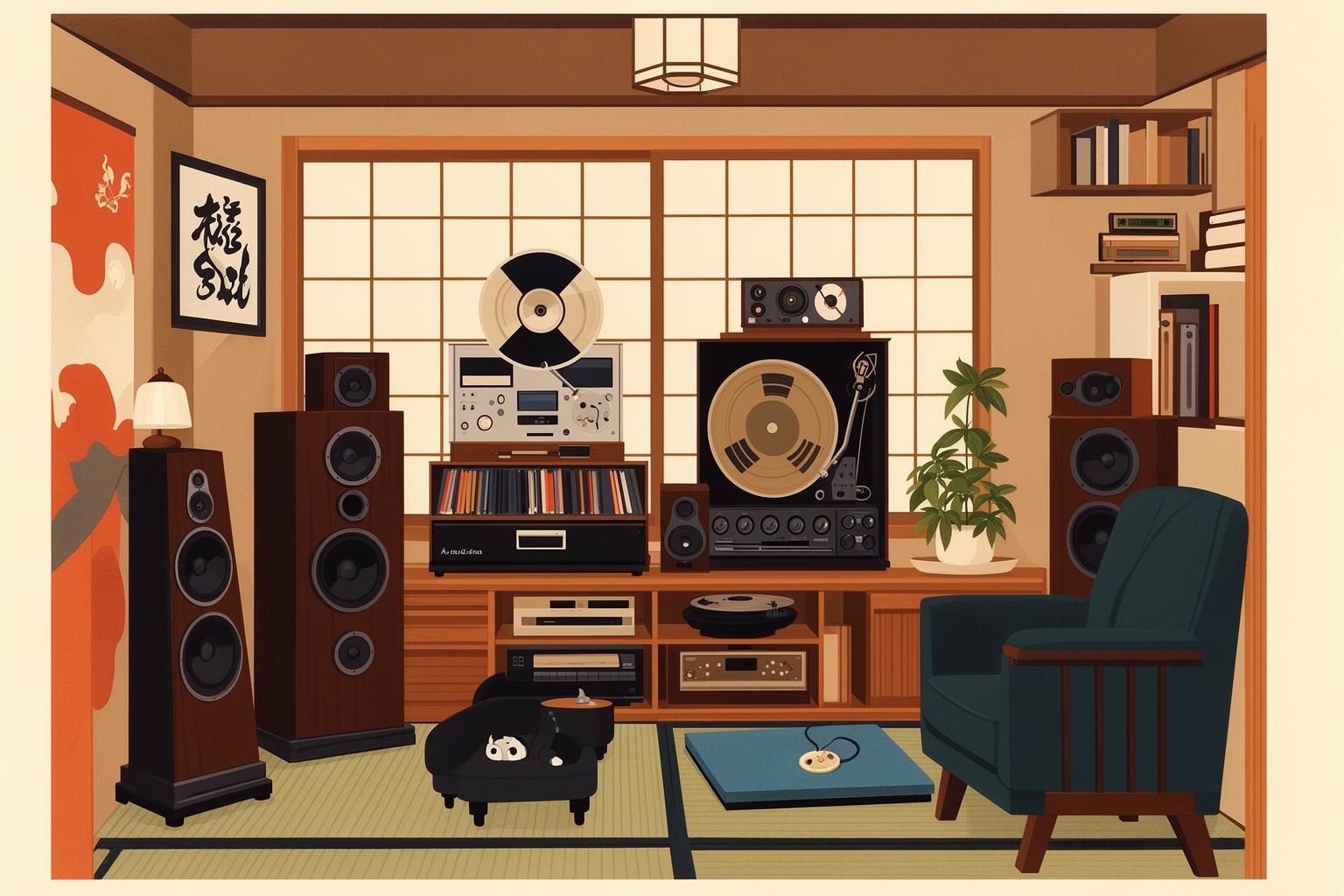
To truly understand why these audio shops hold their equipment in such high esteem, you need to know where and how this gear was intended to be experienced. While the shops serve as the hardware stores, the true temples of this culture are the jazz kissaten (jazz cafes) and meikyoku kissa (classical music cafes).
These are not mere cafes with background music; they are spaces specifically designed for the singular purpose of listening to music on monumental, high-end vintage audio systems. They represent the cultural wellspring from which the entire Japanese audiophile scene originates. Many of these kissaten were established in the ’50s and ’60s when imported records were prohibitively expensive for individuals to own, allowing patrons to hear the latest jazz from America for the price of a cup of coffee.
Entering a classic jazz kissa is like stepping back in time. The air often carries the lingering scent of cigarette smoke from decades ago. The room is dimly lit, the furniture aged and well-worn, and dominating one wall is a sound system that would make any rock promoter envious: massive horn speakers, glowing tube amplifiers, and a professional-grade turntable. Behind the counter stands the master, a stern figure who curates the music with the focus of a symphony conductor.
There is usually a strict rule: no talking, or at least no loud conversation. You are there to listen. Patrons sit alone, nursing a coffee or whiskey, their eyes closed or fixed on the speakers. It is a solitary, meditative, and deeply personal experience—like a public library for sound. Here, the gear is not the ultimate goal; it is the vehicle, the conduit for a deeper connection with the music. It is in the reverent silence of the kissaten that the Japanese philosophy of deep listening was perfected.
Audiophile shops and kissaten exist in a symbiotic relationship. Shop masters supply and maintain the very systems that create these unique sonic experiences, while the kissaten nurture a culture of serious, focused listening that drives demand for high-quality audio equipment. When you visit a vintage audio shop in Japan, you are not merely looking at a collection of old electronics; you are witnessing artifacts of a rich and profound cultural tradition—one that believes music deserves to be heard with utmost respect, care, and the finest tools imaginable.