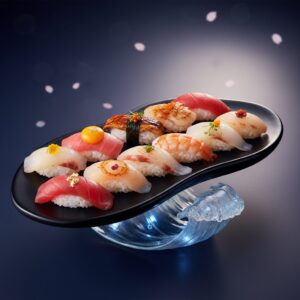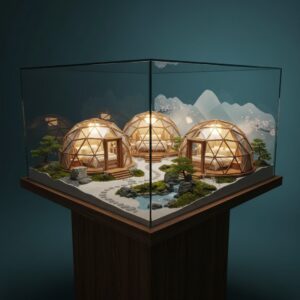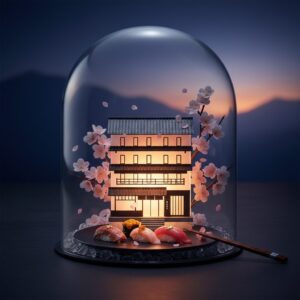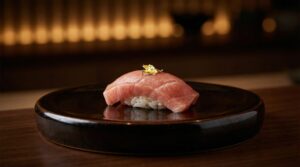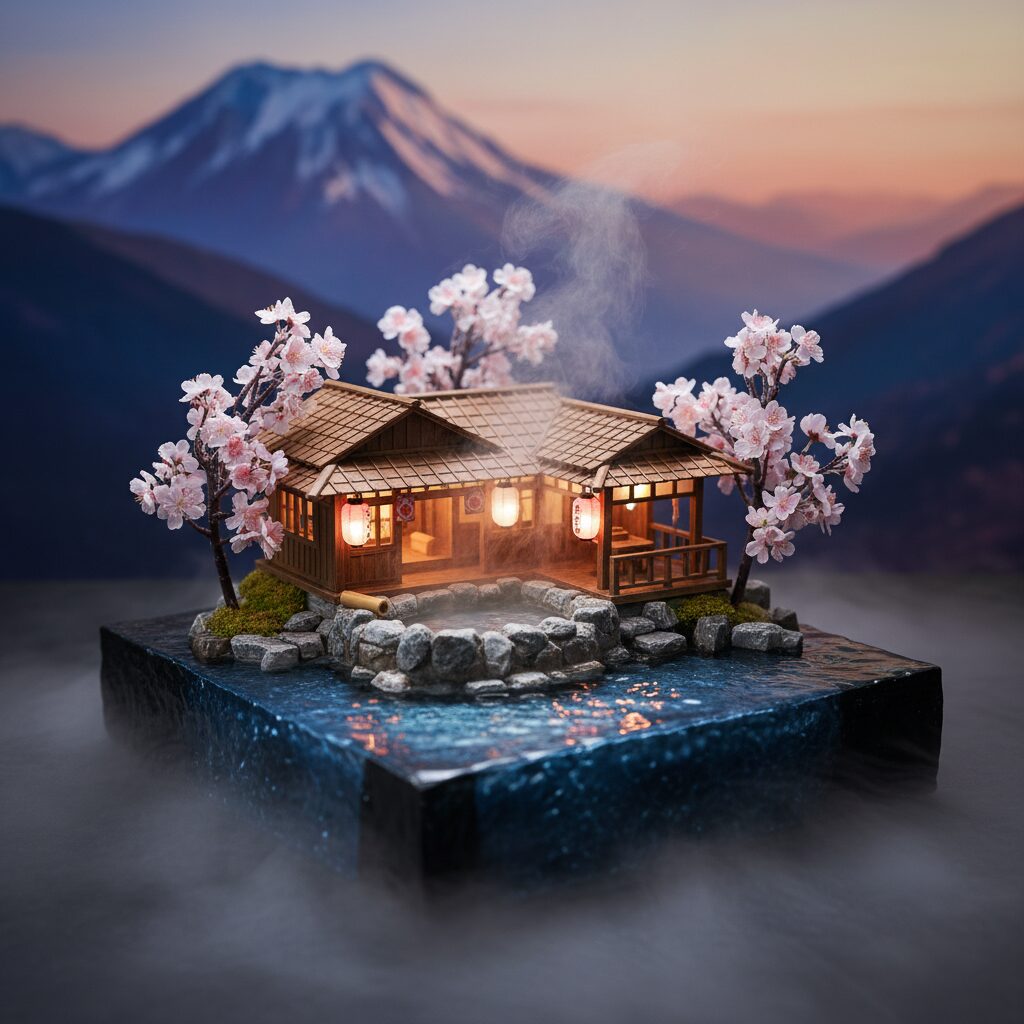
Yo, what’s up? Li Wei here. So, you’ve been doomscrolling through Japan travel inspo, right? You see the aesthetic pics: some influencer chilling in a private hot spring, steam rising into a perfect zen garden, followed by a story swipe to a chef meticulously plating a piece of toro that looks more like art than food. The caption is always something vague and aspirational like “serenity” or “unforgettable.” And you’re probably thinking, “Okay, looks sick, but what’s the actual tea? Is this just a crazy expensive hotel room, or is there something deeper going on?” And for real, that’s the right question to ask. Because this experience—the private onsen villa with your own omakase chef—isn’t just about luxury. It’s not a Western-style, see-and-be-seen resort vibe. It’s a cultural deep dive, a full-blown expression of some core Japanese philosophies that can feel a little confusing from the outside. It’s the peak of an introverted, detail-obsessed approach to luxury that’s, like, the total opposite of a Vegas penthouse party. It’s a low-key flex, but the flex is about taste, tranquility, and ultimate trust, not just dropping a bag. To really get it, you have to unpack the cultural baggage behind the concepts of privacy, nature, and service in Japan. It’s a whole universe, so let’s get into it. This isn’t just a bougie getaway; it’s a masterclass in the Japanese art of disappearing into the perfect moment. We’re talking about places often tucked away in regions known for their natural beauty and hot springs, like Hakone or Izu, where the entire environment is part of the experience.
To fully appreciate the chef’s meticulous plating, it helps to understand Japan’s deep-rooted obsession with seasonal perfection, or ‘shun’.
The Sanctuary of Self: Decoding the Obsession with Privacy
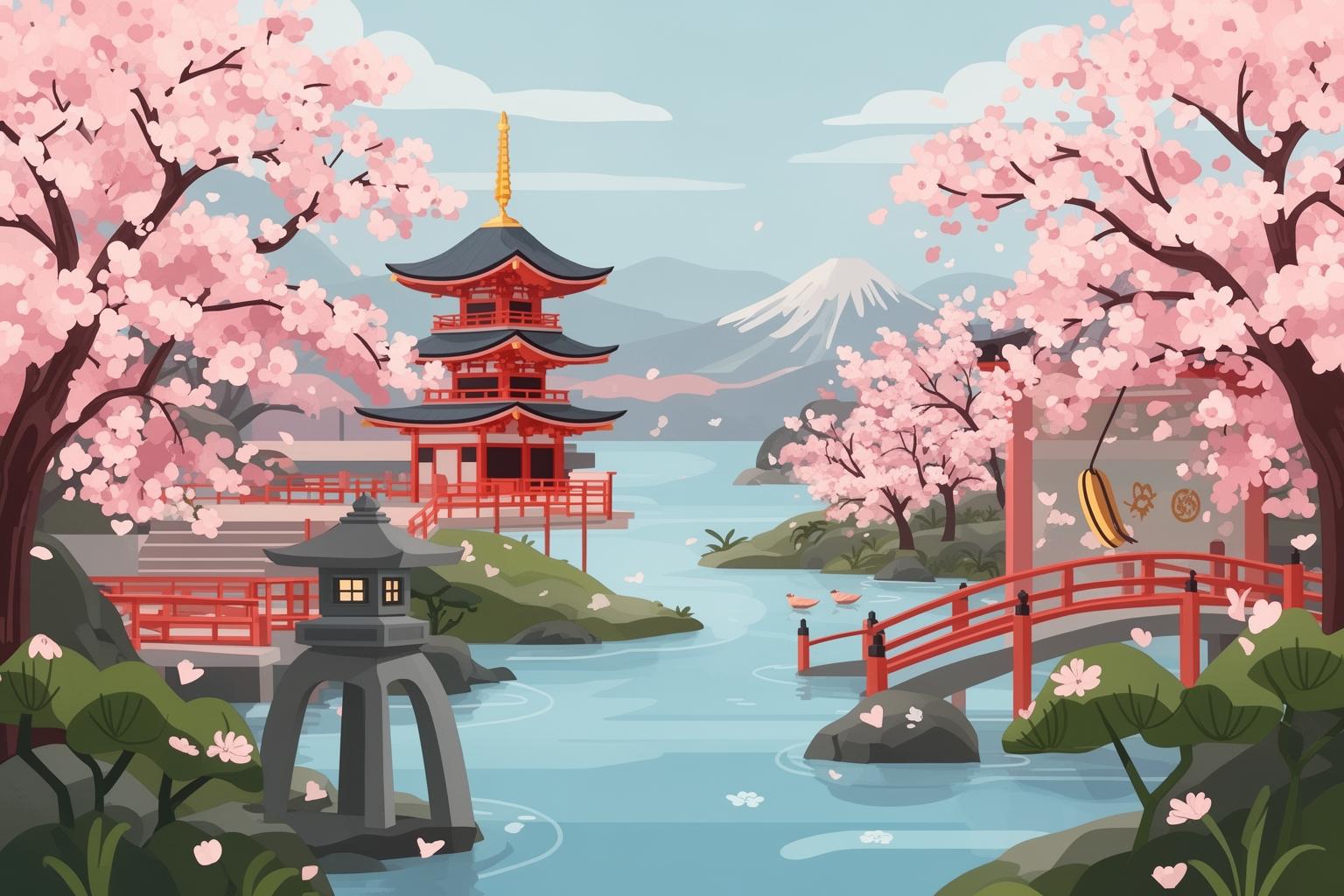
First and foremost, let’s explore why solitude represents the ultimate luxury in this context. In Western culture, luxury often involves performance: reserving the best table at the trendiest restaurant to be seen, lounging by the hotel’s infinity pool to capture the perfect photo. It’s about being part of an exclusive social scene. In contrast, Japanese luxury, particularly at this level, tends to embody the opposite. It’s about crafting a space so flawless and self-contained that you have no urge to leave or be noticed. The aim is to escape from the world, not to showcase yourself to it.
Okomori: The Art of Hibernation as a Status Symbol
The Japanese concept of ‘okomori’ (お籠り) literally means to seclude oneself or hibernate. Traditionally, it carried spiritual significance, akin to a monk retreating to a mountain temple. In modern times, however, it has been adopted by luxury travel. An ‘okomori stay’ involves checking in and ideally not encountering anyone besides your personal attendant and private chef. The entire experience is meant to unfold within the confines of your villa. There’s no lobby to linger in, no communal bar to mingle at. The whole point is to vanish. Why does this hold such appeal? Consider life in a city like Tokyo: a densely packed, high-pressure environment governed by countless unspoken social codes. You constantly navigate crowded trains, work long hours, and maintain your ‘tatemae’ (public facade). The sensory and social overload is overwhelming. An okomori experience transcends mere vacation; it’s a system reboot—a release from social demands. You’re free from performance, existing in a state of perfect, unobserved tranquility. This yearning for privacy is deeply ingrained in Japanese aesthetics and architecture. Take the traditional Kyoto ‘machiya’ (townhouse), for example. From the street, it appears as a modest, unassuming wooden exterior. But step through a narrow passageway, and it opens onto a beautiful private courtyard garden (‘tsuboniwa’) visible only to its residents. The beauty is inward-facing, concealed from the public eye. The private villa is the modern incarnation of this principle. Every element—the architecture, garden, onsen, view—is directed inward, for your exclusive enjoyment. This stands in stark contrast to a Miami hotel balcony designed to overlook a bustling beach scene.
The Villa as a Personal Universe
Understanding the okomori concept requires appreciating the design of these villas. They are not mere rooms; they are carefully curated microcosms. Every detail is deliberate and harmonized. The layout blurs the boundary between indoors and outdoors, often featuring floor-to-ceiling glass walls that fully slide open, merging living areas with private gardens or terraces. Natural, tactile materials abound: fragrant hinoki cypress wood bathtubs, cool slate floors, textured washi paper screens. The underlying philosophy is that your environment profoundly shapes your mindset. By crafting a space of utter serenity and natural beauty, the villa itself becomes therapeutic. It is a controlled setting designed to systematically dismantle stress. The sound of water trickling from a bamboo fountain, the aroma of wooden beams, the sight of moss on a stone lantern—these are not mere decorations, but carefully designed sensory inputs to induce calm. This approach contrasts sharply with the luxury of a European palace hotel, where grandeur, history, and public spectacle define opulence. Here, luxury lies in impeccable simplicity and seamless harmony with nature.
More Than a Hot Tub: The Soul of the Onsen
Alright, so we’ve set the tone with privacy. Now, onto the highlight: the private onsen. To someone unfamiliar, a hot spring might just look like a warm bath—a natural jacuzzi. But in Japan, onsen (温泉) culture runs much deeper. It’s connected to spirituality, community, and the nation’s identity as a volcanic archipelago. Grasping this is essential to understanding why having a private onsen is such a significant matter.
A Ritual of Purification, Beyond Mere Hygiene
The relationship between water and purity is a cornerstone of Japanese culture, mainly due to Shintoism, the native religion. In Shinto, purification rituals called ‘misogi’ (禊) use water to cleanse ‘kegare’ (impurity or spiritual pollution). Although soaking in an onsen isn’t a formal religious rite, this cultural view infuses the experience. Being in an onsen is about more than just physical cleanliness; it symbolizes a cleansing of mind and spirit. It offers a chance to wash away workday stress, social worries, and city grime. The geothermally heated, mineral-rich water is regarded as a gift from the earth with healing qualities. For centuries, people have journeyed to ‘tōji’ (湯治), or hot spring healing resorts, to treat ailments. So, soaking in that water means engaging in a tradition that views this as a potent, almost medicinal act. It’s holistic therapy bestowed by nature.
Communal Bathing Versus the Ultimate Sanctuary
Traditionally, onsen bathing is communal. Visitors go to a ‘sento’ (public bathhouse) or large public baths at a ‘ryokan’ (traditional inn). There’s an entire etiquette: washing carefully beforehand, avoiding splashing, maintaining quiet. It’s a beautiful, shared cultural ritual. But honestly, it can also be daunting. For foreigners, there’s the fear of breaking the rules. For tattooed individuals, often linked to the yakuza (Japanese mafia) in many areas, admission may be refused entirely. Even many modern Japanese find the prospect of being naked with strangers or coworkers stressful. The private onsen—whether a ‘kashikiri-buro’ (private, reservable bath) or a ‘heya-buro’ (an onsen attached to your room)—offers the answer. It delivers the spiritual and physical benefits of the onsen without social unease. A ‘heya-buro’ in a villa is the ultimate expression of this. It’s not simply a private bath; it’s your onsen. You can use it anytime, for as long as you please. You might watch the sunrise from it at 5 AM or gaze at the stars at midnight. Here, the experience transcends the ordinary. It’s no longer merely a bath; it’s your own private gateway to nature. Often, the tub itself is an artwork—carved from stone, crafted from fragrant wood, or designed with an infinity edge that seems to pour into the surroundings. The view is essential, non-negotiable. You won’t be looking at a tiled wall. Instead, you’re immersed in nature—a bamboo forest, a distant mountain scene, or a carefully raked zen garden. Soaking while witnessing the changing seasons becomes a form of meditation, an expression deeply rooted in Japanese aesthetics that embraces beauty in the imperfect and ephemeral, a concept called ‘wabi-sabi’.
The Chef in Your Kitchen: Omakase as a Private Performance
Now, for the second act of this extraordinary luxury experience: the in-room omakase. You’re relaxing in your yukata, your post-onsen glow fully radiating, when a master chef steps into your private dining space to cook exclusively for you. This is far more than just dinner; it’s a private concert, with the food serving as the music. To truly grasp why this is so remarkable, we need to unpack the concept of ‘omakase’ itself.
Omakase: The Art of Absolute Trust
‘Omakase’ (お任せ) means “I’ll leave it up to you.” It signifies a total surrender of control to the chef. There’s no menu, no choices to make. You place your trust in the chef’s expertise, their knowledge of seasonal ingredients, and their artistic vision. This is a deeply Japanese cultural principle. In Western fine dining, choice is often a hallmark of luxury. You peruse an extensive wine list, select your appetizer, main, and dessert. Omakase turns this notion on its head. The luxury lies in being relieved of the burden of choice. It reflects profound respect for the ‘shokunin’ (職人)—the master craftsman dedicated to perfecting their art. You are not merely a customer purchasing a meal; you are a patron engaging with an artist. You trust that, with their years of experience, the chef knows best what you should eat on this particular day, at this exact moment, better than you do. This relationship demands humility from the diner and immense responsibility from the chef. The chef’s reputation hinges on every piece served. They source the finest ingredients from that very morning’s market, factoring in weather, temperature, and even your presumed mood to craft a narrative on the plate.
The In-Villa Experience: Front Row Seats to Mastery
Now, imagine transferring this intense, trust-driven omakase experience from a small, 8-seat sushi counter in Ginza to your private villa. The encounter becomes tremendously more personal and profound. The chef’s attention isn’t divided among multiple patrons; their entire focus, their entire performance, is dedicated to you. This elevates the meal from a transaction to a conversation. The chef often shares the provenance of each ingredient: “This ‘uni’ (sea urchin) comes from a specific bay in Hokkaido, harvested this morning by a fisherman I’ve known for twenty years. Due to a recent typhoon, the kelp it feeds on is especially rich, which is why today’s flavor is so sweet.” You’re not just eating; you’re receiving a story. You witness the craft firsthand—the knife skills so precise they seem magical, the delicate shaping of the ‘shari’ (sushi rice), the single brushstroke of soy sauce. It’s an intimate, enlightening, and almost theatrical experience. The line between creator and consumer vanishes. From a Chinese cultural viewpoint, this parallels the tradition of hiring a private chef for an important family banquet—a profound gesture of respect for guests by arranging a master to create something uniquely for them. Yet, the Japanese version is often quieter, more ingredient-focused, and highlights the one-on-one interaction with the artisan, embodying the ‘shokunin’ spirit. It’s less about social display and more about quiet, deep appreciation of the craft.
Kaiseki vs. Sushi Omakase: The Culinary Narrative
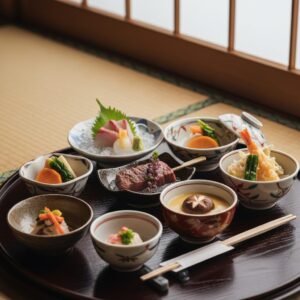
It’s also worth noting that the in-room chef might not only prepare sushi. Often, it’s a ‘kaiseki’ (懐石) experience—a traditional multi-course Japanese meal. If omakase is like a curated playlist, kaiseki is a full opera. It’s a meticulously structured meal with a deliberate progression of courses, each showcasing different cooking techniques (simmering, grilling, frying) and seasonal ingredients. A kaiseki meal weaves a story. It follows a rhythm and flow, beginning with delicate appetizers, moving to sashimi, soup, grilled dishes, and concluding with rice, pickles, and a light dessert. The chef in your villa is not merely a cook but a conductor, guiding you through this culinary performance. Every detail is thoughtfully considered—from the charcoal used to grill the fish to the pottery chosen for each course, selected to complement the food and the season. A spring kaiseki might be served on light green ceramics adorned with cherry blossoms, while an autumn meal features deep reds and oranges on rustic, earthy stoneware. Experiencing this in your villa allows full immersion in the narrative without distractions. The pacing is tailored entirely to you. There’s no pressure from other diners or the need for table turnover. It is, in essence, the ultimate personalization of a centuries-old culinary art.
The Synthesis: Why This Combo is the Apex Experience
So, why does the combination of a private villa, a private onsen, and a private chef represent the pinnacle of Japanese luxury? Because it unites these essential cultural values into a seamless, perfectly enclosed realm of excellence. It embodies the ultimate expression of the pursuit of privacy, reverence for nature, and deep respect for craftsmanship.
Omotenashi, Intensely Personalized
You’ve probably heard the term ‘omotenashi’ (おもてなし), Japan’s renowned style of hospitality. While often translated as ‘wholehearted hospitality,’ it carries a more subtle meaning. It involves anticipating a guest’s needs before they even arise, often through quiet, unspoken gestures. It’s selfless and asks for nothing in return. In a large ryokan or hotel, this omotenashi is shared among many guests; in a private villa, it is concentrated like a laser beam, focused entirely on you. Your dedicated attendant, or ‘nakai-san,’ learns your preferences intimately—they know you like your morning tea at a specific temperature or prefer your onsen a bit hotter. The chef may recall you particularly enjoyed a certain fish and thoughtfully include it again in a different dish. This level of service is nearly invisible. Everything simply unfolds perfectly: your yukata is prepared, lanterns light the path to the onsen at dusk, a post-dinner digestif appears on your terrace. The environment is meticulously designed to eliminate every point of friction. During your stay, you needn’t think, plan, or request anything. This enables a state of mental calm, rarely attainable in everyday life.
Reality vs. Expectation: Is It Worth It?
Now, the key question: with costs often reaching thousands of dollars per night, is it truly worth it? Honestly, the answer depends entirely on your values. If your ideal vacation is filled with adventure, socializing, and high-energy activities, this experience is definitely not for you. You might feel isolated and quite frankly, bored. The silence can be overwhelming if unprepared. The pace is slow, almost meditative. The luxury is understated—found in the wood’s grain, the temperature of the water, the harmony of flavors in a single bite. It’s not about spectacle. But for those who are overworked, exhausted, and longing for genuine tranquility, it can be transformative. It’s an investment in your well-being—a chance to disconnect fully from life’s demands and reconnect with yourself and nature in a highly curated, deeply comfortable environment. The “wow” moments are quiet: the cool night air on your face while warm in the onsen; the dish so beautifully presented you hesitate to eat it; waking to mist drifting through pine trees in your private garden. This is a mature, introspective kind of luxury that offers not excitement but profound, soul-deep rest. It is the ultimate expression of a culture that for centuries has perfected finding richness in simplicity and tranquility.