Ever found yourself scrolling online or wandering through a high-end kitchen store, only to be stopped dead in your tracks by a Japanese knife? You know the one. It’s sitting in a velvet-lined box, looking more like a museum artifact than something you’d use to chop carrots. It has a price tag that could cover a month’s rent, a name you can’t pronounce, and a waitlist longer than a Monday morning. Your first thought, and you’d be forgiven for it, is probably something like, “Okay, seriously? Is this whole thing for real, or is it just next-level marketing for people with too much money?” It’s a fair question. In a world of disposable everything, the intense, almost spiritual reverence for a simple kitchen tool feels… extra. It feels like hype. But what if I told you it’s not? What if I told you that the secret to understanding that thousand-dollar knife isn’t found in a modern kitchen, but on an ancient battlefield? The story of the Japanese knife is inextricably linked to the story of the samurai, and the soul of their legendary sword, the katana, is very much alive and well. It’s just been reforged for a new kind of battle: the one for the perfect slice. This is the deep-dive, the cultural unpacking of how centuries of warrior philosophy, spiritual craftsmanship, and national upheaval funneled down into the blade you see today. This is the ‘why’ behind the razor-sharp edge. So grab a cuppa, and let’s get into it. We’re heading to the heart of Japan’s blade country, at least spiritually, to figure this whole thing out.
This philosophy of a single, decisive cut is also what makes the climactic duels in samurai cinema so uniquely compelling.
The Soul of the Sword: Deconstructing the Katana Myth
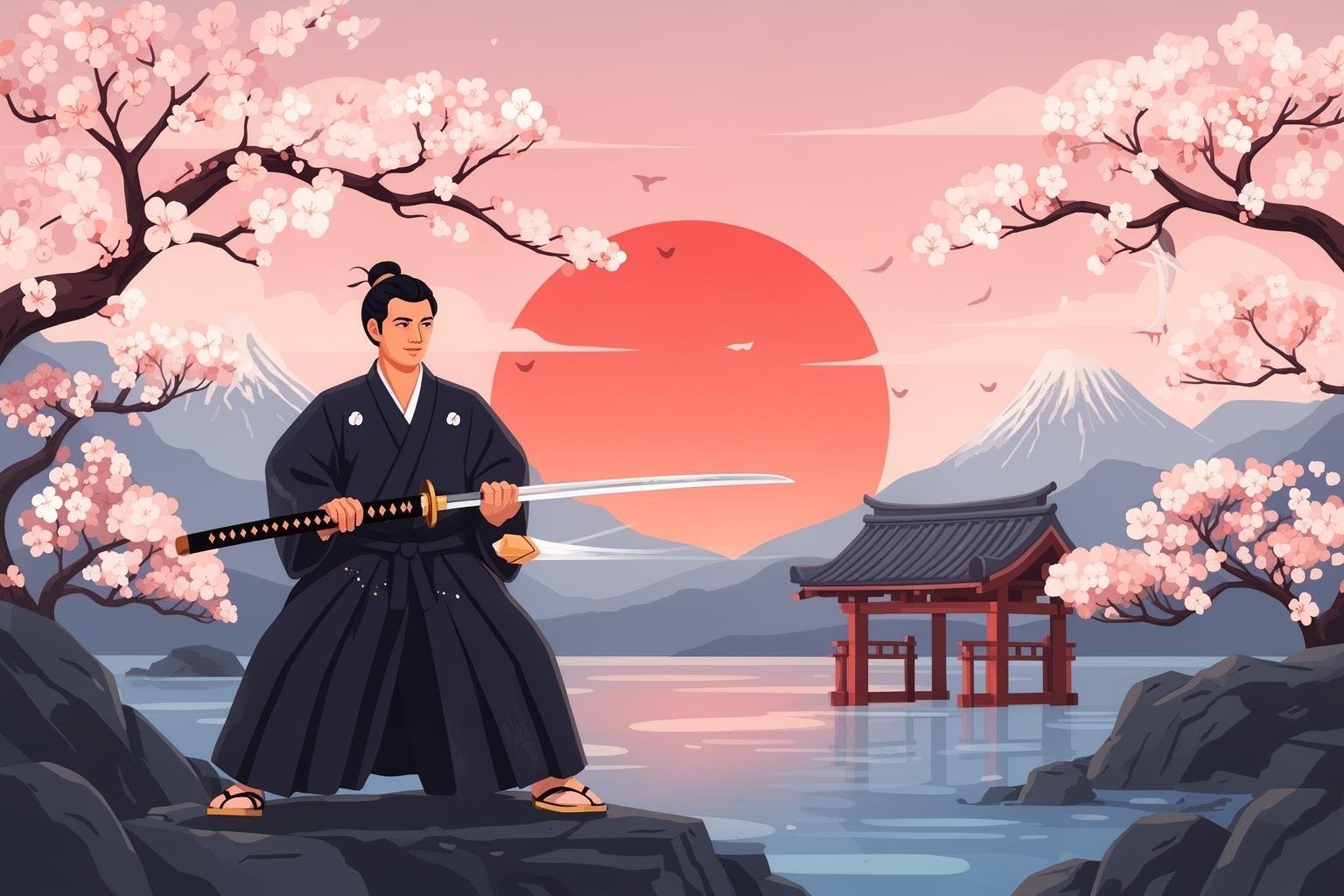
To understand why Japanese knives are the way they are, you first need to grasp the original blade icon: the katana. Honestly, our pop-culture perception of it is somewhat distorted. We see it as an unrivaled weapon from movies and anime—essentially a steel lightsaber. But in samurai-era Japan, the sword was far more than just a combat tool. It was a status symbol, a masterpiece, and most importantly, a tangible expression of the warrior’s soul.
More Than Just a Weapon: The Katana as a Symbol
The bond between a samurai and his sword was deeply personal and philosophical, governed by Bushido, the unwritten code of the warrior. This code stressed virtues like discipline, integrity, loyalty, and honor. The katana embodied these ideals. Its sleek design symbolized purity of purpose, and its razor sharpness represented the decisiveness and martial skill of its owner. A samurai’s honor and his sword were inseparable. To lose one’s sword, or to have it taken, was to lose one’s honor—a fate often deemed worse than death.
This reverence extended throughout the creation process. A swordsmith was not merely a metalworker but a spiritual artisan, a master craftsman balancing the physical and the divine. The forging process involved Shinto rituals. The smith underwent purification rites, donned specific ceremonial attire, and decorated his forge with sacred ropes (shimenawa) to repel evil spirits and invite benevolent kami (deities) to aid in the sword’s creation. It was believed that a truly great sword could not be forged by human hands alone; it required divine intervention. The smith wasn’t just shaping steel; he was imbuing the blade with a soul. This belief—that an object carries the spirit and intention of its maker—is a fundamental idea that directly influences modern knifemaking. The notion that an object can possess a soul isn’t just poetic; it’s a deeply rooted cultural conviction that governs the care and respect afforded to it.
The Art of the Fold: What Made the Katana So Legendary?
The katana’s almost mythical reputation wasn’t just philosophical; it stemmed from revolutionary, and frankly, incredibly challenging metallurgy. Japanese swordsmiths faced a significant problem: their local iron sand (satetsu) yielded poor-quality steel—brittle and full of impurities. They couldn’t simply melt and cast it into a sword mold. Instead, they had to develop a process to literally beat the flaws out of the metal and create something extraordinary from substandard materials. This necessity gave rise to legendary innovation.
Tamahagane: The Jewel Steel
The process began with producing the raw material—a special steel called tamahagane, or “jewel steel.” This was crafted in a large clay furnace known as a tatara. For three days and nights, the tatara was continuously fed with iron sand and charcoal, reaching extreme temperatures. The result was not a neat steel ingot but a large, spongy bloom full of impurities and varying carbon content. The master smith would then carefully break down this bloom, judging each piece by color and fracture pattern, separating high-carbon steel—hard but brittle—from low-carbon steel, softer and more ductile. These two types of steel formed the sword’s foundation. This meticulous selection, even from flawed material, exemplifies the Japanese dedication to detail from the very start.
Forging and Folding: Creating Strength from Imperfection
Here’s the well-known part: folding. But the why behind folding is crucial. The selected high-carbon steel pieces were heated, hammered flat, folded over, and forge-welded repeatedly—ten, twelve, even fifteen times. This wasn’t just for aesthetics. Each fold served two essential purposes. First, it expelled impurities from the original tamahagane; you could visibly see slag being hammered out with every strike. Second, it evened out the carbon content throughout the steel, producing a uniform structure. A blade folded 15 times would have 2^15, or 32,768, individual layers. This layered structure, akin to an advanced Damascus steel, created an incredibly resilient, break-resistant blade—vastly superior to the brittle metal it began as. This painstaking transformation of raw, imperfect material into sublime quality lies at the craft’s core.
The Differential Hardening Clay: The Secret to the Curve
This is where the true genius—and the understated secret—of the katana emerges. A blade must be hard to maintain a sharp edge but not so hard that it shatters on impact; it needs flexibility to absorb shocks but mustn’t be too soft or the edge will dull quickly. How to achieve both? The solution was a method called differential hardening, or yaki-ire. The swordsmith coated the forged blade with a special, secret clay mixture including charcoal powder and other ingredients. The coating wasn’t uniform: a thick layer covered the spine and sides, while a thin, carefully sculpted layer coated the cutting edge. The blade was then heated to a precise temperature and quenched in water. The thin clay over the edge allowed it to cool almost instantly, transforming the steel’s molecular structure into hard martensite—the hagane, or razor-sharp cutting edge. Meanwhile, the thick clay on the spine insulated it, causing slower cooling and forming a softer, more flexible pearlite—the shingane, or shock-absorbing spine. This process did two remarkable things: it created a hybrid blade with a glass-hard edge and a tough, springy body, and it gave the blade its iconic, elegant curve. The visible line between hard edge and soft spine is called the hamon, a unique, cloud-like pattern that serves as both the smith’s signature and proof of a successful quench. It is, essentially, the sword’s soul made visible.
The End of an Era: What Happened to the Swordsmiths?
For centuries, this art was the pinnacle of Japanese craftsmanship. But history intervened. In 1868, the Meiji Restoration modernized Japan, ending feudalism. The samurai, the warrior elite who had supported swordsmiths for nearly a thousand years, were dissolved. In 1876, the government issued the Haitorei Edict banning the public carrying of swords. This was a devastating blow. The demand for katanas—these artisans’ lifeblood—vanished overnight. Thousands of master swordsmiths, heirs to a craft passed down through generations, suddenly found themselves relics, their profound skills rendered obsolete by a single decree. Their entire world disappeared, and the blade’s soul was nearly lost forever. This crisis, this near extinction of a tradition, marks a critical turning point. It’s where the warrior’s spirit had to find a new form.
From Battlefield to Kitchen: The Great Pivot
The fall of the samurai class triggered an existential crisis for Japan’s bladesmiths. With their main clientele disappeared, they faced a clear choice: adapt or vanish. Their craft was too deeply rooted, their skills too exceptional to simply fade away. So, they shifted direction. They applied the same principles and profound knowledge of steel, fire, and water—used to forge weapons of war—to crafting tools for peace and everyday life. The spirit of the katana didn’t perish; it transformed. It moved from battlefields and castles into the heart of the Japanese home: the kitchen.
Survival of the Sharpest: A New Purpose for an Ancient Craft
Master artisans once producing blades for powerful daimyos began crafting hocho (kitchen knives), scissors, razors, and agricultural implements. This was never viewed as a downgrade. The ethos of craftsmanship endured. Whether forging a sword to take life or a knife to slice a daikon radish, the pursuit of perfection remained constant. The commitment to creating the finest tool for each task was unwavering. Entire towns, whose economies had revolved around sword production for centuries, led this transformation. Places like Seki in Gifu Prefecture and Sakai in Osaka—once bustling centers of katana forging—redefined themselves as hubs of premium cutlery production. They already possessed the infrastructure, multi-generational knowledge, and, crucially, the right cultural mindset. They simply redirected their mastery into a new form. Today, when you visit these towns, the history is palpable. The quiet workshops, the rhythmic sound of hammers striking steel—it’s a continuous lineage reaching back to the samurai era. They endured by demonstrating that true mastery is adaptable.
The Katana’s DNA in a Kitchen Knife: Tracing the Lineage
Examining a high-quality Japanese kitchen knife reveals more than just a sharp blade. It carries the spirit of the katana. The design principles, metallurgical methods, and philosophical foundations were transferred almost directly from sword to kitchen tool. It’s a remarkable example of cultural and technological evolution.
The Philosophy of Specialization
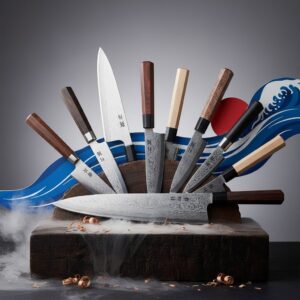
Consider the samurai’s weaponry. There was no single all-purpose blade. He wielded the long katana for open combat, the shorter wakizashi for indoor fighting, and the tanto dagger for close quarters. Each blade was specialized, perfectly suited to its specific role. This specialization philosophy is mirrored in Japanese kitchen knives. Unlike the West, which favors the all-purpose chef’s knife, Japan embraces a family of blades each designed for a distinct task. The long, slender yanagiba slices raw fish for sashimi in one smooth pull to produce a flawless surface. The thick, heavy deba acts as a cleaver for butchering and filleting whole fish, strong enough to cut through bones. The usuba, single-beveled and rectangular, is crafted for paper-thin vegetable slices using the katsuramuki technique. For home cooks, the versatile santoku (“three virtues” for slicing, dicing, and mincing) and the nakiri, a double-beveled vegetable knife, are common. This isn’t about redundancy—it’s the belief that using the perfect tool maximizes efficiency and precision, resulting in superior outcomes. This mindset stems directly from the samurai’s martial efficiency.
The Steel Legacy: Lamination and Hardness
The katana’s genius dual-structure—a hard edge backed by a softer spine—was too valuable to discard. Crafting a true differential temper on a small kitchen knife is painstaking and costly, so smiths adapted the principle through lamination. This is the san-mai, or “three-layer,” construction frequently seen. A core of extremely hard, high-carbon steel (the hagane) is forge-welded between two outer softer, often stainless, steel layers (the jigane). This innovation offers the best of both worlds. The core can be hardened to an incredible degree (often 60–65 on the Rockwell scale, versus 56–58 for most German knives), resulting in an extraordinarily sharp edge with excellent edge retention. However, this hard steel is brittle and prone to rust. The softer, stainless cladding protects the core, adding toughness, reducing chipping, and simplifying maintenance. Often, the lamination line is visible near the blade’s edge as a faint, wavy border resembling the hamon on a katana. This is a modern expression of the same core concept: melding hardness with toughness for ultimate performance.
The Unseen Craft: Tang, Balance, and the ‘Wa’ Handle
The essence of the blade lies not only in the steel but also in ergonomics and construction. Like the katana, a Japanese knife is designed to feel like an extension of the hand. The balance is carefully calibrated, often centered just forward of the heel to promote a proper pinch grip, giving the blade a nimble, lively feel. The nakago, or tang—the portion of the blade that extends into the handle—is precisely shaped and fitted. While many Western knives feature a full tang with riveted slabs, traditional Japanese knives often employ a partial, hidden tang that is heated and burned into a wooden handle for friction fit, sometimes secured with a buffalo horn ferrule. This makes the knife significantly lighter. The handle itself, known as the Wa handle, is a minimalist work of art. Typically crafted from light, water-resistant woods such as magnolia, they come in octagonal, D-shaped, or oval forms. These shapes are intentional, designed to provide a secure, comfortable grip that offers excellent control for precise cuts. Every detail, from the blade’s grind to the handle’s shape, is the product of centuries of refinement aimed at perfecting the union between user and tool. This obsession with a seamless man-machine interface embodies pure samurai DNA.
The Modern Bladesmith: Keeper of the Flame
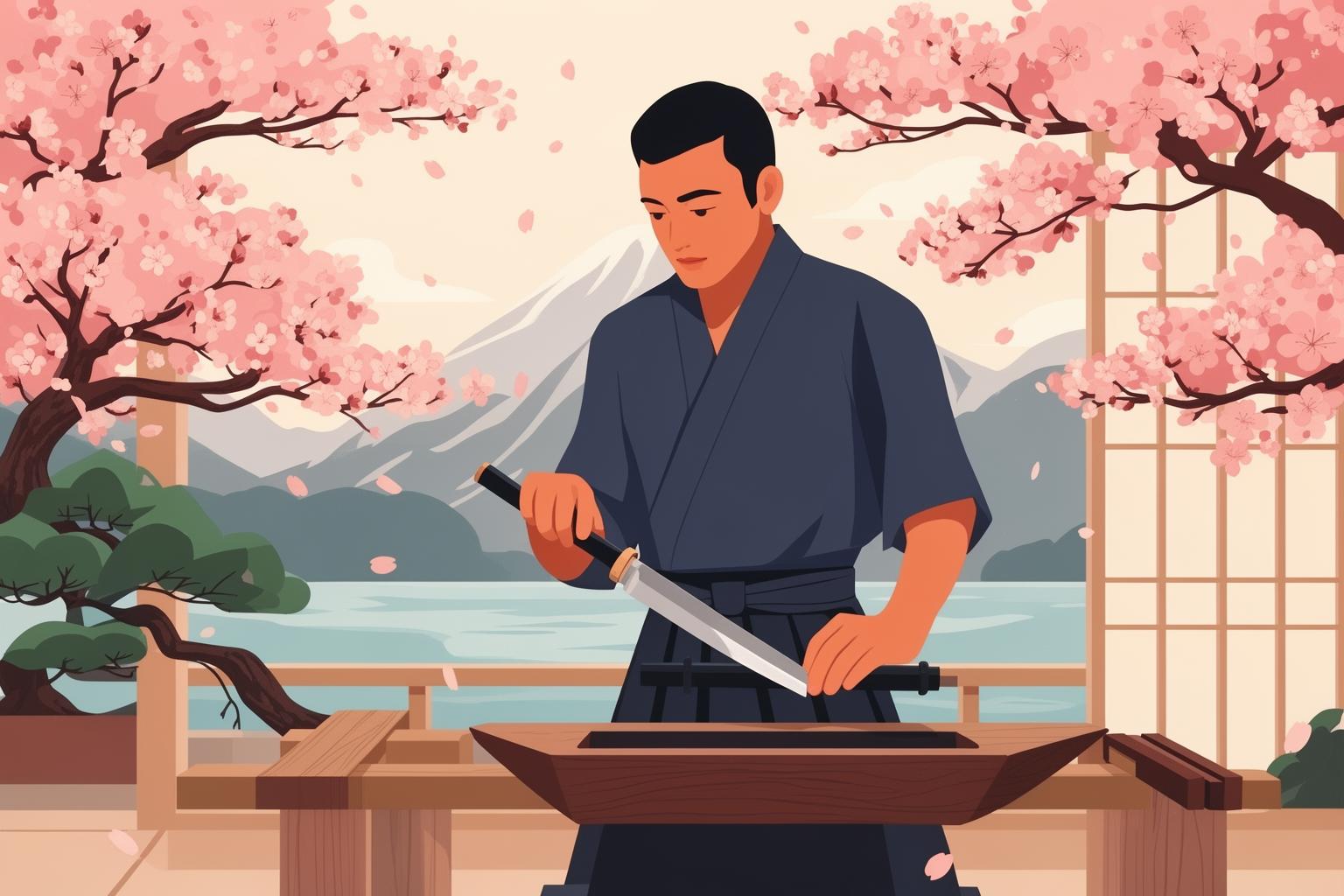
So, who is actually crafting these knives today? The image of a solitary, ancient master hammering away in a mountain forge isn’t entirely inaccurate, but it doesn’t tell the whole story. Modern Japanese bladesmithing is a captivating blend of steadfast tradition and cutting-edge innovation, where the spirit of the past lives on—not as a museum relic, but as a vibrant, evolving craft.
The Artisan’s Atmosphere: Not a Factory, but a Workshop
Dismiss the notion of vast, automated factories. Most high-end Japanese knives originate from small, often family-run workshops. Walking into one feels like stepping back in time. These spaces are usually cramped, dusty, and filled with the deafening chorus of trip-hammers, grinding wheels, and the sizzle of hot steel hitting water. It’s a gritty, hands-on world where skill is measured by callused hands and an instinctive connection to the metal. The craft is generally passed down through a rigorous apprenticeship system reminiscent of the feudal era. Apprentices spend years—sometimes over a decade—under the watchful guidance of a master (shokunin). The early years may involve nothing but cleaning, fire management, and hammering scrap metal. Learning happens through observation, repetition, and touch. There are no detailed manuals; knowledge is transferred by doing—a form of physical osmosis. This deep, long-term commitment lies at the heart of shokunin—an artisan who pursues not just a trade, but spiritual and technical perfection in their craft. This dedication explains the respect smiths earn and the soul imbued in their blades. Their entire life is reflected in that knife.
Steel in the 21st Century: Tradition Blends with Technology
While the techniques remain traditional, the materials have evolved. Modern bladesmiths often work with cutting-edge “super steels.” Names like VG-10, SG2 (or R2), ZDP-189, and the renowned Aogami Super (Blue Super Steel) are common. These advanced alloys and powdered steels are engineered to deliver extreme hardness, wear resistance, and corrosion resistance—modern equivalents of tamahagane. Smiths embrace these materials because they help achieve the age-old goal: the ultimate cutting edge. The philosophy endures, even as tools and materials progress. This sparks lively debate within the community. Purists insist on traditional high-carbon steels like White Steel (Shirogami) or Blue Steel (Aogami), which are reactive, prone to rust, and require careful maintenance. Yet they are incredibly pure, easy to sharpen to a razor edge, and offer a unique cutting “feel” cherished by connoisseurs. Conversely, advocates for modern stainless and semi-stainless steels highlight their exceptional performance with minimal upkeep. This tension between tradition and innovation illustrates that the craft is dynamic, constantly evolving while honoring its origins.
Understanding the Price: More than Just a Knife
This brings us back to the core question: why such a high price? When purchasing a handmade Japanese knife, you’re not buying a mass-produced item. You’re paying for time and mastery—the decades the master smith has devoted to perfecting his art. You cover the countless hours of skilled manual labor: forging, precision grinding of the blade geometry, meticulous hand-sharpening on successive whetstones, polishing, and handle fitting. You’re paying for low production volume; a single artisan might produce only a few knives each month. Most importantly, you’re investing in cultural heritage. You’re acquiring a small fragment of a legacy stretching from the samurai era, through the Meiji Restoration, right up to today. It’s like buying an original painting rather than an Ikea poster: both will adorn your wall, but only one carries the artist’s skill, vision, and soul. A handmade Japanese knife is functional art, a tool with a centuries-old story—that’s what the price truly reflects.
Using the Blade: A Different Kind of Cutting
Owning a high-quality Japanese knife is one thing; using it properly is quite another. The design of these blades requires a different cutting technique, one that is fundamentally based on the principles of efficiency and respect, much like the samurai’s approach to wielding his sword. It’s about finesse rather than force. And with that finesse comes a certain responsibility.
The Cut, Not the Chop: A Philosophy of Motion
Many Western kitchen knives, especially German ones, tend to be heavier with a more pronounced curved belly. They are designed for a “rock-chopping” motion, where the tip of the knife remains on the board, and the blade rocks back and forth. This is a powerful and effective technique. Japanese knives, by contrast, are usually lighter, thinner, and flatter in profile. They are not intended for heavy chopping or hacking through bones or frozen foods, as this can easily chip their hard, thin edges. Instead, they shine at slicing. The proper methods involve the push-cut (pushing the blade forward and down through the food) or the pull-cut (drawing the blade back towards you, like with a sashimi knife). The motion is smooth and precise, allowing the knife to do the work. This approach derives directly from swordsmanship. The samurai’s cut was a clean, slicing draw—not a forceful hack. Applying this technique in the kitchen minimizes cell damage to ingredients. A cleaner cut reduces oxidation, better preserves texture and flavor, and produces a more appealing presentation. This principle underpins washoku (traditional Japanese cuisine), where the natural flavors of ingredients take center stage. The knife is not simply a tool for cutting food into smaller pieces, but an instrument that maintains the food’s integrity.
The Responsibility of Ownership: More Than Just Washing Up
In the West, knife care often consists of little more than a quick pass with a honing steel and avoiding the dishwasher. In Japan, however, caring for your blade is an essential part of ownership. It’s a ritual that honors both the tool and the craftsman who made it. This entails learning to sharpen your knife on a progression of Japanese water stones, or toishi. While a honing steel merely realigns an edge, whetstones actually grind the steel to form a new, refined cutting edge. This is a meditative and skillful process that fosters a deeper connection to your tool. For reactive carbon steel blades, it also means thoroughly cleaning and drying them immediately after use and often applying a thin layer of camellia oil to prevent rust. Proper storage is important too—ideally on a magnetic strip or in a wooden block, never tossed haphazardly in a drawer. Though this may seem demanding, it transforms the relationship. You’re no longer just a user but a caretaker. Just as a samurai carefully cleaned and oiled his katana after every use, the owner of a fine Japanese knife is expected to actively maintain it. This commitment elevates the knife from a mere utensil to a treasured possession.
So, Is It Worth It for My Kitchen? A Reality Check
Let’s be frank. Are these artisanal blades suitable for everyone? Definitely not. If your cooking involves prying open cans, hacking at frozen chicken, and then tossing the knife in the sink to soak, buying a handcrafted Japanese knife would be an utter waste. You’d ruin it. But if you genuinely enjoy cooking, find joy in the precise preparation of ingredients, appreciate fine craftsmanship, and are willing to learn the necessary techniques and maintenance, then yes, it’s absolutely worth it. Using a truly sharp, well-balanced knife is a transformative experience. It makes prep work faster, more precise, and far more enjoyable. It can completely change how you relate to being in the kitchen. For those wanting to experiment, you don’t need to start with a highly specialized, single-bevel usuba. A versatile gyuto (the Japanese equivalent of a chef’s knife) or a santoku from a reputable maker offers excellent Japanese performance in a familiar shape—a perfect gateway into this captivating world.
The Enduring Soul of the Blade
So, we return full circle to that knife resting in its velvet box. Is it mere hype? No. It’s heritage. The deep respect for a Japanese kitchen knife is not a recent marketing creation. It is the natural outcome of a cultural narrative spanning centuries. It forms a direct, unbroken link between the highest ideals of the samurai warrior and the simple act of preparing a meal.
A Legacy Reforged
Though the samurai have disappeared from Japan’s hills and castles, their spirit—the relentless quest for perfection, profound respect for their tools, and philosophy of precision and discipline—proved too enduring to vanish. It simply took on a new form and purpose. It was reforged, hammered, and quenched into the shape of a kitchen knife. The blacksmiths who no longer had warriors to arm turned their craft towards nourishing the nation, embedding the warrior’s soul into the heart of the home. When you lift a beautifully crafted Japanese knife, you feel it immediately. The lightness, the perfect balance, the razor-sharp edge. It feels less like a lifeless object and more like a living extension of your own intention. You hold the result of a thousand years of trial and error, a piece of cultural DNA passed through generations of fire and steel. You hold the quiet, sharp spirit of the samurai, ready to assist you in making dinner.