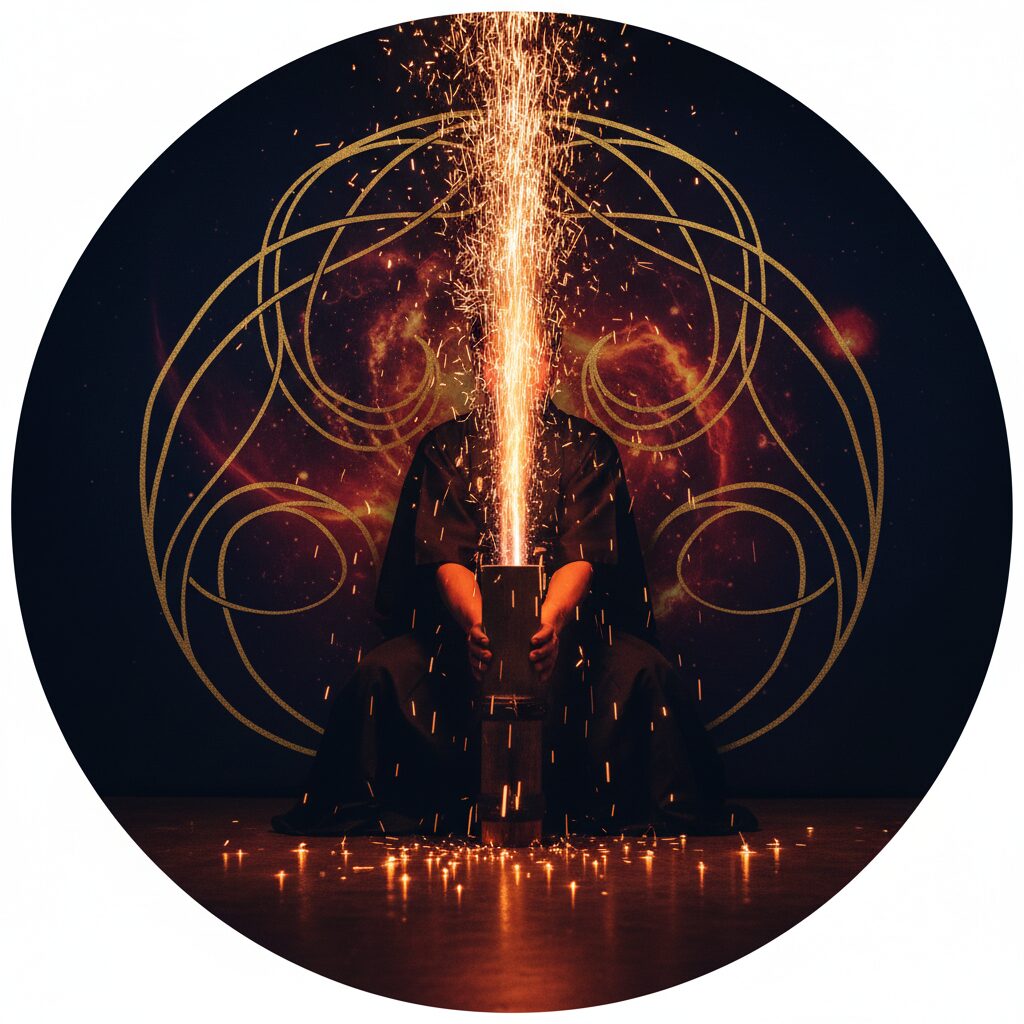
Yo, let’s get real for a sec. You’ve probably scrolled past it on your feed—some dude in a traditional Japanese outfit, looking impossibly calm while holding what is, for all intents and purposes, a literal volcano. A meter-long bamboo cannon, spewing a ten-meter pillar of incandescent fire, showering him and everyone nearby in a storm of brilliant orange sparks. Your first thought is probably something like, “Okay, Japan, you’ve officially gone off the deep end.” Or maybe, “What in the final boss battle is this?” It looks insane. It looks like a health and safety manual’s worst nightmare. And in a country famous for its meticulous order and obsessive safety protocols, the Tezutsu Hanabi, or hand-held fireworks festival, feels like a massive contradiction. It’s raw, it’s chaotic, and it feels dangerously real in a way that most of modern life just… isn’t. Why would anyone willingly hug a tube of explosives? This isn’t just for the likes or the clout. This isn’t a daredevil stunt. What you’re seeing isn’t a performance; it’s a prayer. It’s a centuries-old conversation with the gods, the community, and the very idea of what it means to be a grown-up in this town. It’s a tradition so deeply woven into the fabric of certain communities, particularly in the Mikawa region of Aichi Prefecture, that to not do it would be unthinkable. This is a story about fire, but it’s really about what that fire represents: courage, community, and a seriously hardcore form of faith. So, let’s get into the heat of it and figure out why Japan holds onto this beautifully bonkers tradition.
This fiery tradition shares a deeper spiritual resonance with other Japanese summer customs, such as the communal celebration found in Bon Odori.
Unpacking the Inferno: This is Not Your Average Firework
Before we plunge into the deeper cultural significance, there’s one thing to clarify: erase the image of a typical firework display from your mind. Forget the perfectly timed bursts of color painting the night sky, set to a swelling orchestral soundtrack, enjoyed from a cozy distance on a picnic blanket. Tezutsu Hanabi is the exact opposite of that. It’s not about passive beauty; it’s about intense, overwhelming, and visceral involvement. It’s a sensory onslaught, and that’s precisely the point. The experience is meant to be overpowering, to shake you to your core, leaving you with something far more profound than just a pretty scene.
A Symphony of Controlled Chaos
The first thing that strikes you isn’t the light; it’s the sound. It’s not the familiar thump-whistle-bang of an aerial shell. Instead, it’s a deafening, continuous roar, like a jet engine roaring right next to your ear. The sound vibrates through the ground, up your legs, and deep into your chest. It’s so loud that thinking becomes impossible; you can only feel. Then comes the heat. From several meters away, a wave of warmth washes over you, like opening the door of an industrial furnace. The air itself seems to shimmer and distort. And then the sparks appear. It’s not a gentle cascade but a torrential downpour of glowing embers, a rain of fire falling upon both the holder and the crowd. Spectators huddle beneath hats or towels, not purely for protection but as part of the shared experience. Accepting the shower of sparks becomes a blessing, a kind of purification. The air thickens with the acrid, metallic scent of gunpowder, clinging to your clothes and hair for hours. This is what sets Tezutsu apart so fundamentally. An aerial firework is something you watch. A Tezutsu is an environment you enter. You are inside the spectacle, not outside it. The line between performer and audience blurs into a communal space of ritual chaos.
The Art of the Bamboo Cannon
The firework itself is a blend of tradition and personal investment. This is no mass-produced pyrotechnic. Each Tezutsu is handcrafted, often by the very person who will bear it. The process is a ritual in its own right, a months-long journey that builds anticipation and deepens spiritual meaning. It begins with selecting the right bamboo, a thick-walled giant bamboo known as mōchiku. This bamboo is carefully harvested, dried for years, then tightly bound with sacred straw ropes called shimenawa, which you might recognize from Shinto shrines. This binding is both practical—preventing the bamboo from exploding—and symbolic, marking the tube as a sacred object.
Inside, the holder carefully packs up to three kilograms of black powder, a mixture of charcoal, sulfur, and potassium nitrate. The recipe and packing method are closely guarded secrets, passed down from father to son or mentor to apprentice. How the powder is packed controls everything: the height and shape of the fire pillar, the color and density of the sparks, and the burn duration. It’s a highly skilled craft and a form of personal expression. The final product isn’t merely a firework; it reflects the maker’s spirit, skill, and devotion. When a man holds that pillar of fire, he holds his own creation, his own commitment made tangible and explosive. This personal connection elevates the act from a simple display to a profound personal trial and offering. He’s not just lighting a fuse; he’s bringing his own creation, his own soul-fire, to life.
The Spiritual Core: A Prayer Made of Fire and Sound
So, we’ve established that this is an intense, handcrafted experience. Yet the central question remains: why? To truly understand Tezutsu, you must look beyond the spectacle and recognize it for what it is: a deeply serious Shinto ritual. This is not entertainment. It is a form of communication with the divine. The entire event is presented as a sacred offering, or hōnō, devoted to the local gods, the kami. This tradition dates back nearly 500 years, and its purpose has remained consistently clear: to pray for protection, prosperity, and purification.
From Battlefield Signals to Divine Offerings
Tezutsu Hanabi’s origins trace back to the Sengoku period, Japan’s 16th-century era of warring states. With the arrival of black powder technology, these early rockets were likely used as signal flares or weapons to intimidate on the battlefield. However, as peace returned to Japan, this technology of war was transformed for spiritual use. Instead of signaling an attack, the fire and smoke became a way to communicate with the gods. These festivals became part of the Shinto shrine calendar, held to pray for bountiful harvests, to ward off plague and disasters, and to ensure the safety and well-being of the community’s families. The firework’s immense power—its blinding light and earth-shaking roar—was believed to have purifying qualities. In Shinto belief, negative forces, bad luck, and evil spirits, collectively known as kegare, could be driven away by such powerful displays. Holding a Tezutsu was an act of communal purification, blasting the area clean of spiritual impurity and creating a sacred space for the gods to descend.
Waiting for the ‘Hane’: The Final, Thunderous Word
If you observe a Tezutsu firing from beginning to end, you’ll witness a dramatic finale. After the main pillar of fire roars for about 20 seconds, it sputters and fades away. For a tense moment, the holder remains with a smoking bamboo tube. Then, with a cataclysmic boom, the tube’s bottom explodes. This final, deafening blast is called the hane. To an outsider, it might appear as a catastrophic failure, the firework suddenly exploding in the holder’s hands. But the hane is the entire purpose. It is the climax of the prayer. A loud, successful hane is a good omen, a sign that the prayer has been heard and accepted by the kami. The sound is the god’s response. The relief that washes over the holder’s face, the eruption of cheers from the crowd—this is the moment of catharsis. All the risk, the endurance, the months of preparation culminate in this one thunderous sound. Standing firm through the rain of fire to receive the hane is a demonstration of faith and resolve. It is the ultimate test of courage—not against the fire itself, but in the patient anticipation of a divine reply. The danger is not a flaw; it is a feature. It is the price of admission for a direct connection to the gods. The sincerity of the prayer is measured by the willingness to stand strong in the face of overwhelming power and noise, and to await the final, explosive answer.
A Rite of Passage in a Hyper-Modern World
In a society as famously risk-averse and orderly as modern Japan, the continued existence of a tradition like Tezutsu Hanabi appears paradoxical. This is a country where children walking to school receive rigorous training in traffic safety and every public space is governed by numerous rules and regulations. So how does a festival involving willingly standing in a shower of fire not only survive but thrive? The answer lies in the fact that Tezutsu is much more than a historical reenactment; it fulfills an essential social and psychological role. It acts as a powerful rite of passage and a forge for community bonds that are increasingly rare in today’s atomized world.
The Ultimate Community Trust Fall
Despite the striking image of a lone figure against a pillar of fire, holding a Tezutsu is anything but a solitary act. It is a profoundly communal effort. From the moment the bamboo is cut to the final hane, the holder is surrounded and supported by his community. The creation of the fireworks is a collective process, with experienced elders instructing the younger generation in the delicate and hazardous art of packing gunpowder. It is a months-long apprenticeship that fosters mentorship, trust, and shared expertise. On the night of the festival, the holder is accompanied by supporters. There are men with buckets of water ready to extinguish any stray flames. Spotters watch his stance and the firework’s burn, prepared to intervene if necessary. The entire crowd, a sea of faces from his own neighborhood, is present, their combined energy and cheers forming a barrier of support. This is the ultimate trust fall. The holder trusts in the teachings of his elders, the quality of his own workmanship, and the safety net provided by his peers. In return, the community places its trust in him to represent them before the gods. This act creates an unbreakable bond, a sense of shared identity and mutual reliance known as kizuna. It serves as a powerful social glue, reaffirming that everyone has a role to play, and that individual bravery ultimately reflects collective strength. In many of these communities, a young man is not considered a full adult—an ichininmae—until he has held his first Tezutsu. It is a public demonstration of his readiness to accept responsibility, endure hardship for the group’s benefit, and uphold the traditions that define them.
An Antidote to a Sanitized Reality
Why does this ritual remain so compelling in the 21st century? Perhaps its potency lies in its authenticity. We live in a world increasingly mediated, virtual, and safe. Our experiences are often curated, filtered, and consumed through screens. We are detached from the raw, unpredictable forces of nature. Tezutsu Hanabi provides a striking antidote to this digital numbness. There is nothing virtual about the searing heat on your skin, the smell of sulfur in your lungs, or the concussive force of the hane rattling your bones. It is an experience of pure, unfiltered physical sensation. It reminds us that the world is not always controllable, comfortable, or safe. For the young men holding the fireworks, it is a rare chance to confront a true challenge and test their limits in a way modern life rarely permits. It is a physical and mental trial demanding immense gaman—that quintessential Japanese spirit of patient endurance and perseverance. In a world offering easy comforts, the conscious decision to endure discomfort and fear is a powerful act of self-definition. The festival connects them to something ancient and primal, a tangible link to hundreds of years of ancestors who stood on the same ground, held the same kind of fire, and uttered the same prayers. In a nation seemingly racing headlong into the future, traditions like Tezutsu serve as an essential anchor, a way of preserving a core identity that is fierce, spiritual, and unapologetically real.
Experiencing the Inferno: The Spectator’s Sacred Role
If you choose to witness a Tezutsu festival, prepare for an experience that is anything but passive. As a spectator, you won’t be kept at a safe distance behind velvet ropes. Instead, you become an essential part of the ritual, with the event designed to immerse you in its raw energy. The boundary between participant and observer is deliberately blurred, because in the context of a communal prayer, everyone’s presence and energy count.
You’re in the Splash Zone, and That’s the Point
At most Tezutsu festivals, the viewing areas are startlingly close to the action. You find yourself well within the “splash zone” of the sparks. This is no accident; it’s a core element of the experience. The cascade of fire is seen as a blessing and a means of purification. Being showered with embers from a sacred offering is believed to bring good fortune and ward off sickness. Locals often arrive prepared, wearing thick cotton jackets, hats, or simply using a towel to cover their heads, but they do not avoid the sparks. They embrace them. The shared ordeal of enduring the heat and sparks together fosters a strong sense of unity among the crowd. You’re not merely a spectator; you’re braving a beautiful yet terrifying storm alongside thousands of neighbors. The collective gasps, the encouraging calls to the holders—“Ganbare!” (Do your best!)—and the thunderous applause following a successful hane are more than just reactions. They are contributions. The crowd’s energy is believed to empower the ritual, supporting the holder and amplifying the prayer sent to the heavens. You become part of the force that steadies the man, part of the chorus seeking blessings.
The Connoisseurship of Fire
To the untrained eye, one pillar of fire may appear much like another. But to locals and experienced spectators, there is a refined art and connoisseurship in reading the flames. It is a craft, and like any craft, open to judgment. They don’t just see a burst of fire; they see a story. They evaluate the quality of the firework through subtle criteria. They note the flame color—a vibrant, rich persimmon orange is ideal. They examine the fire pillar’s shape: is it straight and strong, or does it flicker? They pay close attention to the sparks, or hibana. Are they dense and plentiful? Do they erupt with a pleasing crackle? A firework that produces a thick, brilliant curtain of sparks is highly esteemed. Even the smoke carries an aesthetic value. This profound appreciation turns the event into something akin to performance art. Each firework is a unique expression of its maker’s skill and spirit, and the crowd’s response reflects this understanding. It’s a dialogue between the artisan and the community, conveyed through an explosion. Watching with this insight allows you to see beyond the chaos and appreciate the artistry, control, and rich cultural language being inscribed in fire against the night sky.
The Real Vibe: Control in the Heart of Chaos
We began with a straightforward, skeptical question: Why would anyone hold a pillar of fire? It appears to be an act of courting chaos, embracing reckless danger for a fleeting thrill. Yet the deeper you look, the more you realize that the true purpose of Tezutsu Hanabi is quite the opposite. It is not about celebrating chaos; it is about showcasing control at its very core. Holding the Tezutsu is a profound expression of human resilience—standing firm with skill, courage, and faith in the face of a primal, overwhelming force. The holder is not a thrill-seeker chasing an adrenaline rush. For those brief moments, he becomes a conduit, a temporary priest bridging the earthly and the divine. He takes fire, one of humanity’s most destructive forces, and contains, directs, and transforms it into a sacred offering through his endurance.
The fire is not an enemy to be conquered; it is the medium. It is a physical, terrifyingly beautiful symbol of a community’s deepest hopes: for a healthy harvest, secure homes, thriving children, and a connection to something greater than themselves. Holding that blazing column of fire means holding onto all of those aspirations. It means preserving tradition in a world that often discards it. It means maintaining the bonds of community in an era of isolation. And it means affirming one’s strength and place in the world. The raw intensity you see in those videos goes beyond the striking visuals. It is the tangible energy of a community pouring its entire history, faith, and spirit into a column of light, trusting one of their own to keep it steady. And ultimately, that is a spectacle far more powerful than any mere firework.