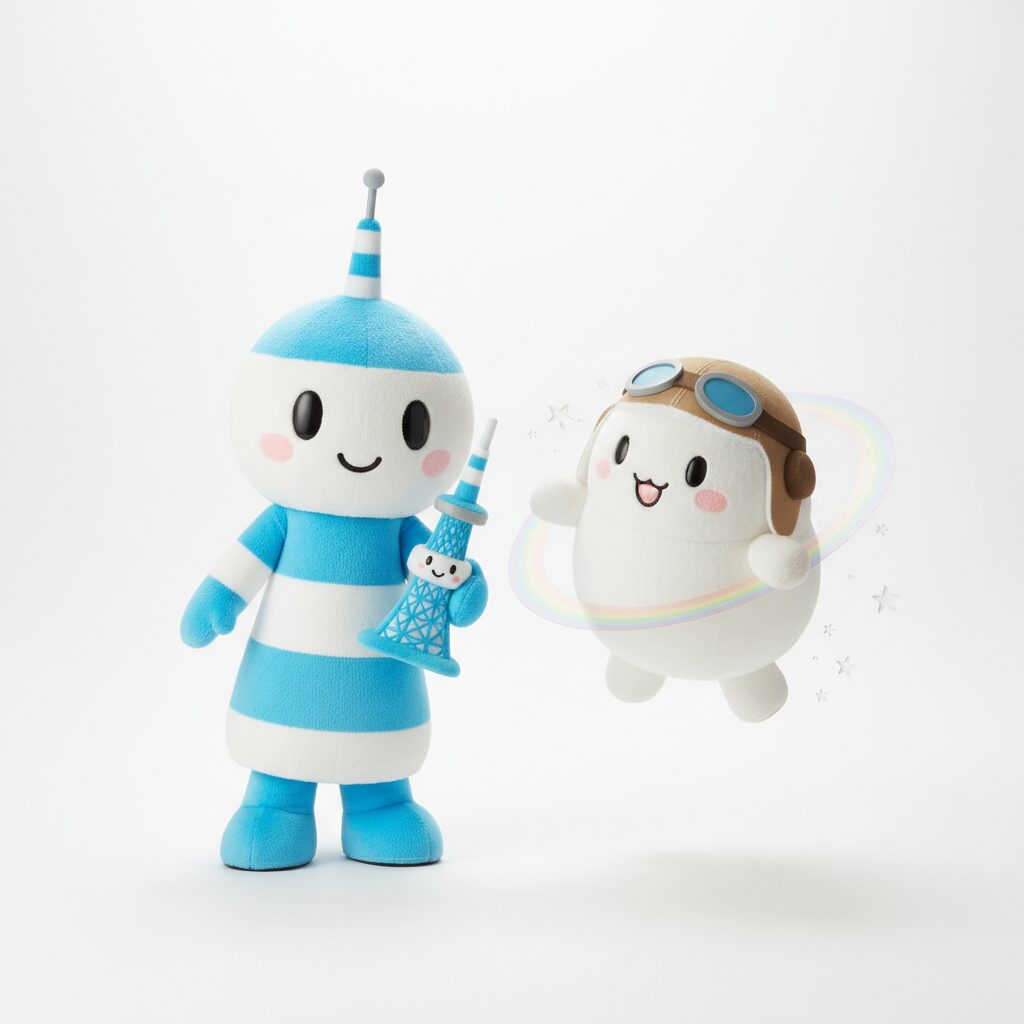
Yo, let’s get real for a sec. You’re in Tokyo. You’ve navigated the human torrents of Shibuya, found tranquility in a quiet shrine, and eaten ramen that changed your life. You feel like you’re starting to get the hang of this place. Then you head east, to the Sumida ward, to see the big one: the Tokyo Skytree. You crane your neck back, and there it is—a 634-meter spike of neo-futurist steel and glass, piercing the sky like a message to the cosmos. It’s elegant, powerful, a testament to Japan’s engineering genius. It’s seriously impressive. Then, you look down. Near the entrance, you see… them. A gang of characters straight out of a fever dream. The leader is a girl with a literal star for a head, wearing a telescope, her eyes wide, vacant circles. She’s flanked by a penguin in a bow tie and a bulldog with a permanent, slightly pained grin. These are the official mascots. And in that moment, the entire, sleek, high-tech vibe of the Skytree shatters. Your brain stalls, trying to bridge the gap between the sublime piece of architecture towering above you and the bafflingly bizarre creatures welcoming you at its base. It doesn’t feel whimsical like Disneyland. It feels… off. A little unsettling. You’ve just tumbled headfirst into the uncanny valley, Japan-style. The question isn’t just, “What are these things?” The real question, the one that gets under your skin, is “Why are these things?” Why does this pinnacle of modern design have mascots that look like they were designed by a committee on hallucinogens? This is one of those moments that makes you feel like you’ll never truly understand this country. But trust me, you can. The answer is a wild ride through corporate branding, ancient beliefs, and the all-conquering power of cuteness. It’s the story of how Japan makes the intimidating approachable, and in doing so, sometimes creates something wonderfully, profoundly weird.
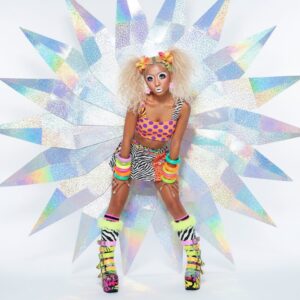
This kind of wonderfully weird cultural phenomenon is a hallmark of Japan, much like the bizarre rebellion of Ganguro fashion.
The Skytree Paradox: Sleek Steel and Star-Faced… Things
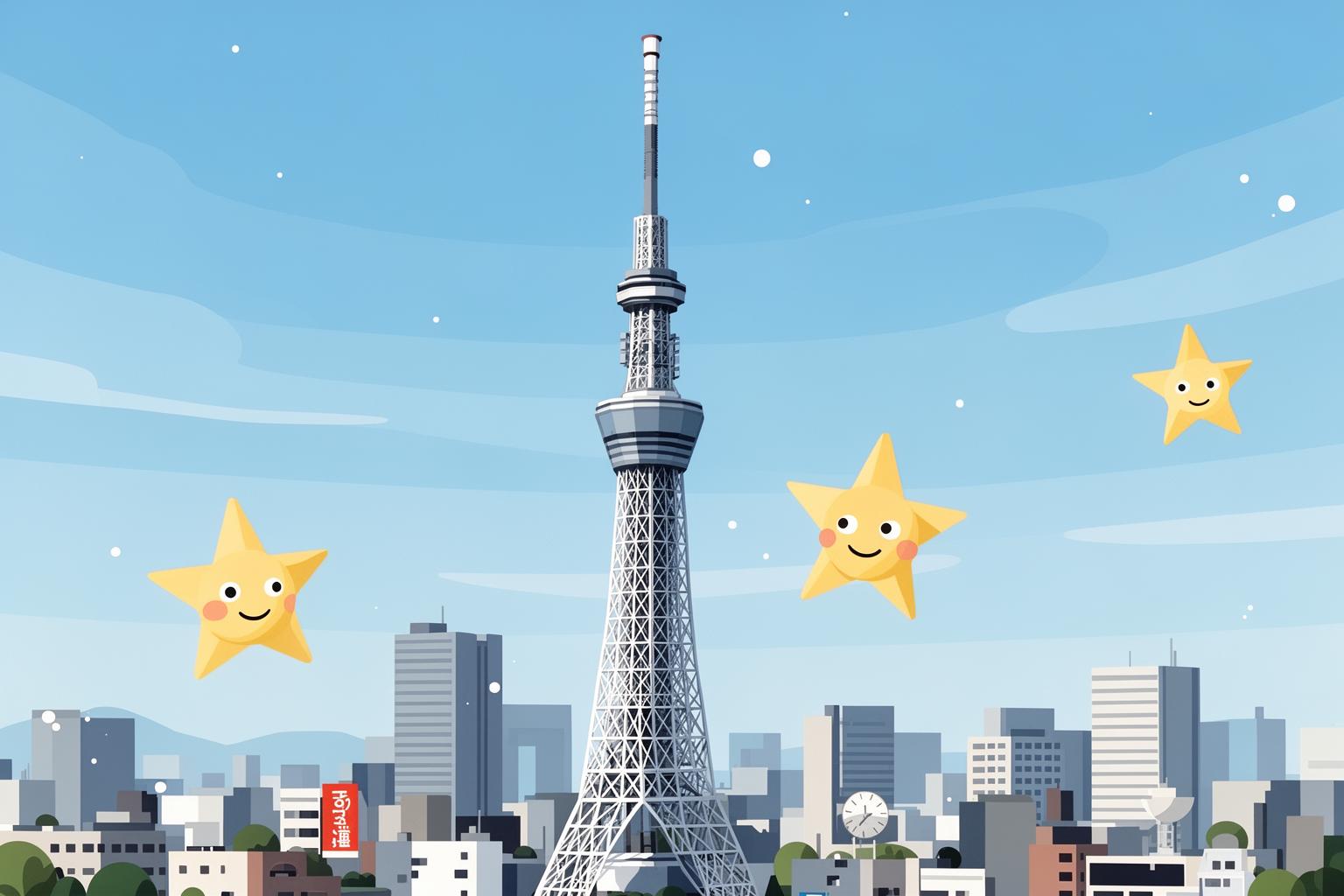
To truly grasp the extent of this cognitive dissonance, you need to understand just how significant the Tokyo Skytree really is. It’s not a theme park ride; it’s a vital piece of national infrastructure—a television and radio broadcasting tower built to replace the shorter Tokyo Tower and guarantee that digital signals can reach across the entire Kanto region without interference from the city’s ever-expanding forest of skyscrapers. Its design, which blends traditional Japanese aesthetics with cutting-edge engineering, carries deep symbolism. The color, “Skytree White,” is derived from aijiro, the palest hue of Japanese indigo, intended to evoke traditional artisan techniques. The structure itself incorporates principles seen in the five-story pagodas of ancient temples, featuring a central column that acts like a giant pendulum to counter seismic swaying during Japan’s frequent earthquakes. Every detail exudes sophistication, precision, and profound respect for both the future and the past. In every way, it stands as a monument to Japan’s vision of itself.
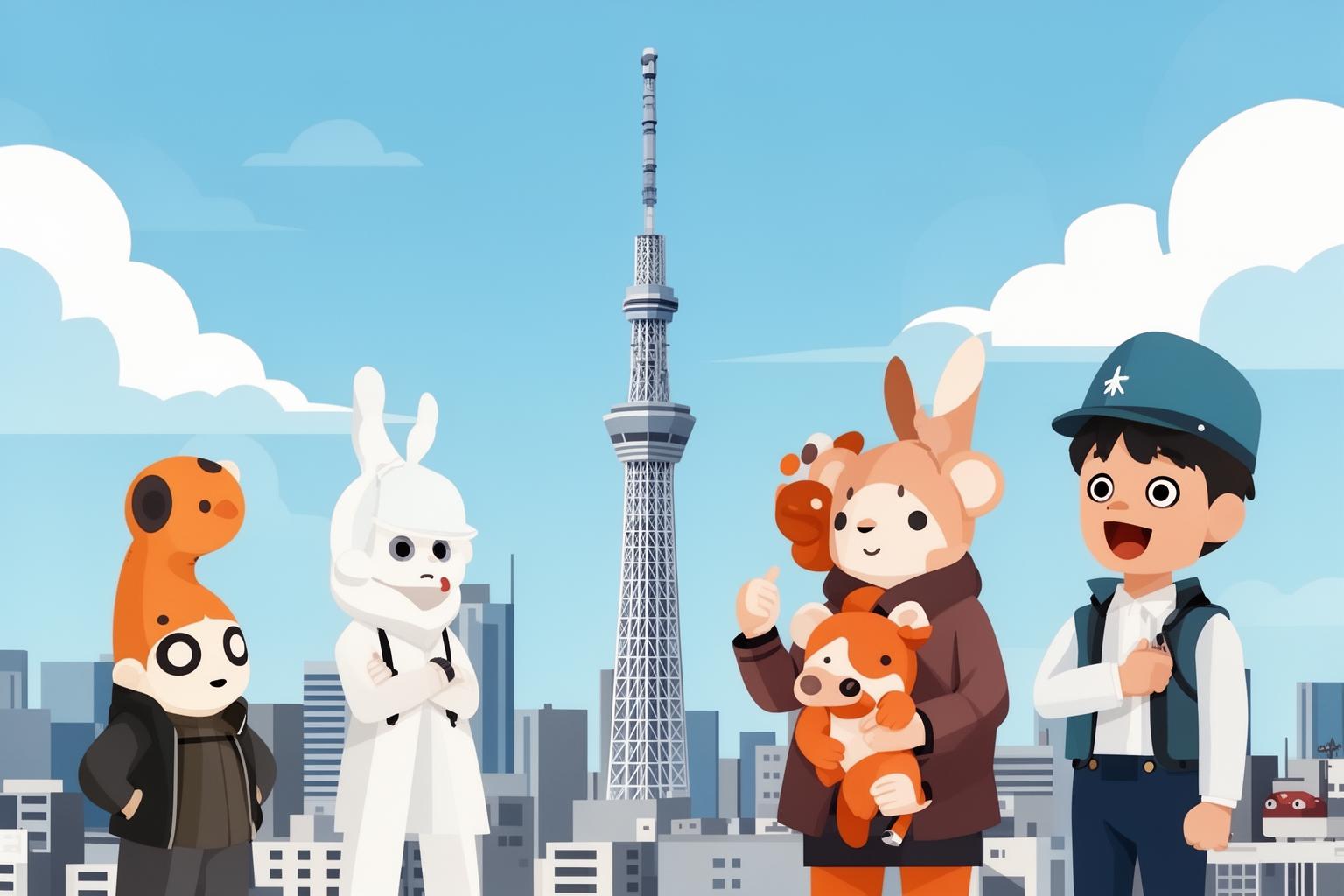
Then there’s the welcoming committee. Let’s unpack them. The main character, the star of the show, is Sorakara-chan (ソラカラちゃん). Her name literally means “From the Sky-chan.” Her head is a five-pointed yellow star, and her hair is a cloud. She wears a dress patterned after the Skytree’s lattice design and carries a telescope passed down from her grandfather. According to her official bio, she’s curious, a little clumsy, and her favorite phrase is “I wonder!” She embodies all the traits of a character meant to be inquisitive and relatable to children. Yet, there’s an unsettling stillness about her. Her wide, perfectly circular eyes, with tiny black pupils, express less wonder and more a blank, unblinking stare. The star for a head isn’t just a quirky hat; it is her entire cranium—a geometric, alien feature atop a humanoid body. The effect is less “cute girl” and more “celestial being in a child’s dress.”
Next is Teppenpen (テッペンペン). His name is a blend of teppen (summit or top) and penguin. He’s a gentoo penguin, though colored a light sky blue. Wearing a formal bow tie, he’s described as knowledgeable and somewhat of a foodie. He lives at the very top of the Skytree and knows everything about it. He serves as the smart, sophisticated sidekick. But once again, the design choices are odd. His eyes match the same vacant circles as Sorakara-chan’s, giving him a perpetually stunned look. Though meant to be a dapper, well-informed guide, he appears constantly surprised to be there.
Finally, there’s Sukoburuburu (スコブルブル), a bulldog whose name plays on the Japanese word sukoburu (exceedingly or very) and the sound dogs make (buru buru). He hails from the shitamachi, the old downtown neighborhood at the Skytree’s base. He represents the earthy, traditional, slightly grumpy local. Wearing a happi coat and sporting a permanently furrowed brow, he’s the old-timer of the group who grounds the celestial Sorakara-chan and the high-flying Teppenpen. The trio fits a classic character archetype: the dreamer, the brain, and the heart. It’s basic marketing strategy. Yet the final execution—the slick but slightly off designs combined with the strange concepts—creates a sense of profound artificiality. This isn’t a beloved local trio; it feels like a focus-grouped simulation of one. The paradox reaches its peak: a structure of immense physical and cultural significance, represented by characters that feel utterly weightless, adrift in a sea of commercial surrealism.
Decoding Japan’s Mascot Mania (Yuru-Chara 101)
To grasp how Sorakara-chan and her friends came into existence, you need to zoom out from the Skytree and take in the whole country. Japan is, without exaggeration, the undisputed global capital of mascots. These characters, or kyara, aren’t limited to the sidelines of sporting events or on children’s cereal boxes. They are everywhere, embedded deeply in daily life. Your local police station has a mascot. The Ministry of Defense has a mascot. Prefectures, cities, towns, airports, TV stations, banks, and even prisons all have mascots. They serve as a vital means of communication, a default form of public engagement.
This phenomenon truly took off with the rise of the yuru-chara (ゆるキャラ), a term coined by cultural critic Jun Miura. It roughly translates as “loose character” or “laid-back character.” Unlike the highly polished, professionally animated figures from Disney or Sanrio, yuru-chara are characterized by a charming amateurishness and a certain lovable awkwardness. Miura outlined three unofficial rules for a genuine yuru-chara: it must express a strong love for its hometown or region, its movements or behavior should be unstable and unique, and it ought to be unsophisticated or “loose” (yurui), giving off an approachable vibe.
This isn’t merely a quirky recent trend; it has deep cultural origins. One could argue that the Japanese tendency to anthropomorphize the world reflects ancient Shinto beliefs in animism—the idea that kami (gods or spirits) dwell in everything, from majestic mountains and ancient trees to everyday objects. The folklore of tsukumogami, where household items gain a soul after a hundred years, is a classic example. In a culture where an old umbrella can possess a spirit, is it really any stretch for a broadcasting tower or a prefecture to have one as well? The mascot becomes the visible, tangible embodiment of a place or concept’s intangible essence.
This ancient tendency was amplified by the post-war rise of kawaii (cute) culture. Kawaii is far more than an aesthetic; it acts as a social lubricant and a core cultural value. In a society that values harmony and indirect communication, cuteness is a powerful tool. It disarms. It removes aggression, formality, and intimidation. A cute character on a public safety poster is much more likely to catch attention than a block of stern text. A cartoon animal explaining a complex financial product makes the bank appear friendlier and less daunting. Kawaii is the spoonful of sugar that helps the medicine of rules, regulations, and commerce go down.
From this rich environment, the yuru-chara boom emerged in the 2000s. It began with characters like Hikonyan, a white cat wearing a samurai helmet created to celebrate the 400th anniversary of Hikone Castle. He was an instant hit, attracting tourists and proving the economic potential of a well-crafted mascot. The true superstar, however, is Kumamon. A simple black bear with rosy red cheeks and a perpetually surprised look, Kumamon was created in 2010 to promote Kumamoto Prefecture. He became a national phenomenon, generating billions of yen in merchandise sales and tourism revenue. Kumamon’s appeal lies in his perfect embodiment of the yuru-chara spirit. He’s simple, slightly goofy, and feels authentic. He’s not selling a product; he is Kumamoto. Then there are the eccentric ones, like Funassyi, the hyperactive, unofficial pear-fairy mascot of Funabashi, who screeches, headbangs, and moves with chaotic, non-corporate-approved energy. Or Okazaemon from Okazaki City, a deliberately creepy, minimalist figure with a deadpan expression that embraces weirdness. These characters illustrate the wide spectrum of mascots, from professionally cute to bizarrely avant-garde. This is the world into which the Skytree’s mascots were born—a world where having a character is not merely optional but expected.
Skytree’s Mascots and the Uncanny Valley of Cuteness
Now we can return to that uneasy feeling you get when looking at Sorakara-chan. You’re encountering a very specific effect: the uncanny valley, applied to character design. The idea was first introduced by robotics professor Masahiro Mori in 1970. He suggested that as robots become more human-like, our emotional response to them grows increasingly positive—up to a certain point. When a robot is almost perfectly human but has subtle imperfections—a jerky movement, lifeless eyes, skin that feels off—our fondness drops sharply into a pit of discomfort and eeriness. This is the uncanny valley. Think of a friendly cartoon robot like Wall-E (high affinity) compared to a CGI human character from an early 2000s film that looks nearly real but not quite (deep in the valley).
Although Sorakara-chan isn’t intended to be human, she and her friends occupy a similar sort of valley within the “cuteness” spectrum. On one side, there’s simple, abstract cuteness: a smiley face, a heart shape, or a very basic character like Kumamon. Our brains easily register these as positive symbols. On the other side, there are highly refined, expertly-crafted characters that perfectly hit all the right notes of appeal, like those from Studio Ghibli or Pixar movies. These characters are complex yet internally coherent and emotionally engaging. The uncanny valley of cuteness exists in between. It’s where characters are slickly produced and intricate but lack a vital spark of life or authenticity. They are almost appealing, but something is fundamentally wrong. This is the realm inhabited by the Skytree mascots.
The Gaze of Sorakara-chan
Let’s examine the design choices. The eyes are often the source of that uncanny feeling. Many of Japan’s most beloved characters, from Totoro to Domo-kun, have simple black dot eyes. This simplicity is a strength; it allows viewers to project a broad range of emotions onto the character. Their expression is completed by our imagination. Sorakara-chan’s eyes, by contrast, are more complex. They are perfect circles with defined blue irises and small black pupils. Yet they lack any shading, highlights, or emotional nuance. They are geometric shapes, not windows into a soul. This produces a deeply unsettling effect. The design mimics the form of a cute character’s eyes without grasping their function. She gazes forward, but not at you. It’s the stare of a doll, not a friend. This calculated yet vacant expression is a direct route into the valley.
The Commercial Imperative
The fundamental issue—and the source of the uncanny sensation—is that the Skytree mascots feel less like genuine characters and more like a branding exercise reverse-engineered from the yuru-chara boom’s success. They didn’t emerge from a local community’s quirky idea; they were crafted by professionals in a major advertising agency as part of a multi-billion-yen project. They are the corporate, top-down counterpart to a grassroots, bottom-up phenomenon. They possess the oddness of a yuru-chara (a star for a head!) but lack the charming “looseness,” or yurusa, that defines the genre. Every detail of their design feels too perfect, too polished, too committee-approved. It’s an attempt to manufacture authenticity, which is inherently contradictory.
Your brain senses this, even subconsciously. You pick up on the commercial driver behind them. These characters exist primarily to appear on keychains, plush toys, cookies, and clear files sold at the expansive gift shop at the tower’s base. They are merchandise vehicles. Though this is true of most mascots, the great ones—like Kumamon—transcend their commercial purpose and become true cultural symbols. The Skytree mascots never fully achieve that. They feel confined to their role as smiling sales representatives for the attraction they promote. The tension between the homey yuru-chara style they imitate and the cold, hard commercial reality they embody creates the surreal, uncanny vibe. They are folk art aesthetics executed with the precision of a global marketing strategy. The result is unsettling because it’s a perfect simulation of sincerity.
So, Why Does It Feel So Strange? Your Brain on Japanese Branding
The unease you feel standing before the Skytree and its mascots ultimately stems from a clash of cultural expectations. Your brain, likely shaped by a Western approach to branding and architecture, operates on a different set of assumptions. In most Western cultures, a monumental structure like the Skytree would be branded with something serious and majestic. If there were a mascot at all, it might be an abstract logo, a sleek geometric shape, or perhaps a noble animal like an eagle, symbolizing strength, precision, and importance. The idea of using goofy, child-like characters to represent a nation’s tallest building would be considered frivolous, unprofessional, or simply bizarre.
But in Japan, the cultural framework runs a different program. As observed, kawaii isn’t just a niche aesthetic for children; it is a primary form of public communication. It is the default tool to make anything and everything approachable. The Skytree itself is an imposing presence—huge, expensive, and technologically complex. For many, especially families with children, it could feel intimidating. The mascots represent a deliberate strategic move, a semiotic device designed to soften the tower’s image. They act as a friendly, smiling interface for a piece of hardware. Their message is clear: “This giant metal spike isn’t frightening. It’s a fun, welcoming place for you and your family! Come on in!”
Thus, the uncanny sensation arises from witnessing this uniquely Japanese communication strategy executed with the full force of a massive corporate budget. It isn’t the cuteness itself that feels strange, but the context and intent behind it. It’s the aesthetic of charming imperfection rendered with sterile precision. It’s like hearing an AI-generated folk song; all the right notes are present, but the soul is missing. You sense the gap between the intended feeling (warm, friendly, local) and the actual method of creation (corporate, strategic, commercial).
It’s important to realize these mascots weren’t really designed for you, the international visitor. They were created for a domestic audience whose visual language and consumer culture have long been steeped in kawaii and character goods. For a Japanese family visiting the Skytree, Sorakara-chan is an expected and normal part of the experience. The confusion you feel is actually a gift. It shows you are encountering something authentically Japanese, something not necessarily curated or diluted for a global audience. You are encountering the internal logic of the culture, and that friction is where true insight occurs. You are seeing Japan as it speaks to itself.
Beyond the Star-Head: Appreciating the Method in the Madness
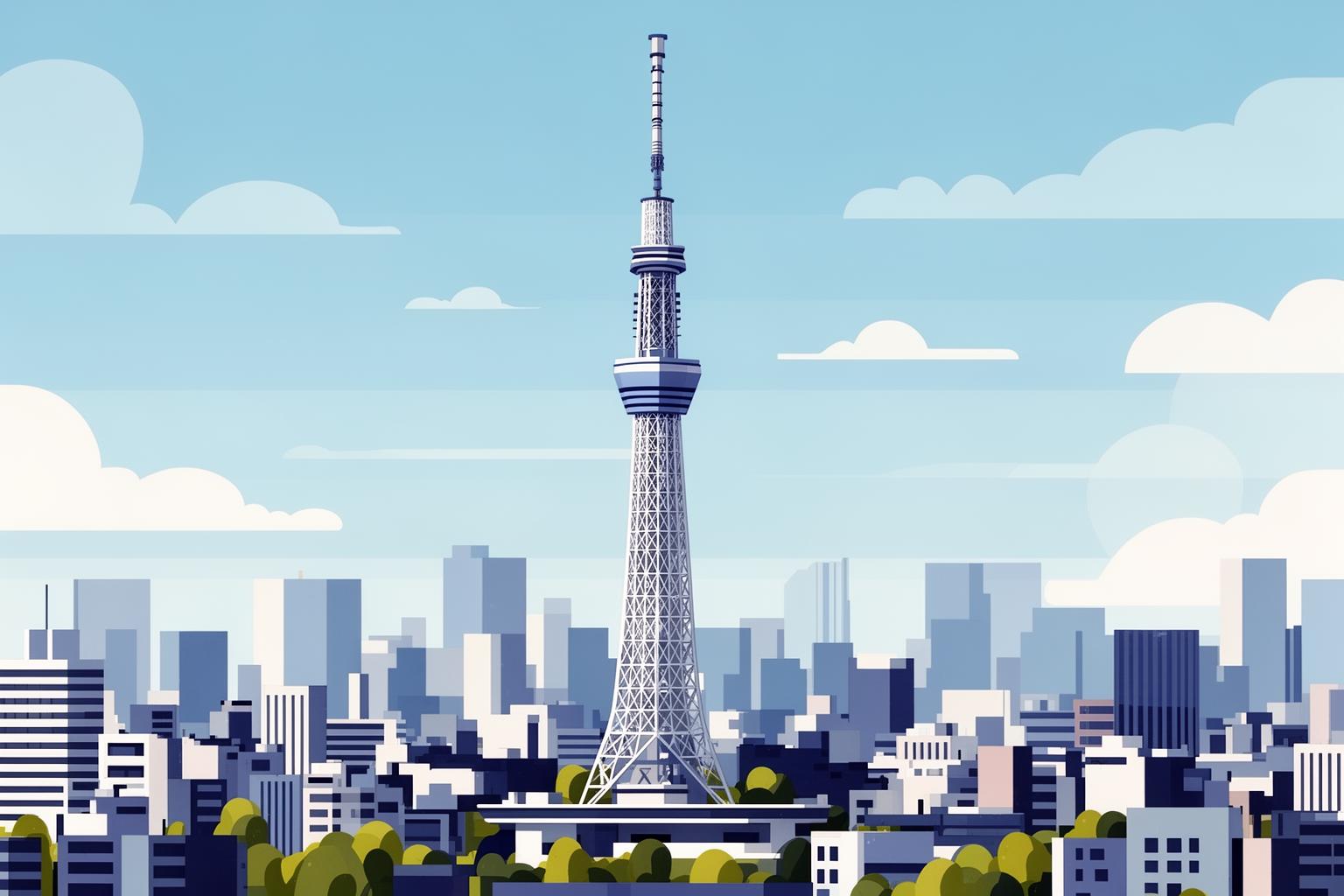
So, what should you do with this feeling? The first impulse might be to dismiss the Skytree’s mascots as just another example of “Weird Japan,” snap a photo to share with friends back home, have a laugh, and move on. But I would argue they offer something deeper. If you can sit with the oddness and look more closely, these star-faced, soulless-eyed figures become a Rosetta Stone for understanding modern Japan.
They are a clear, crystalline representation of the country’s many beautiful contradictions. They embody the seamless fusion of hyper-modernity (the tower) with a character-driven visual culture rooted in ancient animistic traditions. They illustrate how the relentless engine of commerce has co-opted and commodified kawaii, transforming a social lubricant into a powerful marketing tool. They expose the tension between a yearning for a warm, local, community spirit (shitamachi bulldog) and the reality of a vast, top-down corporate development. Between the sleek lines of the tower and the goofy grin of its mascot, you can see the entire story of contemporary Japan: a nation constantly balancing its past, present, and future, its global ambitions, and its unique cultural language.
From a photographer’s point of view, this is the magic of Japan. It’s a land of contrasts. It’s the tranquil rock garden framed by a concrete wall, the salaryman in a sharp suit reading manga, the ancient temple overshadowed by a skyscraper. And it’s the futuristic broadcasting tower personified by a girl with a star-shaped head. These elements aren’t in opposition; they are part of the same intricate, captivating whole. The Skytree and Sorakara-chan are not contradictions but two sides of the same coin, a perfect blend of Japan’s technological mastery and its socio-emotional logic.
So next time you come across a strange mascot at the base of a serious building, don’t just dismiss it. Pause. Look deeper. Instead of asking, “Why is this so weird?” try asking, “What is this trying to tell me?” The surreal sensation is not a flaw in the system; it is the system itself, functioning exactly as it should. And the moment you grasp that—the moment you recognize the method in the madness—is when you begin to truly understand.