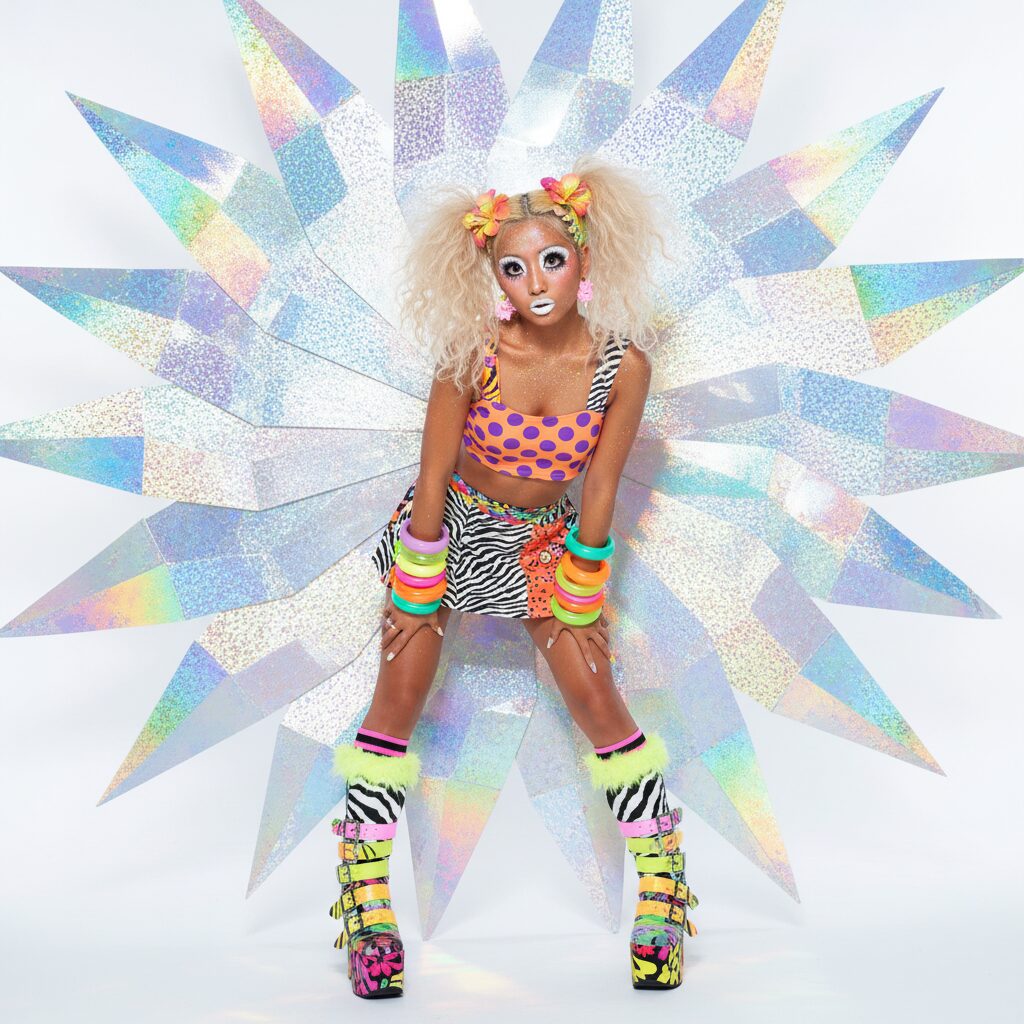
Yo, what’s the deal with Japan? One minute you’re scrolling through pics of serene temples and perfectly manicured gardens, the next you’re hit with an image that completely shatters that vibe. I’m talking about a photo from the 90s or early 2000s: a group of Japanese high school girls with skin tanned so deep it looks like mahogany, hair bleached a shocking shade of blonde or silver, and a ring of stark white makeup circling their eyes like reverse pandas. This, my friends, was Ganguro. And if you’ve ever stumbled upon it online, you’ve probably asked the same question as everyone else: why? In a country globally famous for its appreciation of pale, porcelain skin, why did these teens go to such aggressive, almost theatrical, lengths to become the absolute opposite? This wasn’t just a quirky fashion trend. This was a full-blown cultural rebellion, a visual scream against the silent, crushing weight of Japanese social norms. It was a movement born in the neon-drenched streets of Shibuya, a vibrant, chaotic, and unapologetic statement from a generation that felt lost and wanted to be found on their own terms. To really get it, you have to look past the shocking visuals and dive deep into the cultural currents of late 20th-century Japan. We’re about to unpack the whole story, from the ancient beauty standards they were trashing to the economic despair that fueled their fire. This is the real story of why Japanese teens decided to literally change the color of their skin to fight the system. Get ready, ’cause it’s a wild ride into the heart of a youthquake that shook the foundations of Japanese identity. Before we dive in, let’s pinpoint the epicenter of this cultural explosion: Shibuya, Tokyo.
This visual rebellion against societal norms shares a thematic DNA with Japan’s other great cultural exports, such as the atomic-age anxieties and rebirth fantasies explored in its iconic kaiju monster movies.
The Unspoken Rulebook of Japanese Beauty
To fully grasp the overwhelming impact Ganguro had on Japanese society, you first need to understand the deeply rooted and long-standing beauty standard it challenged. In Japan, for centuries, the pinnacle of aesthetic appeal has been bihaku (美白). The term literally breaks down into “beautiful” (bi) and “white” (haku). This goes beyond merely avoiding a tan; it represents a profound cultural belief that associates fair skin with beauty, purity, and high social status. This concept is ancient, dating back to the Heian period more than a thousand years ago. Court ladies in old Kyoto would apply a thick white powder called oshiroi to their faces, striving for a luminous pale complexion. This was not just makeup but a symbol of status, indicating aristocracy—someone who did not have to work in sun-exposed rice fields. It implied a refined life of poetry and indoor activities. This ideal was solidified through classical literature and art, shaping a powerful and enduring image of Japanese beauty.
Jumping to modern Japan, the essence of bihaku remains strong, albeit evolved. It is now less about a stark white face and more about achieving a translucent, blemish-free, and most importantly, pale complexion. Enter any Japanese drugstore, and you’ll encounter an overwhelming array of bihaku products—whitening lotions, brightening serums, spot-correcting creams, and face masks, all promising to lighten and purify skin tone. This huge industry reflects how deeply this standard is embedded in the everyday lives of millions. Yet, it extends beyond skincare. On any sunny day, even a mildly warm one, you’ll notice women walking around equipped with UV-blocking umbrellas. They often wear long, detachable sleeves—commonly called “arm covers”—alongside their t-shirts to shield their arms from sunlight. Wide-brimmed hats and full-face visors that seem straight out of a sci-fi movie are common sights. The message is clear and unyielding: the sun is the enemy of beauty. A tan is not viewed as a healthy glow, as it often is in Western cultures, but rather as a sign of neglect, poor skincare, or even lower social status. This intense cultural pressure to maintain pale skin formed the backdrop against which the Ganguro girls staged their rebellion. They didn’t just get slightly tanned; they shattered the most sacred rule of Japanese beauty into countless fragments. They chose to be dark—and not just dark, but artificially, boldly, unmistakably dark. It was the ultimate visual act of defiance.
The Birth of a Counter-Culture: Welcome to the 90s Bubble Burst
The stage for this dramatic rebellion was set by a massive economic and social transformation in Japan during the 1990s. The decade prior, the 1980s, marked the peak of the Japanese “bubble economy.” The country was an economic powerhouse, seemingly unstoppable. Money flowed freely, luxury was widespread, and there was an unshakable sense of optimism. The path for young people was clear and assured: study hard, pass your exams, get into a good university, and you would be rewarded with a secure, lifelong position at a prestigious company. This was the promise given to the generation that would soon become the parents of the Ganguro girls. But in the early 1990s, the bubble burst—spectacularly so. The stock market crashed, real estate values plummeted, and Japan entered a lengthy period of economic stagnation known as the “Lost Decade.”
Suddenly, the promise of a stable future disappeared. The lifetime employment system, once a cornerstone of Japanese society, began to unravel. Companies started laying off workers, and the secure “salaryman” career path was no longer guaranteed. This economic despair generated a deep sense of disillusionment and anxiety, especially among the youth. They observed their parents’ generation, who had toiled relentlessly in service of a system that now appeared broken and deceitful. A vast generation gap opened wide. The old values of conformity, diligence, and self-sacrifice for the company and nation no longer resonated with a generation that saw no reward awaiting them at the end of that journey. They felt disconnected, unheard, and trapped in a society governed by rigid rules that no longer made sense. This environment created fertile ground for an outburst of youth subcultures. Young people began seeking new ways to define themselves, to form their own communities and rules. The streets of Tokyo’s youth-centric districts, especially Shibuya, became the laboratory for this new identity formation. Shibuya, with its giant video screens, bustling crowds, and the iconic 109 building, turned into the mecca for teens wanting to escape the gray conformity of school and home life. It was here, in this neon-lit petri dish of youthful angst and creativity, that Ganguro was born. It was not just a fashion trend; it was a response to a national identity crisis, a way for teenage girls to literally wear their disillusionment and defiance on their skin.
Deconstructing the Ganguro Look: It’s More Than Just a Tan
To view Ganguro merely as a “tan style” is to completely miss its essence. This look was a carefully constructed collage of rebellious symbols, a head-to-toe repudiation of everything traditionally deemed beautiful, proper, and Japanese. Every element was a conscious choice, exaggerated to the extreme to maximize both shock value and symbolic meaning. It was a costume, a uniform for a tribe of girls proclaiming their independence from mainstream society.
The Tan: The Ultimate Defiance Against Bihaku
The name Ganguro (ガングロ) itself reveals the core idea. It’s slang combining gan, meaning a dark color or even a type of cancer, with kuro, meaning black. Likely coined by outsiders, the term carries a somewhat derogatory and shocking tone. The deep tan formed the foundation of the entire aesthetic and its boldest statement. This wasn’t a subtle, golden-brown glow from a beach holiday but an extreme, deep, often uneven tan that looked completely artificial. The aim was to achieve the darkest skin possible through marathon tanning salon sessions—whose popularity surged—and layers of dark liquid foundation. Foundations several shades darker than their deepest natural tan were used to intensify the effect, sometimes resulting in a muddy, nearly burnt appearance. This was a raw and visceral challenge to the bihaku ideal. If society demanded purity and whiteness, they responded with unapologetic darkness and “dirtiness.” It was a way of reclaiming ownership of their bodies, marking them in ways deemed ugly and undesirable by the older generation—a visual statement rejecting traditional Japanese beauty standards.
The Hair: Bleached and Audacious
To create the starkest contrast with their dark skin, Ganguro girls bleached their hair to near obliteration. The ideal was an almost white-blonde or silver shade. However, repeated harsh bleaching often left hair damaged, straw-like, and tinted with brassy orange or yellow—an outcome welcomed rather than shunned. The goal wasn’t silky, beautiful blonde hair but rather a loud, unnatural look. This served as another refusal to conform to a core Japanese beauty ideal: long, straight, glossy black hair (kurokami). In Japan, where black hair is tightly linked to national identity—so much so that many schools require students with lighter natural hair to dye it black—bleaching their hair white, silver, or even dyeing it bright pink or blue was a form of rebellion against educational conformity. The combination of dark skin and light hair created deliberate aesthetic dissonance, a striking visual clash impossible to ignore. It guaranteed they stood out, turning them into living performance art that challenged conventional notions of beauty.
The Makeup: Panda Eyes and White Lipstick
Makeup was perhaps the most theatrical and iconic element of Ganguro style, centered on extreme contrasts. While the skin was dark, key facial areas were starkly highlighted with white. Thick white concealer or stage makeup was applied as lipstick and lip liner, erasing the lips’ natural color. This white pigment covered the eyelids, often extending up to the eyebrows. Thick black eyeliner encircled the eyes, frequently paired with multiple spiky false eyelashes on both upper and lower lids. The result was a striking, high-contrast “panda eyes” look—but unlike a cute panda, this one was meant to appear alien and intimidating. It was a mask. To complete the look, small metallic or iridescent gem stickers called purikura stickers were added to cheeks and under the eyes, and the nose often featured a stripe of white concealer down the bridge. This makeup wasn’t to enhance features but to transform the face into a stylized, non-human caricature—a way to hide their true selves behind a rebellious persona while simultaneously demanding attention.
The Fashion: Platforms, Miniskirts, and Para Para
The Ganguro lifestyle extended well beyond skin, hair, and makeup—their fashion was equally loud and defiant. Their uniform included brightly colored, often Hawaiian-themed clothing. Brands like Alba Rosa, identifiable by its hibiscus flower logo, became iconic. Tiny miniskirts, tube tops, and tie-dyed sarongs were staples. The style was a pastiche of American West Coast and Hawaiian surfer culture, an idealized, exotic fantasy worlds away from the buttoned-up reality of Japanese life. The most defining fashion accessory was their footwear: platform boots and sandals—not modest platforms, but towering 6- to 12-inch soles that made walking a precarious art. These boots physically elevated them above the crowd, enhancing their commanding presence. All of this was fueled by a specific soundtrack: high-energy Eurobeat music. In Shibuya clubs, Ganguro girls gathered to perform intricate, synchronized hand-dance routines called Para Para, a social ritual and form of community bonding. The fusion of appearance, clothing, music, and dance created a fully immersive subculture—a world crafted with its own rules, language (gyaru-moji, a complex text-speak), and codes of conduct, existing right under the nose of a society that largely misunderstood it.
The Evolution of Extreme: From Ganguro to Yamanba and Manba
Just when mainstream society believed youth culture couldn’t become any more shocking, Ganguro transformed. Like a rebellious caterpillar entering its chrysalis, it emerged as something even more extreme, bizarre, and confrontational. The subculture fractured and intensified, pushing aesthetic boundaries to their absolute limits. This evolution gave rise to two even more radical styles: Yamanba and its wilder cousin, Manba. These styles were not merely an escalation of the tan or makeup; they represented a leap into a new realm of performative identity that bordered on the surreal.
Yamanba: The Mountain Witch Look
As the 2000s began, a more hardcore version of Ganguro emerged, known as Yamanba (ヤマンバ). The name itself holds a powerful cultural reference. A Yamanba is a figure from Japanese folklore — a “mountain witch” or hag who inhabits the wilderness. She is often portrayed with wild, unkempt hair and a demonic grin, sometimes said to devour lost travelers. By adopting this name, the girls deliberately identified with a monstrous, outcast female figure from Japan’s own mythology. They embraced the labels of “witch” and “monster” that society was already implicitly assigning to them. The Yamanba look intensified every element of Ganguro. The tan darkened to near black. The hair was no longer merely blonde but a messy, teased mane streaked with vivid pinks, blues, greens, and oranges — earning them nicknames like “coconut heads” from some. The white makeup became even more pronounced and less precise; instead of carefully applied white eyeshadow, it was now smeared carelessly around the eyes, often with a stark white stripe down the nose, evoking raccoon or spectral imagery. Lips remained stark white, and face stickers multiplied. Pale or light-colored contact lenses were often worn to give an unnatural, otherworldly effect. Clothing grew more chaotic, featuring clashing patterns, layers of accessories, and stuffed animals or leis draped around their necks. Yamanba was Ganguro turned up to the max. It was a deliberate choice to be “ugly” by all conventional standards — a means to harness power through grotesqueness and intimidation in the eyes of the mainstream.
Manba: The Peak of the Bizarre
Then came Manba (マンバ), the final, most extreme, and arguably most cartoonish evolution of the style. Manba built on the Yamanba aesthetic with a dose of playful, almost deranged absurdity. If Yamanba was the mountain witch, Manba was the witch who had raided a toy store. The tans were equally dark if not darker, and the hair was a tangled explosion of rainbow colors. The signature panda-eye makeup persisted but was often exaggerated further with multiple layers of huge, spindly eyelashes. What truly distinguished Manba was the sheer volume of accessories and a shift toward a childlike, kawaii-gone-wrong aesthetic. Faces were covered with even more stickers, often featuring popular characters like Hello Kitty or Disney icons. Hair became a chaotic nest of clips, bows, and plastic flowers. They carried stuffed animals, sported brightly colored leg warmers, and piled their arms high with plastic bracelets. Manba was the logical endpoint of this rebellion — so over-the-top and completely detached from reality that it became pure fantasy. A walking, talking piece of abstract art. By embodying these living cartoons, Manba girls created a total separation from the expectations of Japanese society. You couldn’t judge a Manba girl by normal standards because she wasn’t part of the normal world; she had constructed her own universe where she reigned supreme. This final evolution marked the creative peak of the deep-tan trend and its ultimate break from any conventional notion of appeal.
The Social Message: What Were They Really Saying?
Beneath the layers of dark foundation, white concealer, and towering platform boots, the Ganguro, Yamanba, and Manba girls conveyed a series of powerful social messages. Their appearance served as a coded language of dissent, a visual protest against the unwritten rules that shaped their lives, especially as young women in Japan. To dismiss it as merely a passing fad or a call for attention is to overlook the profound cultural critique at its core. They were responding to very real pressures, and their response was as bold as it was colorful.
A Rebellion Against Conformity
At its core, the Ganguro phenomenon was an outright challenge to one of the strongest forces in Japanese society: conformity. Japan values the group, harmony (wa, 和), and blending in highly. From an early age, children learn the saying, “The nail that sticks out gets hammered down.” The education system enforces this through strict uniform rules, regulations on hair color, and an emphasis on group activities. The corporate world continues this with its focus on teamwork and a uniform company culture. Ganguro was the act of being the nail that sticks out, but covered in unbreakable glitter so you couldn’t be hammered down. By making themselves visually striking, they made blending in impossible. They deliberately chose to be outsiders, existing beyond the comfortable group harmony. In a culture that values subtlety and indirectness, their look was starkly direct. It declared, “I am here. I am different. You cannot ignore me, and I don’t care if you disapprove.” It was a radical assertion of individuality in a culture that often represses it.
A Statement on Female Agency
More specifically, Ganguro was a revolt against the restrictive ideals of Japanese femininity. The traditional ideal, often encapsulated by the term Yamato Nadeshiko, depicts a woman who is polite, demure, graceful, and skilled in domestic roles. She is expected to be modest and to prioritize her family and husband’s needs above her own. In the 1990s, this ideal remained strong, reinforced by the rise of kawaii (cute) culture, which celebrated a childlike, unthreatening femininity. The Ganguro girls rejected all of this. They were the anti-Yamato Nadeshiko. They were loud, used slang, confidently occupied public spaces, and unapologetically controlled their own unconventional sexuality. Their fashion, featuring tiny miniskirts and revealing tops, directly challenged the modesty expected of “good girls.” By making themselves “ugly” according to traditional standards, they liberated themselves from the male gaze and the pressure to look pleasing to men. Their appearance was for themselves and their community, a radical act of female agency—a declaration that they alone would define what it meant to be a woman.
The Misconceptions: Were They ‘Bad Girls’?
Unsurprisingly, mainstream Japanese society and the media did not respond kindly to this rebellion. Ganguro girls were widely demonized, portrayed as delinquents, school dropouts, and promiscuous. The term gyaru (from the English “gal”), the broader category including Ganguro, became associated with a lack of intelligence and moral decay. They were seen as a symptom of youth corruption. While some involved did engage in rebellious acts like skipping school, the stereotype was mostly an exaggeration fueled by fear and misunderstanding. For the vast majority, Ganguro was a form of self-expression and community, not a path to criminality. It was a phase—a powerful, transformative period in their teenage years when they explored their identity and resisted a suffocating society. They built support networks and found strength in their shared aesthetic. The media’s moral panic was less about actual behavior and more about the threat their very existence posed to the social order. They represented a loss of control, a generation of young women refusing to be quiet, pale, and obedient.
The Decline and Legacy: Where Did All the Ganguro Go?
By the mid-to-late 2000s, the deep-tan aesthetic that once dominated the streets of Shibuya began to wane. Like all subcultures, Ganguro had its time in the spotlight before slowly fading away. There was no single event that brought it to an end; instead, it was a mix of shifting fashion trends, the evolution of youth culture, and changes in the technological landscape. New gyaru styles surfaced, with some swinging to the complete opposite extreme. For example, Hime-gyaru (Princess gal) gained popularity, showcasing hyper-feminine, elaborate dresses, big curly hair (often still blonde but styled more “refinedly”), with an emphasis on resembling a Victorian doll. The pendulum of rebellion swung from dark and bold to frilly and fantastical. The tan, the signature element of Ganguro, fell out of favor, replaced by paler-skinned gyaru styles.
The rise of the internet and social media also had a significant impact on how subcultures functioned. In the 90s, participation required physically visiting places like Shibuya; it was a geographically concentrated movement. With social media’s emergence, youth culture became more fragmented and globalized. Trends could spread online, and individual expression was no longer tied to belonging to a large, visible street tribe. The need for such an extreme, uniform-like form of rebellion weakened as young people found new digital ways to express their uniqueness.
Today, spotting a genuine Manba girl at Shibuya Crossing is a rare sight. The style has largely been consigned to fashion history. However, its legacy remains. Ganguro was a cultural seismic event. It cracked the monolithic facade of Japanese beauty standards permanently and opened the door for a broader range of acceptable styles. It demonstrated that a youth movement could boldly challenge and ridicule deeply entrenched social norms. Its spirit of fearless self-expression influenced countless Japanese street fashion trends afterward, even if they looked nothing like it. The core message—that it’s okay to stand out, to be different, to define beauty on your own terms—was powerful and continues to resonate. While the look itself may have disappeared, Ganguro is remembered as a legendary and iconic act of rebellion. It now exists as a piece of “Heisei-era” nostalgia, referenced in anime and manga, and rediscovered with admiration by new generations online who marvel at the sheer audacity of these teenage girls. They were more than just a fashion trend; for a few brilliant, sun-baked years, they were pioneers who remolded the world in their own wild and wonderful image.