
Yo, what’s the deal with Japan? You scroll through your feed and see these wild, boxy little cars that look like they came out of a video game, parked next to skyscrapers that touch the clouds. Then you stumble into a hobby shop in Akihabara and see grown adults meticulously tweaking these tiny, palm-sized race cars with the focus of a brain surgeon. You’re probably thinking, “Okay, I see it, but I don’t get it.” Why the obsession with small? Is it just about saving space in a crowded country, or is there something deeper going on? Real talk: it’s way deeper than you think. This isn’t just about practicality; it’s a full-blown cultural phenomenon. We’re talking about a mindset that finds unlimited freedom inside a very small box. Today, we’re diving headfirst into two of the most iconic yet misunderstood pillars of Japanese street and hobby culture: the world of Kei cars, Japan’s micro-machines, and the universe of Mini 4WD, the DIY racing scene that’s way more than just a toy. They might seem like totally different worlds, one on the asphalt of the Shuto Expressway and the other on a plastic track in a basement, but trust me, they share the same soul. It’s a story about rules, creativity, and the uniquely Japanese obsession with perfecting the little things—a concept we call kodawari. So buckle up. We’re about to decode the DNA of Japan’s love for all things small, fast, and fully custom. It’s a vibe, and once you get it, you’ll see Japan in a whole new light. No cap.
To truly feel this passion in action, you need to experience the legendary gatherings where these machines come alive, like the world-famous Daikoku PA car meet.
The Kei Car Kingdom: More Than Just a Small Ride
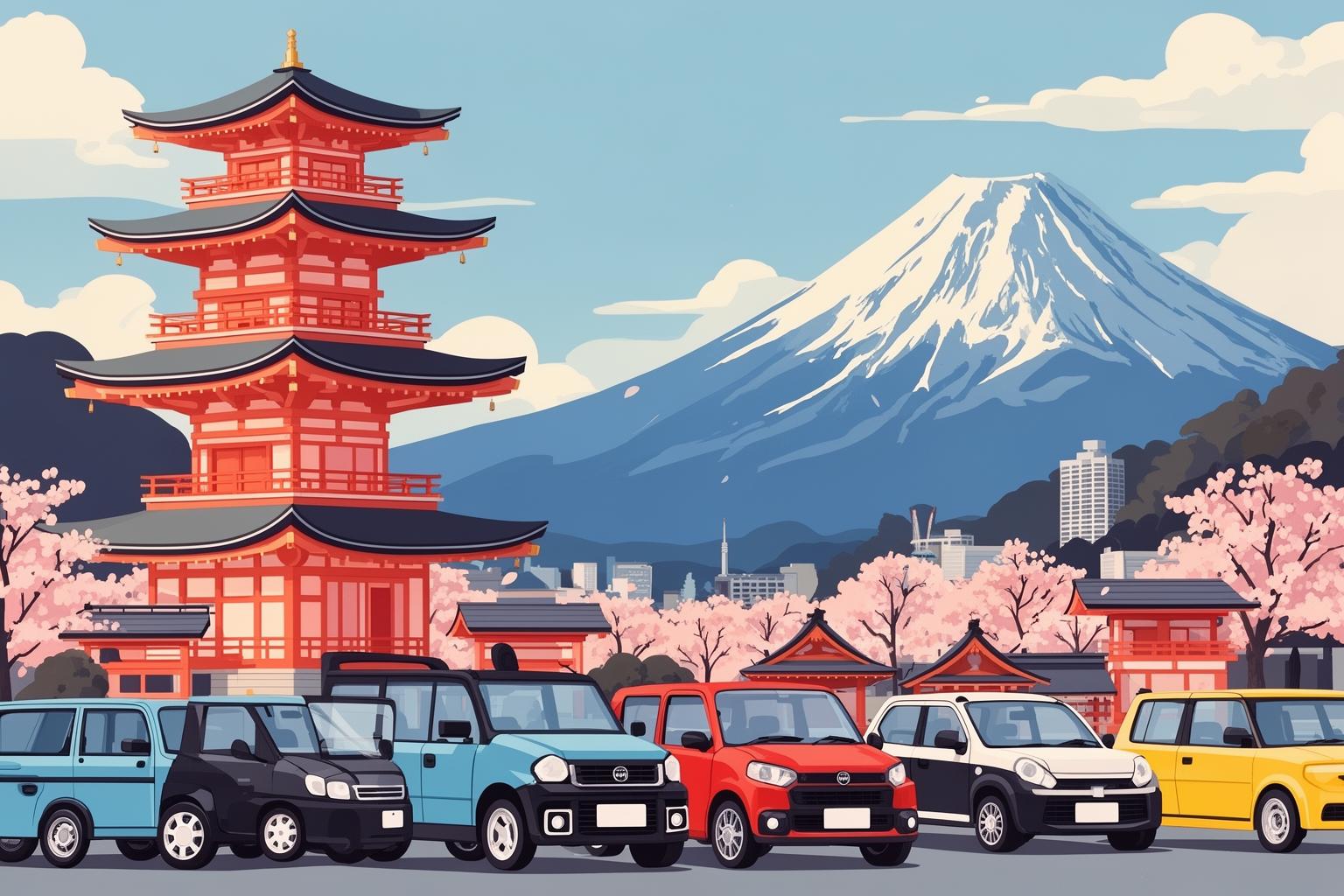
First, let’s discuss the cars you commonly see on the streets here. These small vehicles are known as Kei Jidosha (軽自動車), which translates literally to “light automobile.” To those unfamiliar, they might seem somewhat amusing. They’re short, narrow, and often have the aerodynamic profile of a refrigerator. But dismissing them as merely cute or inexpensive misses the whole point. Kei cars represent a masterclass in design and engineering born out of necessity, evolving into a significant subculture in their own right. They are undeniably the undisputed rulers of Japan’s roads, comprising over a third of all cars in the country. To truly understand modern Japan, you need to understand the Kei car.
The Reason Behind the Size: A Quick History Lesson
To grasp why these cars exist, we need to jump back to post-WWII Japan. The country was rebuilding, and the government had an ambitious goal: motorize the population. People needed to commute, and goods needed transport, but owning a standard car was an unattainable luxury for most families. The solution? Create a new category of vehicle that was affordable to buy, own, and operate. In 1949, the Kei car segment was officially established. The government imposed strict regulations: the vehicle had to remain under specific size limits, and the engine could not exceed 150cc—that’s even smaller than most modern scooters. In exchange for adhering to these limits, owners received significant benefits: major tax breaks, cheaper insurance, and early exemption from shaken (the notoriously costly mandatory vehicle inspection). They were also freed from the shako shomeisho, the proof-of-parking-space certificate required to register a standard car, which is hugely important where parking spots can cost as much as a small car. This was no mere suggestion; it was a powerful economic incentive that shaped Japan’s auto industry. Early models like the charming Subaru 360 (the “ladybug”) and Suzuki Suzulight weren’t just cars—they were emblematic of Japan’s economic miracle, bringing car ownership within reach for millions for the first time.
The Present-Day Appeal: Why Kei Cars Remain Champions
Sure, they made sense decades ago. But Japan is wealthy and advanced now, right? So why do Kei cars still dominate? The answer is straightforward: the factors that made them popular then are often even more vital today. First, the roads. Venture off the main thoroughfares in Tokyo, Kyoto, or other cities, and you’ll encounter a maze of incredibly narrow residential streets, some barely wide enough for one vehicle. A regular sedan feels massive in these tight spaces; a Kei car navigates them like a nimble speedboat. Then there’s parking. Space is the ultimate luxury in Japan, where spots are tiny and expensive. A Kei car’s compact size is a literal lifesaver. Financial incentives remain a huge factor, too: tax and insurance benefits persist, making them far cheaper to run annually than conventional cars. With a stagnant economy for decades, saving every yen matters. But here’s the twist: Kei cars aren’t cheaply made or second-rate anymore. Manufacturers have invested heavily in R&D. The modern Kei is a marvel of smart design. The “tall wagon” or “super height wagon” style—seen in models like the Honda N-Box (Japan’s consistent best-seller), Daihatsu Tanto, and Suzuki Spacia—features a tall, boxy shape creating an interior that feels surprisingly spacious. We’re talking sliding doors, seats that fold flat to fit a bicycle, and more hidden storage than you’d expect. They’re loaded with luxury-level tech—adaptive cruise control, lane-keep assist, heated seats—you name it. They’ve become a deliberate choice, not a compromise. They represent intelligent, practical living.
The Customization Culture: When a Small Box Becomes a Big Canvas
Here’s where it gets fascinating and ties into our theme. Since Kei cars are governed by strict rules (current regulations cap engines at 660cc and specify exterior dimensions down to the millimeter), they’ve turned into the ideal platform for bold, rule-bending creativity. If you think small, practical cars are dull, you haven’t explored the Japanese tuning scene. The culture of personalizing one’s car is massive here, and Kei cars play a huge role. The styles are diverse and rich with decades of Japanese car culture history.
Shakotan and Kaido Racer Style
This is the classic rebellious vibe. Shakotan means “low car height,” focused on lowering a car as close to the ground as possible to achieve an aggressive stance. This often blends with Kaido Racer style, inspired by the exaggerated shapes of 1980s Group 5 race cars. Picture huge, bolt-on fender flares, ridiculously long front splitters (deppa), and towering rear spoilers (takeyari exhaust pipes reminiscent of bamboo spears are also common, though more so on larger cars). Seeing this style on a tiny Suzuki Alto Works or Daihatsu Mira is a striking blend of fierce and cute. It’s a tribute to a bygone era of Japanese rebellion, transforming humble economy cars into race-ready machines. It’s bold, proud, and deeply embedded in Japanese automotive heritage.
VIP Style (Bippu)
On the opposite end is VIP or Bippu style, which began in the 1990s with tuners modifying large black luxury sedans like the Toyota Celsior to resemble what a Yakuza boss might drive. The essentials include an ultra-low stance (often achieved with air suspension), massive deep-dish chrome wheels perfectly flush with the fenders, and a sleek, luxurious aesthetic. Transplanting this style onto a Kei car creates a captivating contrast. Tiny Daihatsu Move or Suzuki Wagon R models decked out with all the VIP trimmings—dazzling multi-piece wheels, plush leather interiors with neck pillows and crystal accessories, and a ride height barely above a pebble—project an aura of extravagant luxury on an unexpectedly small platform. It’s both ironic and undeniably cool.
The Sporty Side: Tiny Powerhouses
Don’t overlook the performance-driven Kei cars. Japan has a legacy of producing legendary small sports cars that meet Kei standards, like the Suzuki Cappuccino, Honda Beat, and the Autozam AZ-1 from the ’90s. Today, models like the Honda S660 and Daihatsu Copen continue that tradition. The tuning scene here is intense, focused on squeezing every bit of power from the tiny 660cc turbocharged engines. You’ll find these cars at track days, touge (mountain pass) runs, and autocross events, often outperforming much larger, more powerful vehicles thanks to their lightweight agility and sharp handling. These aren’t mere cute roadsters; they’re genuine driver’s cars, backed by a passionate community dedicated to the art of high performance in a compact package.
The Mini 4WD Universe: Pocket-Sized Engineering Dreams
Now, let’s scale things down even more—from cars you can barely sit in to cars that fit in the palm of your hand. Welcome to the world of Mini 4WD. Step into a large electronics store like Yodobashi Camera or a specialty hobby shop, and you’ll inevitably find a dedicated section for it. You’ll notice walls lined with colorful car boxes and aisles packed with tiny, intricate parts: wheels, motors, gears, rollers, and quirky plastic components. Often, you’ll also find a massive, multi-level race track set up, with kids and—more often than not—very serious adults bent over their toolboxes. This is Mini 4WD, a genuine cultural institution in Japan.
So, What Exactly Is Mini 4WD?
Let’s cover the basics. Mini 4WD (or Mini Yonku in Japanese) are 1/32 scale, AA battery-powered plastic model cars. The key point is this: there is no remote control. You build the car, flip a switch to turn it on, and place it in a lane on a specially designed walled track. The car then runs on its own—no more input required. It keeps going until the battery dies or it crashes. Winning the race isn’t about driving skill, because there is no driving—it’s about what happens before the car even hits the track. It’s a contest of engineering, physics, setup, and careful customization. The goal is to build the fastest, most stable car possible for the particular track. The whole hobby is dominated by one company: Tamiya. They invented Mini 4WD back in 1982 and remain central to the scene, producing the cars, parts, and sponsoring official competitions, including the prestigious Japan Cup.
The Golden Age and the Comeback Story
Mini 4WD has experienced several huge booms in Japan. The first major surge came in the late 1980s, fueled by the manga and anime series Dash! Yonkuro. Kids nationwide became obsessed, buying the cars their heroes drove and battling at local candy stores and department stores. The absolute peak—the golden age—came in the mid-to-late 1990s, driven by another hit anime, Bakusō Kyōdai Let’s & Go!!. This series raised the bar, featuring characters whose cars had special moves and signature styles. The craze was enormous, making Mini 4WD the “it” hobby for kids then. After this boom, its popularity waned in mainstream culture but never disappeared. Over the last decade, there’s been a huge resurgence with a twist: the kids who idolized Let’s & Go!! heroes are now adults in their 30s and 40s. They’re returning to the hobby with adult budgets, a better grasp of physics, and access to a vast array of high-performance parts. This dynamic has created a multi-generational community where newcomers and veteran “returnee racers” build sophisticated, high-tech machines side by side. It’s a shared passion that transcends age.
The Art of Tuning: Details Matter Most
This is the heart of the Mini 4WD experience. Building a kit straight out of the box is only the beginner’s game. The real challenge lies in tuning. The official Tamiya rulebook sets constraints (maximum width, height, roller count, etc.), and much like Kei cars, all the creativity happens within those limits. The sheer number of adjustable variables is staggering, making it a deep pocket-sized mechanized rabbit hole. Let’s explore the intricacy involved.
Chassis: The Base
Everything begins with the chassis. There are dozens of types, each with distinct layouts, pros, and cons. You have modern mid-ship motor chassis like the MA (Midship Aero) and MS (Midship), prized for stability and balance. Then, rear-motor chassis such as the classic Super-II, the modern VZ (Vertex Zero), and the AR (Aero Response) appeal for various reasons—some are lightweight, some rigid, some easier to modify. Selecting the right chassis for the track is the first major decision for any racer.
Motor: The Engine
The motor is the machine’s heartbeat. Not all motors are equal. Tamiya offers a range of official motors with varying RPM (revolutions per minute) and torque. High-RPM motors like the Hyper-Dash excel on long straights but may lack torque needed for slow corners. High-torque motors like the Torque-Tuned offer strong acceleration but lower top speed. For technical tracks with elevation changes, balanced motors like the Light-Dash are ideal. Picking the right motor is a critical balancing act based on the track layout.
Gears, Wheels, and Tires: The Drive System
Transmitting motor power to the wheels is equally vital. You can tweak gear ratios to favor acceleration (larger ratio) or top speed (smaller ratio). Wheels and tires also play a big role. You can select small, medium, or large diameter wheels—larger wheels yield higher top speed but slower acceleration. Tires come in numerous compounds, from standard rubber to hard, super-hard, and low-friction plastics. Tracks with many corners demand grip, while those with long straights benefit from low-friction tires to minimize speed loss when bumping the walls. Some racers even precisely shave tires to specific diameters for fine-tuning.
Rollers: The Guidance System
Since these cars lack steering, they navigate by bouncing against the track walls via small wheels called rollers. The placement, size, angle, and type of rollers are among the most complex and critical setup elements. Front and rear bumpers have rollers whose angles affect how the car takes corners. Roller types—plastic, aluminum, with or without ball bearings—influence friction and speed. A well-tuned roller setup lets the car glide through corners with minimal speed loss. A poor setup causes slowdowns or worse, wall climbs and crashes. Veteran racers spend hours adjusting rollers to shave milliseconds off lap times.
Mass Dampers: The Secret Edge
Modern Mini 4WD tracks aren’t simple ovals; they feature jumps, bridges, and obstacles that can send cars airborne. This is where mass dampers become essential. These are small, movable weights mounted on carbon fiber or fiber-reinforced plastic (FRP) plates. When landing from a jump, the chassis tends to bounce and risk flying off the track. Mass dampers move independently and, due to inertia, shift opposite to the bounce’s direction, exerting a downward force that keeps the chassis on the track. The placement, weight, and movement range of these dampers distinguish novices from pros. Mastering “damper setup” is crucial for even completing complex laps.
The Connection: A Shared DNA of ‘Making it Your Own’

So, we have one world of real, functional cars and another of tiny, battery-powered racers. Though they seem far apart, the philosophy that drives both cultures is exactly the same. This philosophy emerges from the unique conditions of life in Japan.
Constraint as a Canvas
This is the key point. Both Kei cars and Mini 4WD operate under strict, non-negotiable rules. For Kei cars, these are government regulations on size and engine displacement. For Mini 4WD, it’s the official Tamiya competition rulebook. Yet rather than limiting creativity, these constraints serve as a catalyst. They establish a level playing field and compel innovation within set boundaries. How can you make a car look bold and distinctive when its dimensions are fixed? How can you make a Mini 4WD faster when everyone uses the same pool of motors and parts? The brilliance lies not in breaking the rules, but in mastering them so thoroughly that you uncover new, creative ways to express yourself and gain an edge. It’s about finding maximum freedom within minimal limits.
‘Kodawari’: The Obsession with Detail
There is a Japanese word, kodawari (こだわり), without a perfect English equivalent. It roughly means a relentless, almost obsessive quest for perfection—an uncompromising focus on detail in a particular craft or passion. This mindset drives both of these subcultures. It’s the Kei car owner who spends weeks fine-tuning their coilovers to achieve the perfect fender-to-wheel gap down to the millimeter. It’s the Mini 4WD racer painstakingly polishing a gearbox interior to reduce friction or using a digital caliper to ensure their car’s width is exactly at the 105mm legal limit, not a fraction over. It’s a deep, personal dedication to one’s hobby, a belief that the small details are not just details—they are everything. This is about more than just the final outcome; it’s about the process, the continual journey of incremental improvement.
It’s Not Just a Hobby, It’s a Community
Importantly, none of this occurs in isolation. Both scenes are founded on remarkably strong communities. On any weekend night, you can find Kei car owners gathered in large parking areas like Daikoku Futo near Yokohama, not to race illegally, but to hang out, showcase their latest modifications, and share tips and admiration for each other’s builds. Similarly, hobby shops with Mini 4WD tracks serve as essential community hubs. These are places where racers of all ages and skill levels meet, test their machines, exchange setup advice, and compete in store races. It’s a social scene centered on a shared passion for miniature machines. This social fabric sustains these cultures, passing knowledge and enthusiasm from one generation to the next.
Where to See This Culture IRL
If you’re in Japan and want to see this firsthand, it’s not difficult, but you do need to know where to look. This is not a list of tourist attractions, but rather a guide to experiencing the culture in its natural environment.
For Kei Car Enthusiasts
You don’t have to go anywhere special to spot standard Kei cars; they’re everywhere. However, to see the customized ones, you’ll need to be a bit more deliberate. Check out trendy neighborhoods like Shimokitazawa or Koenji in Tokyo, where you might catch some stylishly modified vehicles used as daily drivers. For the more dedicated scenes, you’ll have to go where the car meets happen. Places like Daikoku PA are legendary, but keep in mind: these are genuine gatherings of enthusiasts, not tourist spots. If you attend, be respectful. Don’t touch the cars, avoid using flash photography, and simply observe quietly. The best way to discover these meets is often by following Japanese car culture accounts on social media.
For Aspiring Mini 4WD Racers
This is much more accessible. The first stop for any curious visitor should be Tokyo’s Akihabara district. Explore the backstreets, and you’ll find multi-story hobby shops like Super Rajikon or TamTam. Head to the Mini 4WD section and just take it all in. You’ll likely spot a track with racers tuning their cars. But the real mecca is the Tamiya Plamodel Factory in Shimbashi, Tokyo. It’s their official flagship store with multiple floors of products and, most importantly, a beautifully maintained permanent Mini 4WD track where you can watch serious racers in action. You can even buy a starter kit and basic tools for about 2,000 yen, build it right there, and try it out on the track. It’s the best way to appreciate the charm—to see your own creation come to life and speed around the course.
The Final Lap: So, What’s the Takeaway?
Returning to the original question: why is Japan this way? Why the fascination with these tiny things? The answer, as you’ve seen, is intricate. It’s a narrative beginning with post-war pragmatism and evolving into a rich tapestry of subcultures. The Kei car and Mini 4WD perfectly embody a national character that values efficiency, embraces limited space, and finds great joy and identity in customization and refinement. It’s about transforming a mass-produced object—whether a modest city car or a small plastic model—into something uniquely personal. It rejects the notion that bigger is always better, instead embracing the idea that the deepest creativity arises within the tightest limits. It’s more than a hobby or a type of vehicle; it’s a mindset. So next time you spot a tiny, boxy car wedged into an impossibly small parking space, or see a miniature race car zooming down a plastic track, you’ll understand. It’s not just about being small—it’s about mastering the small, and that, quietly, is a significant achievement.