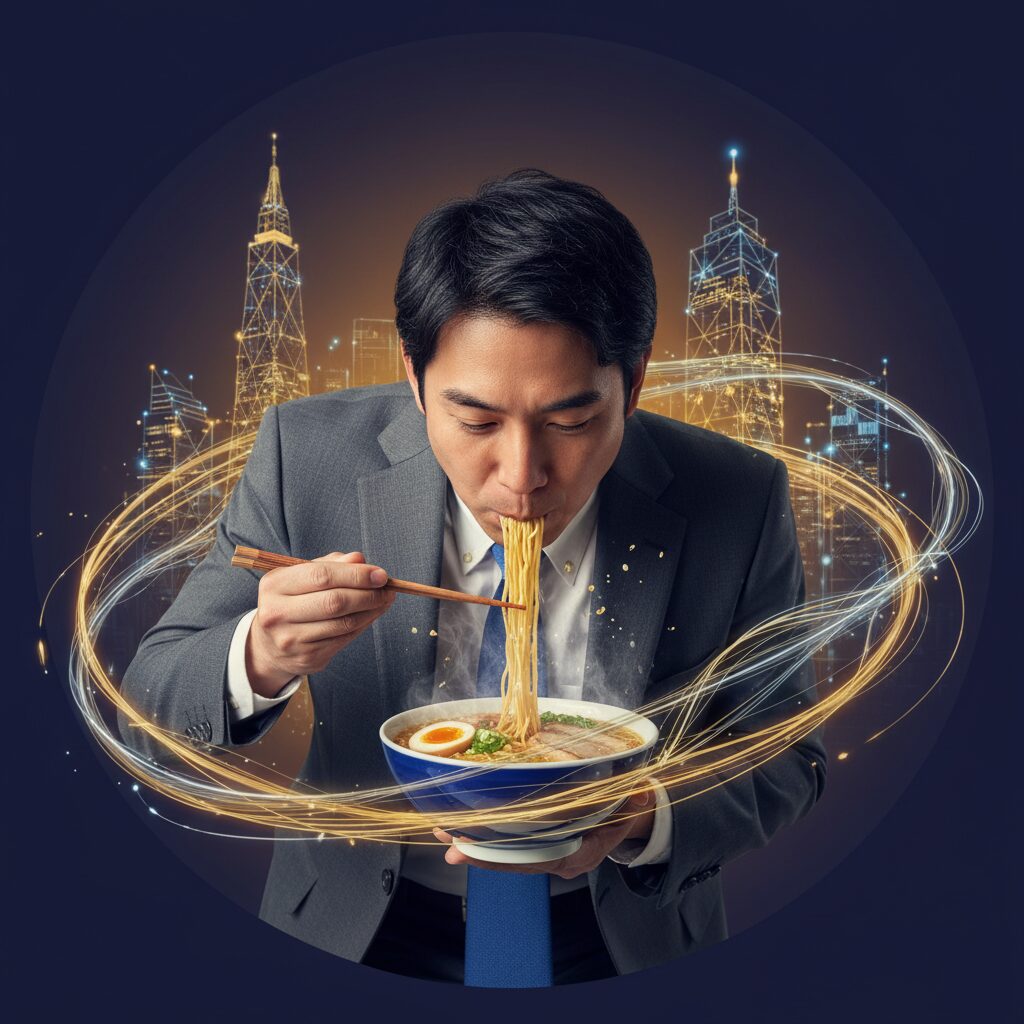
Yo, let’s talk about Japan. You’ve seen the reels, the TikToks, the neon-drenched cityscapes, the serene temples, the wild fashion. It’s a vibe, for sure. But then you get here, you’re sitting in a tiny, steamy ramen joint, and you hear it. A sound that cuts through the air like a power tool. A chorus of intense, unapologetic, full-throated slurping. It’s loud. It’s wet. And if you grew up being told to chew with your mouth closed, it can feel like a full-frontal assault on everything you know about table manners. Your first thought is probably, “What is happening? Is this… rude?” And that’s the disconnect, the classic Japan puzzle. You’re handed this image of an ultra-polite, quiet, and reserved society, but then you’re confronted with a sound that feels anything but. It’s a classic case of expectation versus reality that leaves so many people scratching their heads.
But here’s the drop: that slurp isn’t just noise. It’s not a random cultural quirk or a collective lapse in etiquette. It’s an auditory artifact. It’s a sonic fossil pressed into the concrete of modern Japan, and its story is deeply entangled with the rise of one of the most iconic figures in the nation’s history: the Showa Era salaryman. To understand the slurp is to understand the immense pressure, the breakneck speed, and the soul-crushing sacrifice that powered Japan’s post-war economic miracle. It’s the sound of a nation rebuilding itself, one frantic, scalding mouthful at a time. It’s the soundtrack of ambition and exhaustion, a story of how a generation of men in identical dark suits became the corporate samurai who dragged their country from the ashes into the future. So, before we unpack this, let’s ground ourselves. Let’s head to the heart of salaryman territory, a place where this history still echoes between the train tracks and skyscrapers. Welcome to Shimbashi.
This auditory artifact is just one facet of Japan’s enduring Showa retro vibe, a cultural nostalgia that permeates everything from ski lodges to late-night ramen shops.
The Anatomy of a Slurp: More Than Just Noise
Before we enter the corporate battles of the 20th century, we need to clarify one thing. Slurping noodles in Japan isn’t merely accepted; it serves a purpose. This technique arises naturally from the nature of the food itself. It’s not just about making noise for its own sake. There is a science and sensory logic behind it that is completely misunderstood when seen through a Western perspective. For the Japanese palate, noodles offer a multi-sensory experience, and the slurp is the key to unlocking their full flavor. It is a fundamental part of the culinary language—a verb in the act of eating that conveys appreciation, enhances taste, and honors the food’s integrity. Eating noodles quietly is, in a way, not truly tasting them. It’s like listening to your favorite song on cheap headphones—you catch the melody but miss the deep bass and subtle harmonies that add depth and soul. The slurp is the high-fidelity sound system for your noodles.
The Culinary Logic: Flavor, Temperature, and Texture
Let’s unpack how this works. First, flavor. When you slurp, you’re not just drawing noodles into your mouth; you’re actively aerating them. You pull in a stream of air along with the noodles and broth. This process, similar to swirling wine in a glass, releases the volatile aromatic compounds in the broth, especially from ingredients like dashi, soy sauce, and miso. These aromas travel up the back of your throat to your olfactory receptors, a method known as retronasal olfaction. Much of what we perceive as “taste” is actually smell. By slurping, you immerse your senses in the full fragrance of the dish before chewing. It’s a flavor enhancer. In contrast, a quiet bite delivers only a fraction of this aromatic intensity.
Next is temperature. Japanese noodles—whether ramen, soba, or udon—are typically served piping hot. The broth may be near boiling, and the noodles are carefully cooked to a texture that deteriorates quickly once they sit. You’re expected to eat them quickly, at their peak. Slurping offers a clever cooling mechanism. The same inflow of air that boosts aroma also cools the hot noodles just enough to prevent mouth burns. This lets you enjoy the dish rapidly without discomfort. It’s a practical answer to a practical challenge, a culinary design honed over centuries.
Lastly, and perhaps most importantly to the Japanese connoisseur, is the concept of nodogoshi. This term, lacking a direct English equivalent, roughly means “throat feel” or “the sensation of food gliding down your throat.” For noodles, the ideal nodogoshi is a smooth, swift, and pleasant passage. The aim isn’t to chew noodles into mush but to savor their texture and elasticity as they flow down. The slurp powers this sensation, creating a continuous, fluid momentum that allows the noodles to be experienced as long, silky strands rather than a fragmented mouthful. This textural pleasure is central to enjoying Japanese noodles and is physically unattainable without a proper, energetic slurp.
Beyond the Bowl: A Social Soundtrack
The slurp is practical, but its meaning extends far beyond the mechanics of eating. It’s also a form of non-verbal communication, a social soundtrack that defines a certain dining atmosphere. Enter a tachigui-soba (stand-and-eat soba) shop—often tucked away in a train station corner—and you find yourself in a temple of speed and efficiency. There are no chairs, no leisurely chatter. The space is designed solely to fuel the body quickly. Within this context, the rhythmic slurping is the background music. It’s a collective hum of intent. It says, “We are all here to eat, and we are all in a hurry.” A silent, hesitant diner would feel out of place, breaking the unwritten rules of the environment.
The sound also serves as a signal to the chef. A hearty slurp is an audible compliment. It communicates, more effectively than words, that you are thoroughly enjoying your meal. It’s a sign of gratitude, a visceral thank you for the food. In a culture that often favors subtlety in communication, this loud, clear, and immediate feedback is a powerful form of praise. It completes the connection between creator and consumer in a primal, satisfying way. It’s a raw expression of pleasure in a society that generally values restraint. This duality is essential. The slurp is a brief, permitted break from the quiet conformity that dominates many other areas of Japanese public life. It’s a small act of rebellion—a pocket of acceptable noise in a world of expected silence.
Birth of a Modern Samurai: The Rise of the Salaryman
To fully understand why the slurp became so deeply ingrained in the cultural fabric of modern Japan, you need to go back to 1945. The end of World War II left Japan in complete devastation. Its cities lay in ruins, its empire had vanished, and its national identity was fractured. The nation faced what seemed like an insurmountable challenge: rebuilding from absolute zero. What ensued was one of the most remarkable economic recoveries in history, often referred to as the Japanese post-war economic miracle. Between the 1950s and 1980s, Japan transformed from a defeated country into a global economic powerhouse. At the heart of this national effort, the frontline figure in this economic battle, was the salaryman.
From Ashes to Skyscrapers: The Post-War Context
Picture the psychological state of post-war Japan. There was a strong sense of collective purpose, a shared national mission not only to recover but to surpass the West. It was about more than economics; it was about reclaiming national pride. The government, particularly the influential Ministry of International Trade and Industry (MITI), worked closely with Japan’s major industrial conglomerates, the keiretsu (successors to the pre-war zaibatsu), to drive growth. They focused on key sectors—steel, automobiles, electronics—and invested heavily in them. The aim was total economic mobilization, which demanded a new type of workforce.
This national endeavor required a disciplined, loyal, and hardworking labor force willing to sacrifice personal interests for the company’s good, which in turn was tied to the nation’s well-being. The company became the new domain, the new clan. The battlefield had shifted from Pacific islands to the global marketplace. Every Japanese citizen, especially the educated white-collar male, was expected to enlist in this new workforce army. The message was implicit but strong: personal life was secondary to the grand national project of reconstruction and economic supremacy. The needs of the group, whether company or country, overwhelmingly outweighed those of the individual. This mindset became the foundation of the salaryman’s world.
The Corporate Warrior: Forging a New Identity
The term sararīman (salaryman) is a uniquely Japanese creation, a wasei-eigo (Japanese-coined English word). He was more than just a white-collar worker. He stood as a symbol and an ideal, a modern samurai who had exchanged swords for a briefcase and his feudal lord for a corporation. This was more than a metaphor; the parallels were deliberate. The samurai code of Bushido—with loyalty, duty, and self-sacrifice at its core—was adapted for the corporate environment. The salaryman pledged absolute loyalty to his company, which in return provided a paternalistic, cradle-to-grave security system.
This system was supported by three pillars, known as the “Three Sacred Treasures” of Japanese management. First was lifetime employment (shūshin koyō), guaranteeing a job for life once hired out of university. Second was a seniority-based wage system (nenkō joretsu), where salary and rank rose steadily with years of service, regardless of performance. Third was the enterprise union, collaborating with management to maintain stability rather than pursue adversarial labor relations. This social contract strongly appealed to a generation that had only known the chaos and hardship of war and its aftermath. It promised stability, predictability, and a clear path to a comfortable middle-class life. The cost of this security, however, was near-total commitment. The company was not just a workplace; it became one’s identity. You didn’t simply work for Sony; you were a Sony man. Your life revolved around the company’s rhythms, demands, and culture.
The Uniform of Conformity: Suit, Briefcase, and Identity
This subordination of the individual to the corporate collective was visually embodied by the salaryman’s uniform. Strolling through a major business district like Marunouchi or Otemachi during the Showa Era, you would see a sea of identical figures: men dressed in dark, conservative suits (navy, black, or grey), crisp white shirts, muted ties, black leather shoes, and practical briefcases. This was not a matter of fashion but a deliberate statement of intent. The attire indicated seriousness, reliability, and interchangeability within the corporate machine. Individuality was minimized. Flair was viewed with suspicion. The goal was to blend in and demonstrate commitment to group harmony (wa), the paramount social value.
This conformity served as a powerful tool for social cohesion. It visually erased class distinctions and fostered a sense of shared purpose. Each suited man was a fellow soldier in the economic battle. The uniform was a badge of honor. It signified success—a member of the educated, middle-class elite driving Japan’s progress. It represented stability, a steady income, and social respectability. It was the physical manifestation of the Showa dream. Yet it was also a cage. The uniform dictated not only appearance but also behavior: stoic, diligent, and utterly devoted to the company above all else, including family and personal well-being. This immense pressure to perform and conform daily created the conditions under which the salaryman’s slurp transcended mere noodle eating; it became a symbol of his entire existence.
The Slurp as a Symbol: Fueling the Economic Engine
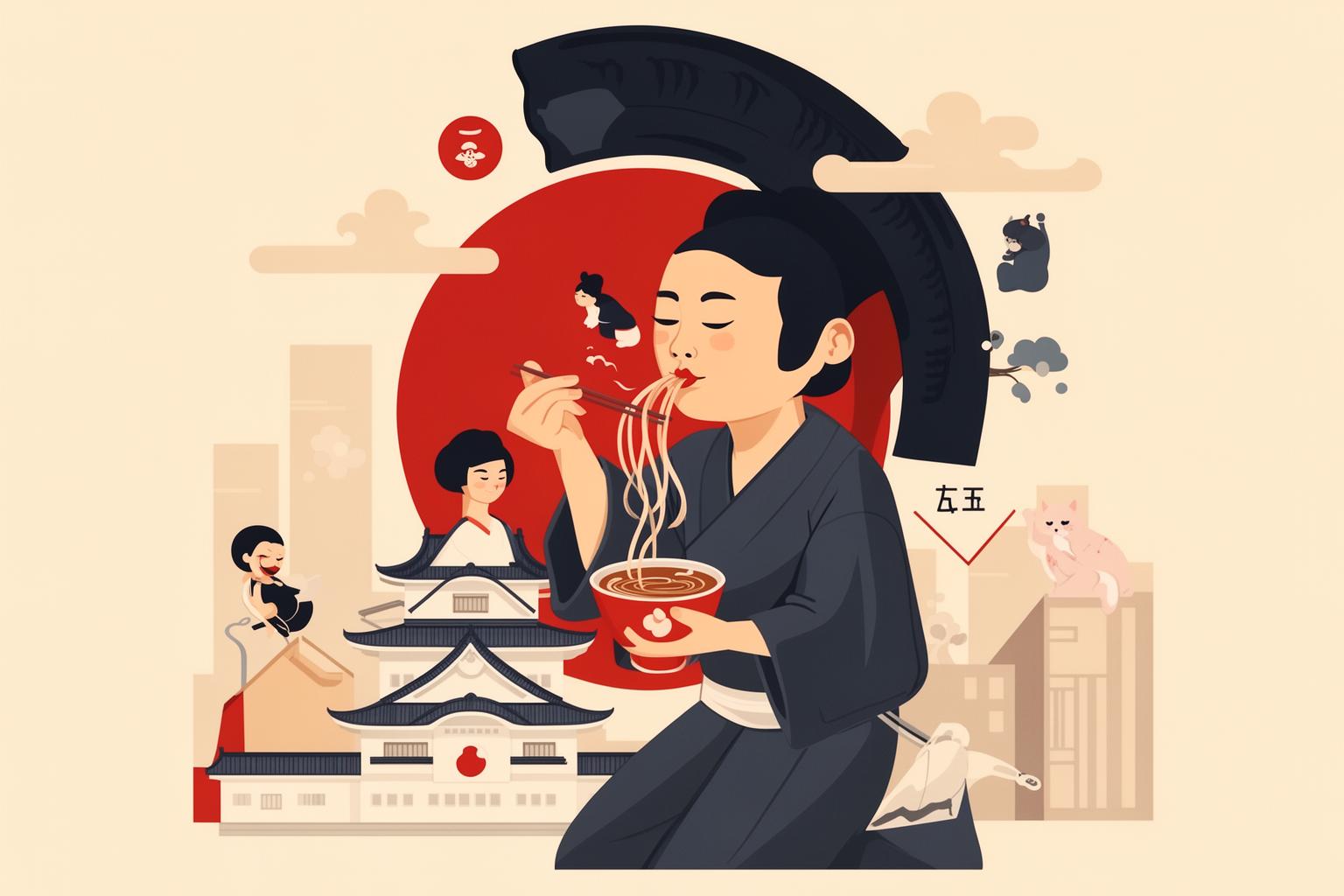
Now, let’s connect the dots. We have this figure—the Showa salaryman—a man enduring grueling hours under immense pressure, in a culture that prizes efficiency and group harmony above all else. His entire existence is a race against time. His time doesn’t belong to him; it belongs to the company. How does a man like this eat? He doesn’t dine; he refuels. Within this context, the loud, rapid slurp of noodles becomes more than a mere culinary habit—it turns into a potent symbol of his life and era. It is the sound of the economic miracle in motion, the rhythmic pulse of a workforce driven by exhaustion, ambition, and cheap, fast carbohydrates.
Lunchtime as a Pit Stop: The Gospel of Efficiency
For the salaryman, lunch wasn’t a moment for leisurely rest. It was a pit stop. The Western idea of a one-hour lunch break was an unimaginable luxury. Time away from the desk was time wasted, viewed as a betrayal of the collective effort. The salaryman’s lunch was often a rushed, 10-to-15-minute affair. This is where tachigui-soba and corner ramen shops became vital infrastructure. They were the fueling stations for the corporate army.
These establishments were, and remain, marvels of efficiency. You buy a ticket from a vending machine, give it to the cook, and a steaming bowl of noodles appears in front of you within minutes. You stand at a narrow counter, shoulder-to-shoulder with other suited men, and you eat. Fast. Here, slurping wasn’t just acceptable; it was essential. It was the only method to consume a scalding hot bowl of noodles at the necessary speed. The slurp was a tool, a technique to maximize caloric intake in minimal time. Every noisy, rapid mouthful was a testament to the gospel of efficiency dominating the salaryman’s world. It was a physical embodiment of the kaizen (continuous improvement) philosophy applied to eating. How can I consume this energy faster to return to my post? The answer was the slurp. It was pure, unfiltered function over form.
A Sound of Solidarity and Struggle
Picture a tiny noodle shop crowded with a dozen men in identical suits, all slurping in unison. That sound forged an extraordinary sense of unspoken camaraderie. It was a shared ritual, a moment of collective experience bonding these corporate soldiers. It was masculine, unpretentious, and powerful—a stark contrast to the delicate, silent, highly ritualized etiquette of traditional Japanese dining, such as the tea ceremony or formal kaiseki meals. The slurp was the sound of the modern working man—the builder, the producer. It was earthy and genuine.
Within that shared sound lay an implicit recognition of their common struggle. Each slurp acknowledged the long hours ahead, demanding bosses, endless meetings, and the crushing pressure to meet targets. It was a sound that said, “I see you, I’m with you, we’re in this together.” It served as a form of non-verbal communication in a culture that discourages open displays of emotion or complaint. You couldn’t openly grumble about your job, but you could slurp your noodles with a ferocity that spoke volumes about your hunger, stress, and fatigue. It was a small, sanctioned act of defiance—a way to confront the day starting with lunch. It was a brief, visceral release in a life marked by control and restraint. The louder the slurp, the more you were enjoying the food—but perhaps also, the more stress you were attempting to momentarily escape.
The Izakaya Aftermath: From Slurping Soba to Sipping Sake
The salaryman’s workday didn’t end at 5 PM. Often, it was just the beginning of a second shift. The culture of nomikai (literally, “drinking gathering”) was, and still is in many companies, an essential and frequently quasi-mandatory part of the job. These after-work sessions at an izakaya (Japanese pub) were not simply for enjoyment. They were an extension of the office—a critical space for building relationships, smoothing conflicts, and exchanging information that couldn’t be shared within the formal workplace hierarchy. This was where your boss, lubricated by sake and beer, might reveal his true intentions, and where you could forge the alliances needed for your career.
Refusing to attend a nomikai was seen as antisocial or a sign of not being a team player. So, the salaryman went. He drank, poured drinks for his superiors, listened, and bonded. These gatherings could last for hours, often moving through multiple locations in a practice called nijikai (second party) and sanjikai (third party). And what was the final stop for many of these exhausted, inebriated men before stumbling to the station to catch the last train home? A late-night ramen shop. The shime-ramen, or “finishing ramen,” was another ritual. Once again, the bowl would be consumed with a loud, satisfying slurp. It was the final refueling—a salty, fatty comfort food that bookended a day often started 16 or 18 hours earlier. The slurp was the alpha and omega of the salaryman’s grueling day, a constant sonic motif in the opera of his working life.
The Showa Echo: The Slurp in Contemporary Japan
The Showa Era, once synonymous with promises of continual growth and stable employment, came to an abrupt end in the early 1990s. The collapse of Japan’s asset price bubble marked the beginning of an economic stagnation known as the “Lost Decades.” The world that had given rise to the salaryman—and which the salaryman in turn helped shape—began to unravel. The certainties of the post-war period vanished, and the social contract was broken. This profound shift profoundly influenced Japanese work culture and, by extension, transformed the cultural significance of the slurp. Though the sound remains, its meaning has become less straightforward. It now stands as a site of cultural tension, symbolizing a past that many younger Japanese are actively questioning.
The Heisei Hangover and the Lost Decades
The economic collapse of the 1990s delivered a severe psychological blow. Companies that once guaranteed lifetime employment began to lay off workers. The seniority-based wage system deteriorated, replaced by performance-based evaluations. The clear and secure path once envisioned for the Showa salaryman now appeared to lead nowhere. Young people entering the workforce could no longer rely on the same stability their fathers had. A new class of precarious workers emerged: “freeters” (a blend of “free” and the German “arbeiter”) who drifted between part-time jobs, and dispatch workers lacking job security.
The salaryman ideal, formerly a source of national pride, became met with skepticism and even pity. The image of the corporate warrior gave way to that of the exhausted, disenfranchised worker—a cog in a machine that no longer advanced. The immense sacrifices made by the Showa generation were reassessed. Was it worth it—to devote your entire life to a company, to sacrifice your health and family, only to be discarded when the economy faltered? This widespread disillusionment sparked a fundamental reevaluation of the individual’s relationship with the company. The concept of “work-life balance” began entering the Japanese lexicon, directly challenging the work-first ethos that dominated the Showa era.
Is the Slurp Fading? Generational Shifts in Etiquette
With these changing attitudes toward work came a shift in how behaviors associated with it are viewed. For younger generations, the frantic, all-consuming lifestyle of the Showa salaryman is not something to emulate. The slurp, so closely linked to that culture of speed and efficiency, is now seen through a more critical perspective. In recent years, the term nuuhara, or “noodle harassment,” has appeared. This term, discussed with a mix of seriousness and sarcasm, refers to the discomfort that slurping sounds can cause, especially to foreigners but also to some younger Japanese accustomed to a more globalized, digitally connected world.
This debate exposes a growing generational divide. For many older Japanese, the idea that slurping could be offensive is baffling. To them, it is the natural, proper, and respectful way to eat noodles—a cherished part of their culinary culture. But for some younger people, influenced by Western etiquette through media and travel, the sound can be grating. They may see it not as a sign of appreciation, but as an outdated, unrefined, and somewhat embarrassing habit. This tension reflects a broader cultural negotiation happening in Japan today: which traditions deserve preservation, and which are outdated relics of a bygone era? Is the slurp an indispensable element of Japanese identity, or should it be softened to fit a more globalized sensibility? There is no simple answer, and the debate itself signals a culture in transition.
The Enduring Soul of the Salaryman
Despite these shifts, it would be wrong to declare the era of the salaryman—or the slurp—over. While economic structures have changed, the cultural DNA runs deep. Core values that defined the Showa workplace—emphasis on group harmony (wa), reading the atmosphere (kūki o yomu), the clear divide between public face (tatemae) and private feelings (honne), and the intense social pressure to work long hours as proof of commitment—remain powerful forces in many Japanese companies. The phenomenon of karoshi, or death from overwork, tragically testifies to this enduring legacy.
And so, the slurp persists. You can still enter a noodle shop in Shimbashi or Toranomon during the lunch rush and hear that familiar symphony. It may no longer be the sound of a nation single-mindedly pursuing economic conquest, but it remains the sound of Tokyo at work. It’s the sound of an impending deadline, a train to catch, a brief moment of solace in a hectic day. The slurp has become a complex echo, carrying the history of Showa era triumphs alongside their immense human cost. It represents both a deeply rooted culinary tradition and a controversial social practice. It is a sound connecting today’s Japan to the sacrifices of its past—a reminder of the tireless energy that built the modern city, one slurped noodle at a time.
Conclusion: Listening to Japan’s Past in a Bowl of Noodles
So, we return to that initial question—the jarring, wet, loud sound that feels so out of place. Is it rude? The answer, like many things in Japan, is, “It’s complicated.” From a strictly culinary standpoint, it is the proper and most appreciative way to enjoy a bowl of noodles. It is a technique, not a breach of etiquette. Yet, as we have seen, the slurp is much more than that. It is a cultural symbol, a sonic key that reveals one of modern Japan’s most significant stories.
It narrates the tale of a nation’s post-war desperation and its extraordinary ambition that followed. It tells of the salaryman, the corporate samurai who devoted his life—his time, energy, and health—to the company’s altar in exchange for stability and a share of the new Japanese dream. The slurp echoes his hurried lunch, the fuel for long hours of overtime, the rhythmic percussion of an economy running at full speed. It carries layers of meaning: efficiency, solidarity, masculinity, stress, and immense sacrifice.
To understand the slurp is to begin grasping the deeply ingrained work ethic and conformity pressures that continue shaping Japanese society, even as new generations challenge them. It perfectly illustrates a key principle for anyone seeking to understand this fascinating and often perplexing country: simple, everyday actions frequently represent the visible tips of vast, submerged cultural and historical icebergs. The next time you’re in Japan, sitting in a ramen shop, listen carefully. Don’t just hear the noise—try to catch the echoes within it. You might hear the sound of a dark-suited salaryman from half a century ago, slurping his soba before rushing back to his desk to build the future. You might just hear the complex, contradictory, and powerful soul of a nation, all contained in a single bowl of noodles.