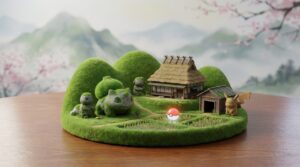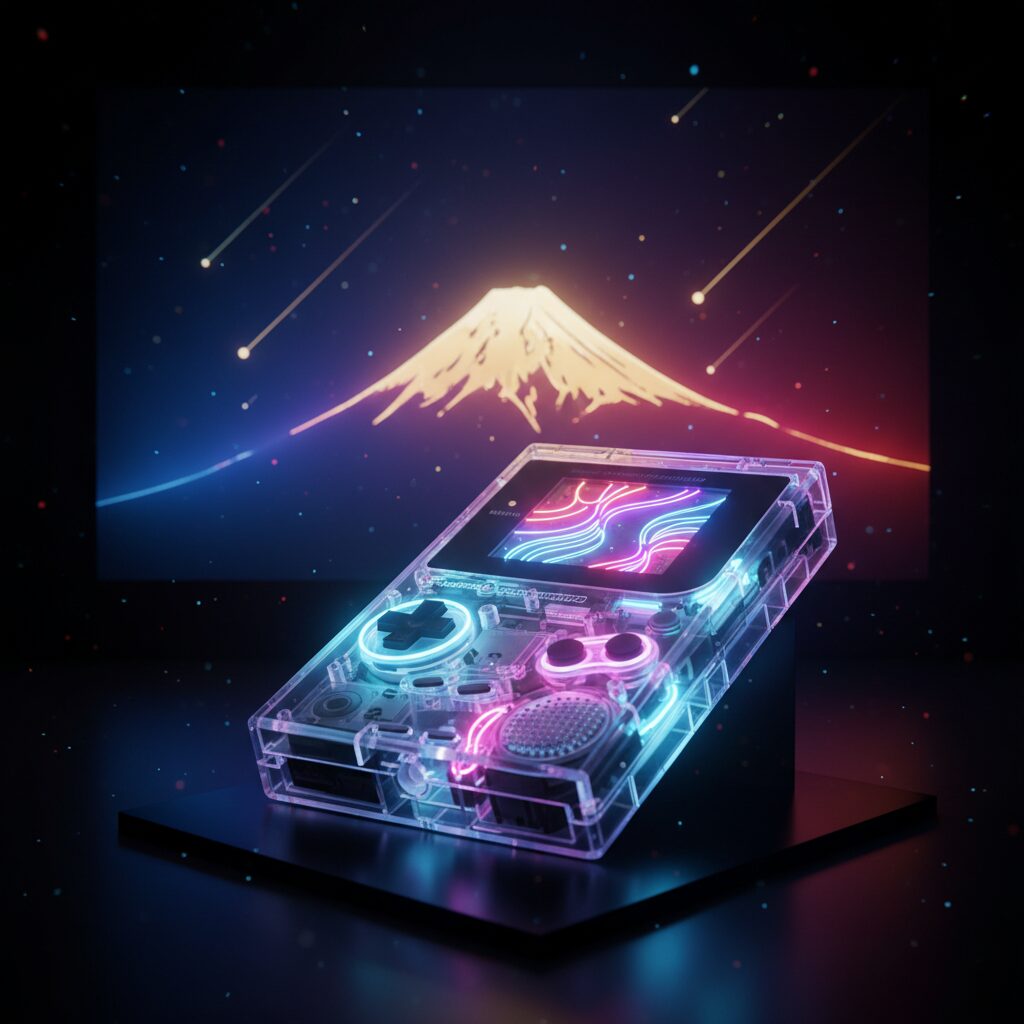
Aight, let’s get real for a sec. Strip away the high-tech gloss of modern Tokyo, the neon-drenched cyberpunk fantasies you see on your feed. I wanna take you somewhere else. A smaller, quieter, more personal space. Picture this: it’s late, maybe 1 AM. The entire house is asleep, cloaked in that specific suburban silence. You’re under your covers, a makeshift tent of fabric and secrets, and the only light source is a tiny, monochrome screen. It’s casting this eerie, greenish-yellow glow on your face. The world outside doesn’t exist. All that matters is the faint, tinny 8-bit music filtering through a single cheap speaker and the soft, plastic thump-thump-thump of your thumb on the D-pad. You’re navigating a forest of chunky pixels, your heart pounding because your starter Pokémon is low on HP and you just heard the cry of a wild Pokémon you’ve never seen before. That, right there, is the core memory. That’s the Game Boy vibe. Specifically, that’s the feeling of playing Pokémon Red, Blue, or Green, a ritual that seared itself into the collective consciousness of an entire generation in Japan. It was more than a game; it was our first taste of a private universe, a world that was entirely ours, tucked away in our pockets and brought to life under the covers. And here’s the wild part: in a nation that’s supposed to be obsessed with the future, with bullet trains and walking robots, this primitive, pixelated feeling is still a major cultural touchstone. It’s a vibe that refuses to die. So the real question isn’t just about nostalgia. It’s deeper. Why does this specific, low-fi experience—the ghost of that 8-bit glow—still have such a profound grip on the Japanese psyche? Why are people still dropping serious yen on dusty cartridges in the back alleys of Akihabara? It’s because that little grey brick wasn’t just a console. It was a cultural blueprint. It taught us how to find infinity in the small, the personal, and the imperfect. It’s an emo-i (エモい) feeling, a kind of gut-punch of nostalgic emotion that’s hard to translate but easy to feel. It’s the origin story for a certain kind of modern Japanese escapism, and to get why Japan is the way it is today, you gotta understand the glow.
This enduring love for the Pokémon world even inspires modern adventures, like our guide to finding real-life Pokémon in the Japanese countryside.
The Sacred Pixels: It Wasn’t About Graphics, It Was About Imagination
Let’s be brutally honest. The original Game Boy was, from a technological standpoint, essentially a potato. It featured a four-shade, pea-soup green dot-matrix screen and a processor that would be outperformed by a modern singing birthday card. Its sound consisted of bleeps and bloops that resembled a fax machine in distress. By any objective modern standard, it was primitive. But here’s the key thing you need to understand about Japanese aesthetics: limitation is often viewed as a strength rather than a weakness. The most powerful art doesn’t always reveal everything; instead, it leaves room for audience participation. The Game Boy epitomized this philosophy. It was a collaboration between designer and player. The designers provided a rough sketch, and your mind was tasked with painting the masterpiece. Its simplicity was its genius—a blank canvas that invited you to add your own colors.
The Art of Absence: How Simplicity Became a Canvas
Consider this: when you entered Viridian Forest in Pokémon Red, you weren’t seeing a photorealistic forest. You saw a handful of generic tree sprites repeated repeatedly. But in your mind, that place felt expansive, mysterious, and brimming with life. The music wasn’t a grand orchestral composition; it was a simple, looping chiptune melody. Yet it perfectly captured the sense of adventure mixed with slight apprehension. And Lavender Town? It’s infamous for its eerie atmosphere. The unsettling music was merely a set of jarring, high-pitched notes, but because it was so sparse and alien, your imagination filled the gaps with unspeakable horrors. It was psychologically terrifying in a way that a modern, graphically intense horror game could never match, because the real horror unfolded inside your mind. This concept is deeply rooted in Japanese culture, embodied by the principle of ma (間), the powerful use of negative or empty space in art and design. In an ink wash painting, the unpainted white space is just as crucial as the brushstrokes; it gives the subject room to breathe and lets the viewer complete the scene. In a traditional Japanese room, the absence of furniture isn’t a sign of scarcity; it’s an intentional design choice to foster peace and focus. The Game Boy’s technical limits forced its creators to embrace a digital form of ma. They couldn’t overwhelm players with detail, so they mastered the art of suggestion. A few pixels had to express an entire emotion. A simple sound effect had to communicate victory or defeat. This imposed creativity both on developers and players. Modern games, with their hyper-realistic graphics and exhaustive detail, are undoubtedly impressive achievements. But they can also be passive experiences, revealing everything and leaving little room for the player’s imagination. The Game Boy didn’t just let you play the game; it made you a co-creator of its world. That feeling of ownership—of shaping Pallet Town in your mind—is what forged a connection photorealism can never replicate. It was a personal universe, colored by your imagination, and that’s an unforgettable vibe.
A World in Your Pocket: The Rise of Personal Universes
To truly grasp the Game Boy’s impact, you must consider Japan’s social reality in the late ’80s and ’90s. This was the time when the bubble economy burst, ushering in the “Lost Decade.” Yet it was also a period of intense urban density. Homes, by Western standards, were extremely compact, and privacy was a luxury. Kids often shared rooms. The daily commute involved being packed shoulder-to-shoulder with strangers on crowded trains. Personal space was—and remains—a rare and valuable commodity. Into this setting, Nintendo introduced the Game Boy. It wasn’t merely a portable gaming device; it was a mobile sanctuary. It was a passport to another reality accessible anytime, anywhere. On that crowded Yamanote Line train, surrounded by a sea of black suits and school uniforms, you could pull out your Game Boy, and suddenly you weren’t confined to a packed metal tube. You were an adventurer, a Pokémon trainer on Route 1, carrying the weight of the world on your tiny 8-bit shoulders. This act of carving out a bubble of personal space in a public setting is a fundamental aspect of modern Japanese urban life. You see it today with people engrossed in their phones—playing a mobile game, reading manga, or scrolling social media—physically present but mentally elsewhere. The Game Boy was the analog prototype of this digital escapism. It gave you a way to reclaim your mental space. The experience of playing was intensely private. Its small screen was hard to view from an angle, preventing easy over-the-shoulder peeking. The sound was often played through headphones. It was a world made for one. This fostered a relationship with the game that felt deeply personal, nearly like a diary or a secret friend. Your team of six Pokémon wasn’t just data; they were your team. You raised them from level 5, agonized over which moves to teach, gave them awful nicknames. This deep personalization, fused with the portability that made the game a constant companion, created an emotional bond unlike any before. It wasn’t a family activity centered around the living room TV, like with the Famicom (NES). It was uniquely yours. This notion of a personal, portable universe has shaped Japanese media consumption ever since. It explains the enduring dominance of handheld gaming in Japan and the enormous success of mobile games today. And it all began with that gray brick and the promise of a world you could hold in your hands.
Digital Bonsai: The Culture of Collecting and Perfecting
If you really want to understand why Pokémon, specifically, became a cultural atomic bomb in Japan, you can’t only focus on the cute creatures. You need to examine the gameplay loop. The core mechanic—“Gotta Catch ‘Em All”—appealed directly to a deeply rooted cultural instinct for collecting, cataloging, and perfecting. It wasn’t just about completing the story. It was about the endless, meditative process of finishing a collection. This was a digital take on a very traditional Japanese pastime. Think of it as akin to tending a bonsai tree. You don’t simply “complete” a bonsai. You nurture it, prune it, and patiently shape it over years toward an ideal form. The process itself is the reward. Pokémon provided a similar sense of fulfillment. It was an ongoing project, a digital garden of creatures to be carefully managed. This style of gameplay resonated on a level that a straightforward “defeat the villain” story never could.
“Gotta Catch ‘Em All” as a Contemporary Kata
In Japanese martial arts, there is a concept known as kata (型). Kata are sequences of moves practiced repeatedly until they become second nature. The goal isn’t simply to master a fighting technique; it’s about discipline, focus, and the quest for perfection through repetition. The process is meditative, calming the mind and refining the spirit. Now, consider the Pokémon gameplay loop: you enter the tall grass, encounter a wild Pokémon, battle it, weaken it just enough without knocking it out, throw a Poké Ball, either catch it or fail, then repeat. After that, you battle trainers to level up, fine-tune movesets, evolve Pokémon, and organize PC storage. This entire process is a form of digital kata—a highly structured, repetitive activity that produces gradual progress. It rewards patience, strategy, and dedication. Unlike the instant-gratification loops common in many modern games, it’s a slow burn, and that’s exactly why it was so addictive. It reflected the shokunin (職人) or artisan spirit—the commitment to mastering a single craft. In Japan, there is profound respect for the sushi chef who perfects rice preparation over decades, or the swordsmith who folds steel countless times. Pokémon enabled every child to become a shokunin of their own digital craft. The objective wasn’t only to become the Pokémon League Champion. For the truly devoted, that was just the start. The real game lay in completing the Pokédex—earning bragging rights for catching all 150 (or the legendary 151). It meant breeding the perfect specimen with ideal stats, a process that could consume hundreds of hours of methodical effort. This pursuit of a self-defined ideal, this steady dedication to a repetitive task, is a cultural value deeply embedded in Japanese society. Pokémon simply provided an accessible, contemporary manifestation. It transformed players into collectors, curators, and masters of their own tiny pixelated worlds.
The Link Cable: A Tangible Bond in an Abstract Realm
Here’s an aspect that those who didn’t live it might miss: the Link Cable. Before Wi-Fi and the internet in every pocket, the only way to trade or battle Pokémon with friends was through a thick, physical cable plugged into each Game Boy. This seems almost quaint now, but its social and cultural impact was enormous. You couldn’t just battle a stranger halfway across the globe. You had to be physically together—sitting next to your friend after school, on a train, or in the park—and literally link your two devices. This physical requirement transformed Pokémon from a solitary pastime into a deeply social, real-world event. Trading a Graveler to evolve it into a Golem wasn’t an anonymous exchange on some global server. It was a negotiation, a conversation, a moment of eye contact and trust: “You’ll trade it back, right?” This tangible connection rooted the digital experience in physical reality. It wove a rich social fabric around the game. Schoolyards buzzed as hubs of rumors and bartering: Who has a Scyther? Did you know you can get a Farfetch’d in a trade at Vermilion City? The ultimate legend was Mew. The mythical 151st Pokémon, unobtainable through normal playing, became the subject of nationwide urban legends. Rumors spread not via websites, but by word of mouth, creating a shared sense of mystery and community. This emphasis on face-to-face interaction is, again, deeply tied to Japanese culture. Despite being highly technologically advanced, Japan maintains a strong preference for in-person meetings and relationship-building through shared time and space. The Link Cable perfectly bridged the digital realm of the game with the analog norms of Japanese social life. It ensured the community surrounding the game was local and personal. It forced players to engage with those around them, strengthening friendships and sparking rivalries. It was a social network before social media, anchored by a bulky, essential piece of plastic and wire. That shared, physical experience is a big reason why nostalgia for this era remains so powerful. Pokémon wasn’t just a game; it was about who you played it with.
The Persistence of Pixels: Why Retro is a Vibe, Not Just a Throwback
Fast forward to the present day. You might assume that in the dazzling, ultramodern cityscape of Tokyo, a bulky piece of ’90s technology like the Game Boy would be long forgotten. But quite the opposite is true. It’s more prominent and cherished than ever before. Step into the right shops in Akihabara or Nakano Broadway, and you’ll find pristine, boxed copies of Pokémon Red fetching prices that could leave you dizzy. This isn’t merely a niche collectors’ market. It reflects a much broader cultural trend known as “Heisei-Retro.” This deep-rooted nostalgia for the Heisei era (1989–2019) has elevated the Game Boy to one of its most revered symbols. It’s not just about reminiscing on the past; it’s a deliberate rejection of today’s oversaturated, perpetually connected world in favor of something slower, more tangible, and perhaps a little more authentic. It’s about pursuing a vibe—a sense of imperfect authenticity—that today’s sleek, seamless technology simply can’t replicate.
Heisei-Retro and the Charm of the “Imperfect” Past
The Heisei era was an unusual period for Japan. It began with the burst of the economic bubble and was followed by years of stagnation, natural disasters, and national soul-searching. Yet, for the generation raised during that time, it’s now being idealized as a golden age. Why? Because it was the last era before the internet and social media completely flattened cultural diversity. It was an age of delightfully clunky technology—flip phones with customizable blinking antennas, MiniDiscs, and Tamagotchis. These gadgets had character and quirks. They had limitations. They weren’t the sleek, black monoliths of glass we all carry today. The Game Boy stands as the ultimate emblem of this ethos. Its imperfections are exactly what endear it to fans. The absence of a backlight meant you needed a good source of light to play, making gaming a ritual. The reliance on AA batteries limited playtime, rendering each session more precious. The chunky, durable plastic felt substantial in the hand. It created a physical connection to the device. This aesthetic of “lovable imperfection” offers a powerful counterbalance to the anxiety of the modern digital world. Today’s devices demand constant attention. Notifications ping endlessly. Social media pressures users to perform and curate a flawless online persona. In contrast, the Game Boy was a completely offline escape, self-contained and private. It didn’t connect to servers or ask you to share your progress. It was a walled garden, a quiet refuge from the world’s demands. The Heisei-Retro movement yearns for that calm. It’s about appreciating the fuzzy resolution of a CRT TV, the warm crackle of a cassette tape, and the simple, honest pixels of a Game Boy screen. It’s a form of cultural digital detox—a way to reconnect with an era when our relationship with technology felt more deliberate and less overwhelming. It’s not simply a nostalgic throwback; it’s a subtle act of rebellion.
Akihabara’s Hidden Corners: Where the Glow Endures
To witness this phenomenon firsthand, head to Akihabara—but skip the main street with its massive, flashy electronics stores. Instead, venture into the back alleys, ascend narrow staircases in dusty, cluttered buildings. There you’ll find retro gaming shrines like Super Potato, Beep, and Trader. Entering one of these stores is like stepping into a time capsule. The air is thick with the scent of aged plastic and cardboard. Chiptune melodies from a multitude of games blend into a chaotic symphony. The walls are lined floor to ceiling with gaming history: cartridges for the Famicom, Super Famicom, PC Engine, and, of course, the Game Boy, all meticulously arranged and priced. Look closely at the shoppers—it’s not just tourists hunting for quirky souvenirs. It’s Japanese people in their 20s, 30s, and 40s, standing before the glass cases with quiet intensity, eyes scanning for that one game that marked their childhood. They carefully inspect the box’s condition, check if the original manual remains inside. This is about more than gameplay—you can do that easily with emulators. It’s about owning the artifact. In an age where games are increasingly sold as fleeting digital downloads, possessing a physical cartridge is a powerful statement. It forms a tangible link to memory—a proof that what you loved truly existed with weight and substance. This connects deeply to the broader otaku culture of collecting. Whether it’s anime figurines, manga volumes, or retro games, collecting, curating, and preserving physical objects is central to fandom. It’s about making a personal museum of one’s passions. Akihabara’s retro game stores are living, breathing examples of this ethos. They serve as archives of joy, run by and for those who understand that these objects’ value lies not only in their code but in the memories they hold. The Game Boy’s glow never truly faded here; it merely hibernated, awaiting a new generation to rediscover its simple, enduring magic.
The Glow Under the Covers: A Metaphor for Modern Japanese Escapism
So let’s circle back to where it all began: that child beneath the covers, bathed in the soft green light of a tiny screen. That moment, that ritual, is more than a fond childhood memory. It perfectly symbolizes a distinct and enduring facet of the Japanese experience. It’s about the art of crafting vast, limitless worlds within tightly confined spaces. It’s about discovering freedom and identity not through outward expansion, but by turning inward. That little haven of light beneath the duvet was a training ground. It taught a generation how to create a universe for one, a skill essential for navigating the complexities of modern Japanese life. The legacy of that glow is everywhere—you just have to know where to find it.
Small Spaces, Infinite Worlds
Japan is a land defined by elegant constraints. A chain of islands, largely mountainous and uninhabitable, it compels a dense population to cluster in urban centers. Living spaces are compact. Social rules can be strict. The group often takes precedence over the individual. In this setting, the ability to forge a rich inner world is more than a pastime; it’s a survival technique. The Game Boy was the ideal tool for this. It physically embodied the principle of finding the infinite within the finite. A small, grey box housing entire continents to explore. This philosophy permeates Japanese culture. The bento box is not merely a lunch container; it’s a tiny, edible landscape, carefully arranged for visual harmony in a limited space. A Zen garden uses a handful of rocks and raked sand to symbolize the great ocean and enduring mountains. The concise, 17-syllable haiku captures a fleeting moment of profound beauty in nature. The pattern is clear: maximum experience from minimal space. The Game Boy and the world of Pokémon fit seamlessly into this cultural mindset. The game offered a vast world to lose yourself in, but the interface was a small screen and a few buttons. It was an intensely personal, manageable adventure. This ethos extends to modern social trends. Consider the rise of ohitorisama (お一人様) culture, where dining, karaoke, and even travel alone are not only accepted but embraced. It’s about enjoying experiences on your own terms, within your own personal bubble. Think of manga and anime that deliver incredibly deep, complex worlds to immerse yourself in over hundreds of chapters or episodes. These are all forms of modern escapism following the blueprint set by that first generation of portable gaming. It’s the art of building a fortress of solitude: a rich interior world accessible anytime, anywhere, as refuge from the pressures of the outside world.
It’s Not Nostalgia, It’s a Blueprint
Ultimately, dismissing the enduring love for the Game Boy as mere nostalgia misses the point entirely. It’s so much more than that. Nostalgia is a passive yearning for a lost past. The Game Boy vibe, by contrast, is an active, living principle shaping Japanese culture. It’s a foundational text. It established a set of preferences for how a generation engages with technology, media, and fantasy itself. It prioritized imagination over raw graphical power. It demonstrated that a deep, personal connection to a digital world was possible. It celebrated the quiet, meditative joy of collecting and perfecting. And it made social gaming a local, tactile, face-to-face experience. The spirit of that child under the covers—shielded from the adult world, fully absorbed in a secret universe of their own creation—remains the driving force behind much of what makes modern Japan fascinating and, to outsiders, somewhat puzzling. You see its presence in the intense dedication of cosplayers refining costumes for months. You see it in the staggering sales of mobile gacha games centered on collecting character rosters. You see it in the focused person on the train absorbed in a light novel on their phone, lost in another world. Technology has evolved into sleek smartphones, graphics are dazzlingly complex, and networks fully global. But the fundamental desire endures: the longing for a world in your pocket, a world that is manageable, personal, and deeply your own. That is the true legacy of the Game Boy. It wasn’t just a toy; it was a teacher. And its lesson is one Japan has never forgotten. That soft green glow was a spark—and the culture it ignited continues to burn bright. It’s a whole mood. IYKYK.