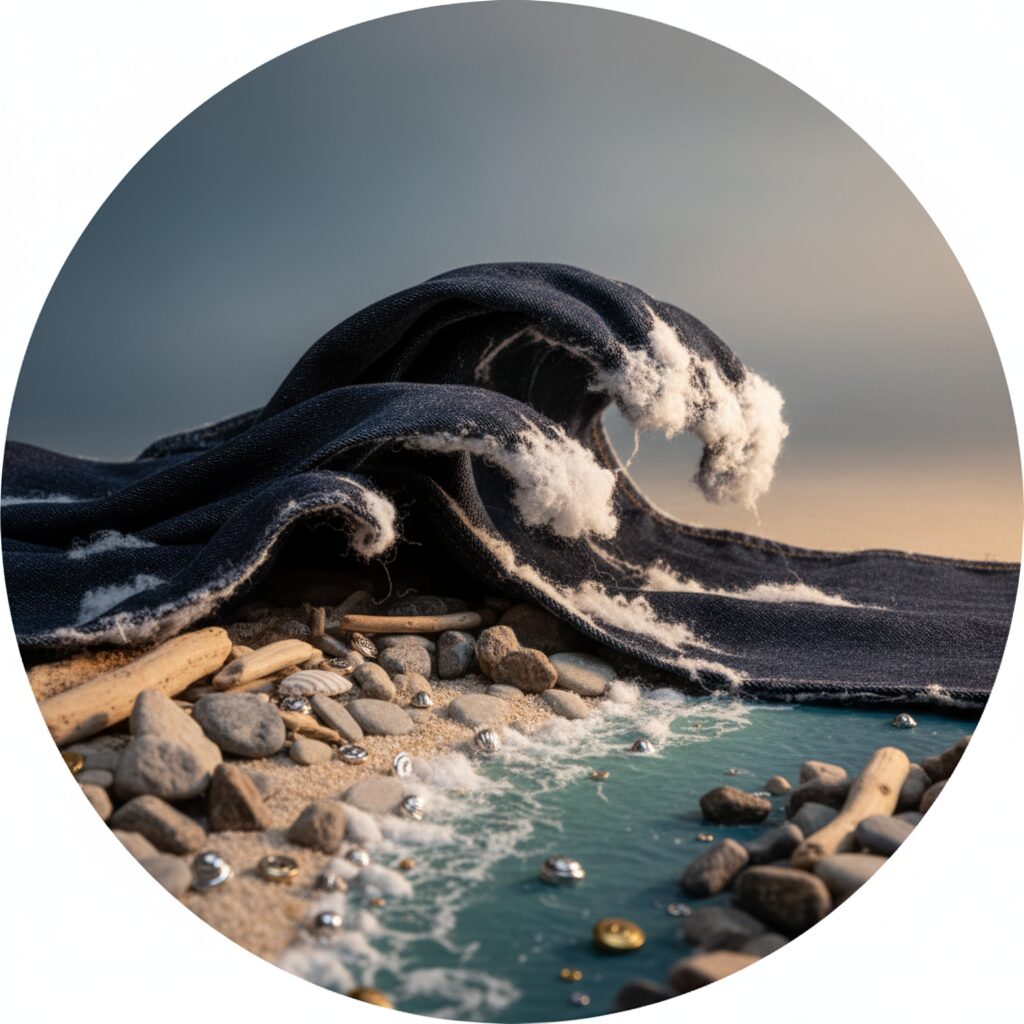
You see it the moment you step off the train in a place like Kamakura or Onomichi. It’s not a uniform in the way a salaryman’s suit is in Marunouchi, but it’s a uniform nonetheless. A sea of faded, light-washed denim. It’s on the guy running the third-wave coffee stand, the girl browsing a bookstore, the family walking their Shiba Inu along the beach. This specific shade of blue, worn soft and pale like the sky on a hazy summer afternoon, feels less like a fashion choice and more like a piece of the landscape itself. It’s a whole vibe, a low-key aesthetic that seems to emanate from the salty air. And if you’ve spent any time in Japan’s coastal towns, you’ve probably wondered, what’s the real deal with this look? It’s not just a fleeting ’90s revival trend; it feels way deeper, more ingrained. Why this particular fabric, in this particular state of fade? The answer isn’t a simple one. It’s a story woven from the threads of post-war aspiration, obsessive craftsmanship, a profound connection to nature, and a quiet, philosophical rebellion. It’s a rabbit hole of cultural history, and we’re about to go all the way down. This isn’t just about pants; it’s about understanding a core piece of modern Japanese identity that lives and breathes by the sea.
この海岸沿いの美学は、波乗りの後にラムネを開ける爽快感と共鳴する、リラックスした生活様式の一部なのです。
The Ghost of Americana: Deconstructing the Post-War Style Blueprint
To understand why faded denim resonates so uniquely in Japan, you have to go back in time—quite far back. The story doesn’t begin in a fashionable seaside café but amid the rubble and rebuilding of the post-war period. The arrival of American GIs was not just a geopolitical event; it was a cultural upheaval. For a generation of Japanese youth raised in a society defined by austerity, tradition, and conformity, American culture symbolized a powerful, almost mythical vision of freedom. And denim was its emblematic fabric.
From GI Uniforms to Ivy League Chic
The initial exposure was immediate and tangible. American soldiers, during their downtime, wore jeans—rugged, practical, and effortlessly stylish—an entirely different approach from the formal, often restrictive attire typical in Japan. These weren’t simply pants; they embodied a relaxed, confident masculinity that was utterly compelling. The worn workwear of the American GI became a focal point of fascination. Yet, the true spark behind denim’s cultural ascendancy came later, fueled by media and the allure of aspirational fashion.
In the 1960s, Japan experienced an “Ivy League” craze, propelled by influential magazines such as Men’s Club and Heibon Punch. These publications acted as style manuals for a generation, carefully dissecting the casual, preppy look of American college students. They produced detailed illustrations and guides for achieving the look: button-down shirts, penny loafers, chinos. Within this polished aesthetic, denim served as the rebellious younger sibling—weekend wear, the choice for a subtle break from the rules. Denim was the fabric of American youth, and Japanese youth longed to be part of it. They sought not just the clothing but the lifestyle it signified—one of leisure, freedom of movement, and self-determination.
The Appeal of the West Coast Dream
While Ivy League style laid the groundwork, it was the sun-soaked imagery of the American West Coast that truly solidified the association between light-washed denim and a particular sense of freedom. Hollywood was the primary purveyor of this dream. Legends like James Dean in Rebel Without a Cause and Marlon Brando in The Wild One embodied a heady mix of rebellion, angst, and casual style, almost always wearing denim. Their jeans weren’t pristine; they were worn, faded, and shaped by life, telling stories of existence lived on the fringes.
This image was further intensified by the rise of surf culture. The California dream—with endless beaches, perfect waves, and a laid-back vibe—became a powerful fantasy for young people in island Japan. Surfing magazines and films captured a world of sun-bleached hair, salty skin, and inevitably, faded Levi’s. The light denim wash was more than a hue; it was proof of a life spent outdoors, exposed to sun and sea. It looked naturally worn by the elements, symbolizing authenticity and a rejection of the indoor, office-bound lifestyle. For Japanese youth, especially those near the coast, adopting this look was a means of importing the Californian dream, embodying a freer, more nature-connected lifestyle than the conventional societal model.
The Monozukuri Mindset: How Japan Mastered and Perfected Denim
Admiring and imitating a cultural product is one thing; adopting it, deconstructing it to its molecular level, and recreating it so flawlessly that you surpass the original is quite another. This is the story of Japanese denim. The shift from consuming American vintage jeans to producing the world’s most sought-after denim perfectly exemplifies the Japanese spirit of monozukuri—a term that roughly means “making of things,” but conveys a profound, almost spiritual commitment to craftsmanship, precision, and continual refinement.
The Kojima Origin Story: From School Uniforms to Global Denim Mecca
The worldwide hub of premium denim isn’t in California or Texas but in a small, humble town on the Seto Inland Sea called Kojima, located in Okayama Prefecture. Before becoming a pilgrimage site for denim enthusiasts, Kojima was known for its textile industry, producing thick, durable canvas and robust fabrics used for traditional workwear and school uniforms. This existing industrial base and deep-rooted expertise in weaving and dyeing laid the perfect groundwork for the denim revolution.
In the 1960s, as jeans demand surged, companies such as Maruo Clothing (which later became Big John) saw an opening. Initially, they imported used American jeans, repairing and reselling them. But their monozukuri drive prevented them from stopping there. They embarked on a painstaking reverse-engineering process, meticulously dismantling vintage Levi’s 501s, analyzing every stitch, rivet, and subtlety of the fabric weave. Their initial obstacle was the fabric itself; American mills held a monopoly on authentic, high-quality denim. However, in the early 1970s, they partnered with Kurabo mill to develop Japan’s first domestically produced selvedge denim, the legendary “KD-8” (Kurabo Denim 8). With this breakthrough, Big John launched the “M” Series, the first jeans completely manufactured in Japan. This marked a turning point—Japan was no longer merely an importer of American culture but a creator, refining the blueprint with its unique sensibilities.
The Art of the Fade: Wabi-Sabi in Weaving and Washing
Here, the story shifts from simple replication to genuine artistry, revealing the cultural essence behind the light-washed aesthetic. To grasp the Japanese fixation on faded denim, one must understand the philosophical notion of wabi-sabi. At its heart, wabi-sabi embraces the acceptance of transience and imperfection. It honors the beauty of modest, humble, and unconventional things. It values the marks of time, the patina of age, the signs of a life lived. A flawless, brand-new item is seen as sterile and characterless. Its beauty blooms through aging, chipping, fading, and weathering.
Denim epitomizes the wabi-sabi garment. A pair of raw, dark indigo jeans starts as a blank canvas. With wear, washing, and time, the fabric narrates a unique story. The deep indigo dye flakes off, revealing fades that directly reflect the wearer’s life and habits. Sharp creases behind the knees are called hachi-no-su (honeycombs). The radiating lines at the crotch are hige (whiskers). The vertical fading along the thighs is tate-ochi (vertical drops). While these fades were often accidental in the West, in Japan, they became a celebrated art form.
Japanese artisans didn’t simply wait for these effects to develop naturally. They devised sophisticated, labor-intensive methods to produce perfect vintage fades from day one. They pioneered and mastered stone washing, sandblasting, hand sanding, and even specialized tools to craft exquisitely detailed, naturally aged wear patterns. The light-washed denim worn along the Shonan coast isn’t merely a pair of old jeans—it’s often a brand-new, costly garment meticulously and artfully aged by a master craftsman. It’s a pre-packaged history, a tangible expression of wabi-sabi available for purchase off the rack. This may seem contradictory, but it reveals a profound cultural desire to own objects embodying aged, imperfect beauty, even if that age is skillfully manufactured.
The Selvedge Secret and the Shuttle Loom Obsession
To truly understand the superiority of Japanese denim, one must discuss the machinery. In the mid-20th century, American denim mills like Cone Mills gradually phased out their old, slow, inefficient shuttle looms in favor of modern, high-speed projectile looms. While these new machines produced fabric faster and wider—ideal for mass production—they sacrificed certain qualities. The old shuttle looms wove a tighter, denser fabric featuring a distinctive “self-edge” or “selvedge” (from which the term derives), characterized by a red or white line running along the outseam. More importantly, the slower, gentler weaving process of these vintage looms introduced subtle imperfections, slubs, and irregularities in the fabric’s texture. This “chatter” of the old machines gave the denim a unique character impossible to replicate with modern looms. Crucially, this irregular texture fosters the most beautiful, high-contrast fades over time.
Recognizing this opportunity, Japanese textile entrepreneurs in the 1970s and 80s traveled to America and purchased decommissioned vintage Toyoda shuttle looms, shipping them back to areas like Kojima. They painstakingly restored and maintained these machines, preserving a manufacturing method the rest of the world had deemed obsolete. This dedication to vintage machinery exemplifies monozukuri at its peak. It’s a belief that the old, slow, and more challenging methods often yield superior results. This is why today the selvedge line on a pair of jeans’ cuff remains a symbol of quality and authenticity—an insider’s mark of distinction. It’s also the fundamental reason Japanese denim possesses the depth and character to fade into the soft, nuanced shades of blue seen along the coast.
The Coastal Connection: Sea, Salt, and a Specific Shade of Blue
The technical expertise behind denim production is only part of the story. The other part involves context. Why did this particular aesthetic—the soft, faded blue—take such a strong hold specifically in Japan’s coastal communities? The answer lies in the powerful interaction between the environment, a subcultural style movement, and the unique psychology of living by the sea in Japan.
An Island Nation’s Palette: Echoing the Environment
Japan is an island nation, shaped by its connection to the sea. The ocean serves as a source of sustenance, a protective barrier, a transportation route, and a constant, influential presence in the national mindset. It’s no wonder, then, that the visual language of its coastal towns is deeply shaped by the surrounding environment. The color palette is naturally softer and more muted than the hyper-saturated, neon-lit urban centers. It’s a world of sandy beiges, weathered wood greys, sea foam whites, and countless shades of blue drawn from the sky and sea.
Light-washed denim fits into this natural palette so seamlessly it almost feels like camouflage. The faded indigo reflects the color of the Pacific on a hazy, sunlit day. It carries the same soft, worn-in character as driftwood or a sun-bleached seaside sign. In places like Kamakura, the Chiba coast, or the islands of the Seto Inland Sea, this aesthetic is about more than fashion; it’s about harmony. It expresses a wish to blend with the environment rather than stand out from it. This sharply contrasts with Tokyo’s urban fashion, which often favors dark, precise, architectural silhouettes designed for a concrete jungle. The coastal uniform is gentler, more organic—a visual representation of the “slow life” philosophy embraced by many of these communities—a lifestyle more attuned to the rhythms of nature, tides, and seasons.
“Ame-kaji”: The Lasting American Casual Influence
To grasp coastal style, you need to understand Ame-kaji. This term, short for “American Casual,” isn’t a passing trend in Japan; it is a lasting, foundational pillar of Japanese fashion, as established as punk, prep, or streetwear in the West. Since its emergence in the ’70s and ’80s through magazines like Popeye, Ame-kaji has grown into an expansive style universe with many sub-genres: rugged workwear, rockabilly, military surplus, and most importantly for this story, the West Coast surf and skate style.
This coastal form of Ame-kaji defines the vibe of places like the Shonan coast. It’s a carefully curated style ecosystem centered around a few essential elements: a perfectly worn vintage t-shirt (often featuring an obscure American university or band logo), a cozy hoodie or flannel, classic sneakers like Converse or Vans, and the undeniable centerpiece—light-washed jeans. This look conveys ease, comfort, and a deep respect for authentic, well-crafted goods. More importantly, it communicates a specific mindset. Wearing this outfit quietly declares that you are not a corporate sarariman. It embodies a lifestyle focused on leisure, hobbies (such as surfing or vintage hunting), and a rejection of Japan’s high-pressure, fast-paced urban world. It’s a style that says, “I’d rather be at the beach.”
Beyond Fashion: Denim as a Philosophical Statement
By now, it’s evident that this is about far more than just aesthetics. In a society as attuned to non-verbal communication as Japan, clothing choices are seldom random. The widespread embrace of faded denim in coastal regions is a subtle yet powerful philosophical statement, pushing back against key aspects of mainstream Japanese life while embracing alternative values.
The Comfort of the Worn-In: A Contrast to Urban Formality
Imagine the typical Tokyo commuter: a crisp dark suit, a starched white shirt, polished leather shoes. This is the uniform of conformity, efficiency, and professionalism—a kind of social armor. It’s sharp, rigid, and projects a flawless, impersonal facade. Now, contrast that with the coastal attire: soft, faded denim; a loose-fitting t-shirt; comfortable sneakers. Every element of this style reflects opposite values—comfort over presentation, softness over rigidity, individuality over conformity. The fabric itself is both physically and metaphorically softer, a garment whose hard edges have been smoothed by time and wear.
Choosing to wear this style is a deliberate rejection of the rigid corporate system. It’s a uniform for a different way of life, one that doesn’t require armor. This is especially meaningful in communities like Kamakura or Zushi, popular bedroom towns for Tokyo workers. For many, changing out of their suits and into faded jeans on the train ride home is a symbolic act: shedding the pressures and expectations of city life and embracing the relaxed, personal identity nurtured by the sea. The denim, in this sense, is a comfort blanket, a tangible link to a more easygoing state of being.
Second-Hand Culture and the Pursuit of Authenticity
The passion for faded denim is tightly connected to Japan’s vibrant vintage and second-hand clothing culture. Neighborhoods like Shimokitazawa and Koenji in Tokyo are renowned for their treasure troves of used clothing shops, where enthusiasts devote hours to finding the perfect, authentically aged piece. This pursuit is less about saving money and more about seeking authenticity—unique items that carry a story woven into their very fabric. A pair of 1980s Levi’s with a natural fade is far more prized by certain consumers than a brand-new pair from the store.
This respect for second-hand goods resonates strongly with the wabi-sabi ideal. The item’s history, imperfections, and wear are exactly what give it value and beauty. The light-washed denim of the coastal regions is the ultimate embodiment of this philosophy. It is a garment that proudly shows its age—whether genuine or artfully created. In a world dominated by disposable fast fashion and mass-produced perfection, this aesthetic champions the idea that things should be made to endure, gaining value rather than losing it as they age. It is a search for something authentic and tangible in an increasingly digital and fleeting world.
The Modern Wave: Is the Vibe Still Real?
We have traced this aesthetic from the California coast to the looms of Kojima and into the philosophical core of Japan. But what does it signify today, in a world dominated by global trends and fast fashion? Does the light-washed coastal uniform still hold cultural significance, or has it simply become another easily replicated style?
Fast Fashion vs. Artisan Denim: A Continuing Struggle
Step into any Uniqlo or GU in Japan, and you’ll find racks of light-washed, pre-distressed jeans priced far below their artisanal counterparts. The aesthetic has been codified so effectively that it is now widely mass-produced. This has inevitably diluted its original meaning. When anyone can purchase the “look” of a well-worn life off the rack for a few thousand yen, does it still serve as a marker of a distinct, counter-cultural lifestyle?
The answer is nuanced. In truth, two parallel currents now exist. The mass market has adopted the light-washed aesthetic because it is comfortable, versatile, and visually appealing. It has become a staple of casual Japanese fashion, detached from its deeper historical and philosophical significance. However, for the core community—the true enthusiasts, the denimheads, surfers, artisans, and vintage aficionados inhabiting these coastal towns—the distinction between mass-produced and authentically crafted denim is paramount. For them, their attention to detail has only deepened. They seek out small, independent brands like OrSlow, Kapital, Fullcount, and pure blue japan, which still utilize vintage shuttle looms and innovate with natural dyeing and washing techniques. They can distinguish between a laser-etched fade and one earned through years of wear. For this group, the uniform holds more meaning than ever, serving not only to differentiate themselves from the corporate mainstream but also from the fast-fashion masses.
The Global Gaze and the Re-Importation of a Japanese Ideal
Perhaps the most intriguing chapter in the modern story of Japanese denim is its return journey across the Pacific. Having mastered an American icon, Japan emerged as the world leader in quality denim. Today, denim connoisseurs from Europe and America turn to Japan for the most authentic, highest-quality, and most beautifully fading jeans. Kojima brands are fetishized on menswear blogs and sold in upscale boutiques in New York and London. There is a profound irony in an American invention being perfected in Japan and then re-exported to the West as a luxury artisanal product.
This global recognition has, in turn, strengthened the pride and value of denim craftsmanship within Japan. It has transformed what was once an imitation of foreign culture into a celebrated exemplar of unique Japanese artistry—monozukuri. The faded blue denim along the Japanese coast is no longer merely a shadow of Americana. It is a richly layered cultural artifact that carries the memory of a post-war dream of freedom, exhibits a dedication to craftsmanship bordering on obsession, reflects the serene beauty of the coastal landscape, and offers a quiet philosophical counterpoint to the relentless pace of modern life. It weaves past and present together with an indigo thread, faded by sun and sea into something distinctly and beautifully Japanese.