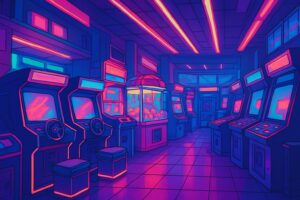
You’ve seen the videos. Someone pushes open a glass door and the world dissolves. A tidal wave of sound—a chaotic symphony of J-pop, synthesized explosions, cheerful announcer voices, and the endless clatter of plastic tokens—washes over the camera. The light is a strobing, shimmering entity, a nebula of neon pinks and electric blues that reflects off every polished surface. Rows upon rows of machines, each a self-contained universe of frantic activity, stretch into a darkened, cavernous space. It looks less like a place of leisure and more like the engine room of a cyberpunk starship. This is the Japanese game center, or gēsen, and your first reaction is probably a simple, overwhelming question: Why?
Why is it so loud? Why is it so bright? Why is it so… much? This isn’t just an arcade. It’s a full-blown sensory assault, an experience so intense it borders on the psychedelic. For anyone who has stepped into one, from the multi-story towers of Akihabara to the modest corner arcade in a suburban shopping mall, the feeling is the same: you’ve crossed a threshold into another reality. It’s a fever dream rendered in pixels and plastic, a place that seems to operate on a different set of physical and social laws. This article isn’t a guide on which games to play. It’s an attempt to decode that fever dream. We’re diving deep into the cultural, historical, and spatial logic that created these magnificent, overwhelming cathedrals of play. Because the gēsen isn’t just a place to play games; it’s a vital text for understanding modern Japan’s relationship with technology, public space, social interaction, and the deep, cultural need for a dedicated zone of beautiful, glorious chaos.
To further explore Japan’s unique blend of technology and urban aesthetics, consider diving into the world of its cyberpunk vending machines.
The Architecture of Overload: Sound, Light, and Vertical Space
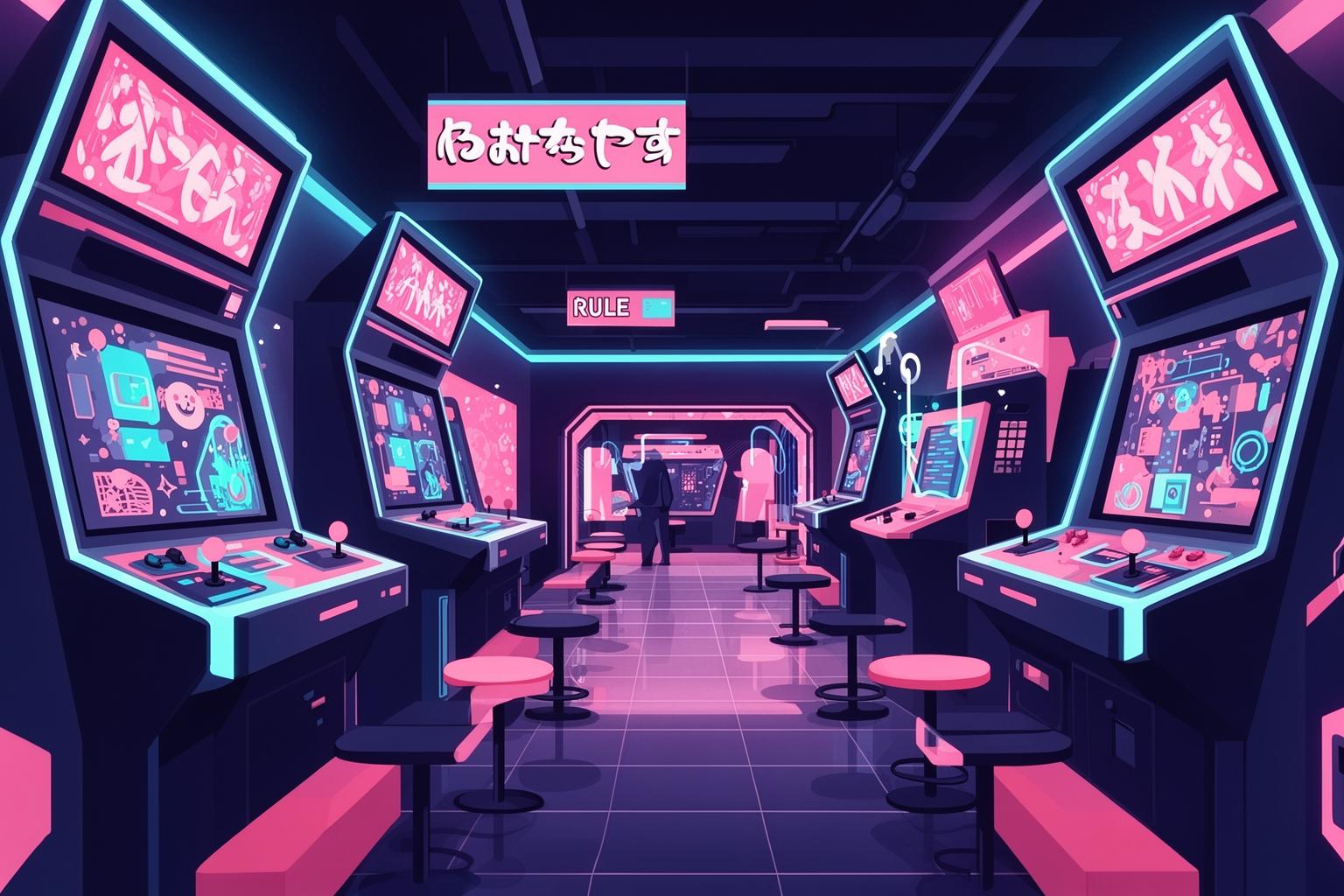
The experience of a Japanese game center is no accident; it is carefully crafted. Every aspect, from the volume of the machines to the layout of the floors, is designed to detach you from the everyday world and immerse you in its own internal logic. It’s an architecture of controlled overload, a constructed environment meant to manipulate your senses and, by extension, your sense of self.
A Symphony of Cacophony
The first thing that strikes you is the sound. It’s a physical presence. In a society where public places like trains and libraries follow an unspoken rule of near-total silence, the game center is a permitted act of rebellion. The noise isn’t an unintended consequence of many machines gathered in one spot; it’s a fundamental aspect of the design. Think of it as a sonic barrier that separates the arcade’s world from the outside world. Once you cross that threshold, the quiet, orderly street fades away.
But it’s not just random noise. It’s a complex, layered cacophony where every sound vies for attention. The high-pitched, cute jingles of the crane games, known as UFO catchers, form the base layer, meant to be inviting and non-threatening. Deeper within, you hear the pounding, thunderous beats from the rhythm game section, where players hit giant drums or stomp on dance pads. This blends with the sharp, staccato sounds of combat from the fighting game cabinets—the digital cries of opponents and the crack of virtual blows. Over everything loop the attract-mode soundtracks and the endlessly cheerful, energetic voices of digital announcers urging you to play. It’s an auditory free-for-all, and the overall effect is paradoxical. The sheer volume creates a kind of privacy. The wall of sound is so dense that it cocoons you at your machine, making conversation with the person next to you nearly impossible without raising your voice. It encourages deep, personal focus—a public space for a private experience. The noise shields you, enabling you to fully sink into the game’s flow state. It’s a loud form of meditation, a sensory deprivation tank filled not with silence and water, but with an overwhelming flood of sound.
Engineered for Immersion: The Role of Light and Darkness
Visually, the game center follows a similar principle of sensory manipulation. Most arcades are deliberately dark, cave-like spaces. Windows are rare, and when present, often covered or blacked out. Clocks are absent from the walls. This is a purposeful tactic, borrowed from casinos, to erase the sense of time. Within the perpetual twilight of the gēsen, there is no day or night, only the endless, pulsating now of the game. Your only light source is the machines themselves.
Each game cabinet acts as a beacon in the darkness, a self-contained world of vivid light. Screens flash with hypnotic patterns, buttons glow with inviting colors, and many machines are trimmed with neon strips and LED displays. This creates an environment of intense visual contrast. The room’s darkness makes the games’ lights appear more vibrant and enticing. They draw your eyes and focus, pulling you from one machine to the next. The visual language conveys urgency and excitement, high stakes and high energy. This isn’t the soft, ambient lighting of a café; it’s the frenetic, deliberate lighting of a space designed to stimulate and energize. This aesthetic ties into a deeper Japanese cultural idea of crafting defined, artificial worlds. The game center is a heterotopia, a separate realm where reality’s rules are suspended. Darkness and light collaborate to reinforce this boundary, ensuring that once inside, the outside world and its temporal rhythms fade into irrelevance.
Stacking Worlds: The Vertical Labyrinth
Unlike the sprawling, single-story arcades common in the West, Japanese game centers are almost always vertical. This is a direct and clever response to the economic reality in Japanese cities: land is scarce and costly. To maximize profit and variety, you have to build upward. A typical large arcade in districts like Shinjuku, Shibuya, or Akihabara can range from five to nine floors, each a distinct ecosystem devoted to a specific type of game.
This vertical layout creates a unique user journey, a kind of pilgrimage through layers of gaming culture. The ground floor almost always features the most accessible and profitable games: UFO catchers. Their bright lights, cute prizes, and deceptively simple gameplay are designed as the lure, drawing in passersby, couples on dates, and casual players. As you ascend, the atmosphere shifts. The second floor might house music and rhythm games like maimai or Sound Voltex, with dedicated players executing precise, complex patterns. The floor above may contain fighting game cabinets, where a focused, competitive community gathers. Higher floors might feature medal games, which resemble slot machines dispensing tokens instead of cash, attracting an older crowd who may spend hours at a single machine. The top floors tend to host niche genres, such as retro games or card-based arcade games. Each floor has its own unique soundscape, social norms, and community of players. Moving up through the building is like advancing through levels of a video game, with each floor offering a new world and a new challenge. This vertical separation allows multiple communities to coexist under one roof without interference, creating a dense, layered microcosm of the broader gaming world.
More Than Games: The Social Dynamics of the Japanese Arcade
To view the game center simply as a place to play video games is to overlook its most important role. For decades, it has functioned as a key social space in Japanese society—a “third place” beyond the home and the structured environments of school or work. How people interact within its noisy, neon-lit walls reveals much about Japanese social dynamics, community formation, and identity performance.
The “Third Place” for the Digital Native
The term “third place,” coined by sociologist Ray Oldenburg, refers to a public setting where individuals regularly gather voluntarily and informally, serving as a community anchor. While Westerners may associate this with cafes, pubs, or parks, for generations of Japanese youth, the game center fulfilled this role. Its history is nuanced. In the late 1970s and early 80s, following the Space Invaders craze, arcades gained a somewhat shady reputation as dark, smoky spots frequented by truants and minor delinquents known as furyō. This image persisted for a while until the industry actively worked to improve its environment.
By the 1990s, the game center had evolved. The arrival of Purikura—stylized photo booths that became a cultural sensation among high school girls—marked a turning point. Suddenly, arcades attracted a female audience, making them brighter, safer, and more mainstream. Crane games featuring cute character prizes also helped draw families and couples. The arcade became a respected and popular venue for dates or group outings after school, serving as a physical social network before the internet’s ubiquity. It was a place to see and be seen, to compete against local rivals, to learn new techniques from experts, and to simply exist in a space that felt like your own, away from the watchful eyes of parents and teachers. This legacy continues. Even in the era of online multiplayer, the arcade’s physical presence remains irreplaceable—a space where digital culture comes alive in the real world.
Parallel Play and Performative Skill
Social interactions in a Japanese arcade tend to be subtle and unspoken, contrasting sharply with the louder, more confrontational style often found in Western arcades. The predominant form of interaction is “parallel play,” a concept from developmental psychology describing children playing side-by-side without directly influencing each other’s behavior. In the gēsen, you’ll find rows of players seated side-by-side at fighting game cabinets or rhythm game machines, each fully immersed in their own screen. Conversation is minimal. The connection is not verbal but situational.
The social bond arises from the shared experience of being present, participating in the same ritual, and respecting the sanctity of “the zone.” Players patiently wait their turn, placing a 100-yen coin on the cabinet’s dashboard to indicate they are next. There is no cutting in line or trash talking. Yet a profound form of communication occurs through gameplay itself. Skill, or waza, serves as the primary form of social currency. Many arcade games are inherently performative. Watching a master player excel at a rhythm game like Dance Dance Revolution or Taiko no Tatsujin is captivating. Their movements are precise, efficient, and often dazzlingly fast. Onlookers gather not to cheer loudly but to watch in quiet admiration. This display of skill earns respect and establishes status within the community. When a player attains a “full combo” or sets a new high score, recognition from spectators is conveyed through silent nods or glances. The social system is built on mutual respect for mastery and dedication. This flex is real but quiet and confident, rooted in a deep cultural appreciation for craftsmanship and perfected skill.
A Genealogy of Gaming: From Department Store Rooftops to e-Sports Arenas
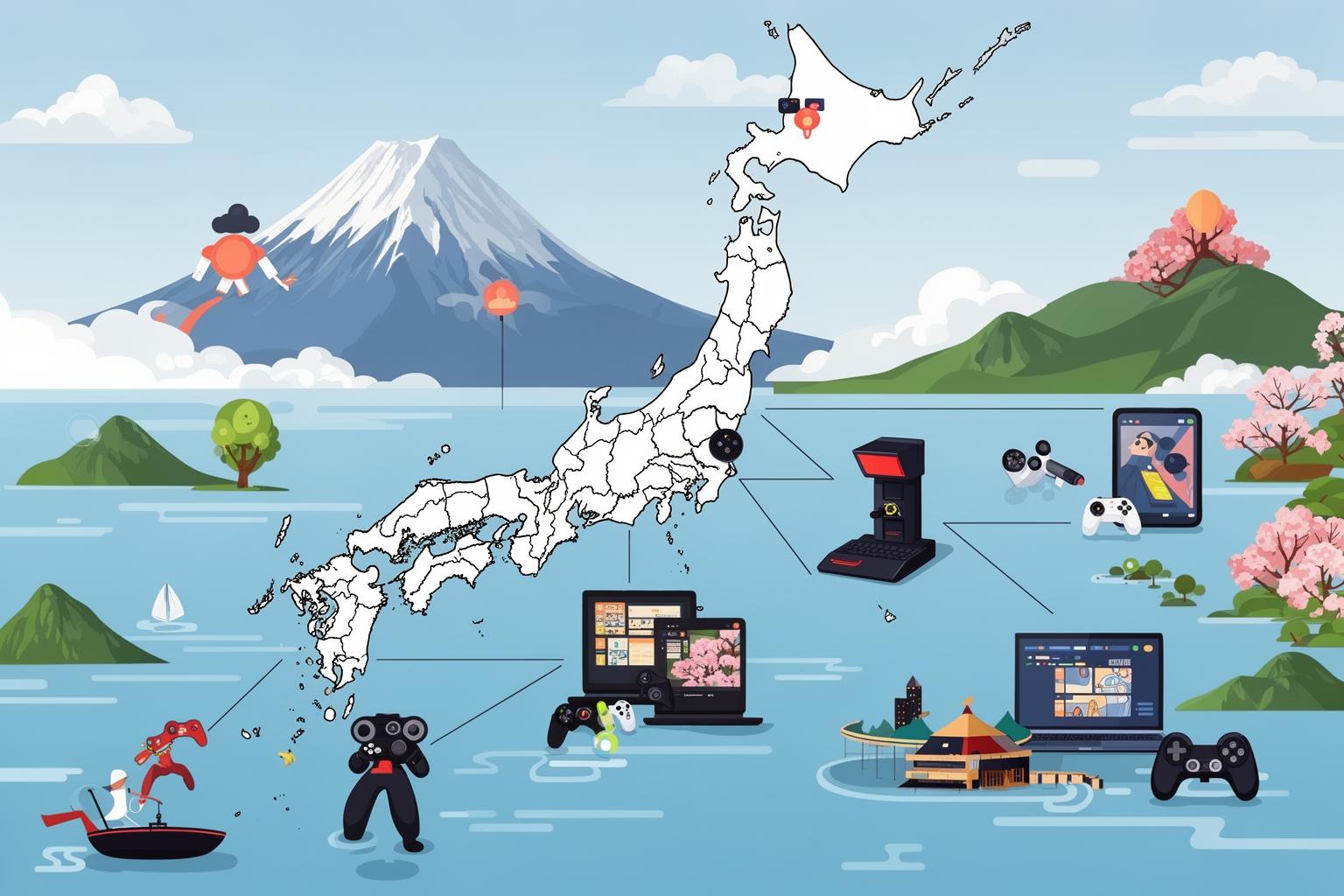
The Japanese game center did not simply emerge out of nowhere. It is the result of a long and captivating evolution, a narrative that reflects Japan’s post-war economic miracle, technological advancements, and shifting social landscapes. Grasping this history is essential to understanding why the gēsen looks and feels the way it does today.
The Post-War Playground: The Origins of the Game Center
The spiritual predecessor of the modern arcade can be traced to the rooftops of department stores. In the 1950s and 60s, during Japan’s rapid recovery after the war, large department stores like Mitsukoshi and Takashimaya became symbols of a new, prosperous consumer culture. To attract families, these stores created amusement parks on their rooftops, called depāto no okujō yūenchi. These were bright, open-air areas featuring small Ferris wheels, coin-operated mechanical horse rides, and simple electro-mechanical games. This is a crucial starting point, rooting the Japanese arcade’s DNA in mainstream, family-oriented commercial entertainment, rather than the dimly lit bars and bowling alleys where arcades first appeared in the United States. This origin helps explain why many arcades still feature a bright, accessible ground floor filled with games for all ages.
The major turning point came in 1978 with the release of Taito’s Space Invaders. The game became a nationwide obsession unlike anything before. Its popularity was so immense that there were rumors of a shortage of 100-yen coins across the country. Coffee shops and various businesses removed tables to make space for Space Invaders cabinets. This marked the birth of the “video game center” as a dedicated business. The demographic shifted dramatically from families to teenagers and young men, changing the atmosphere to one that was more focused, intense, and closely tied to emerging youth culture.
The Golden Age and the Broadening of Play
The 1980s and 1990s represented the golden era of the Japanese arcade. Companies such as Sega, Namco, and Capcom engaged in a competitive race of technological innovation. This period gave rise to game genres that would define gaming for decades. The fighting game boom, sparked by Capcom’s Street Fighter II in 1991, became a cultural phenomenon. It established the head-to-head competitive format that remains central to the arcade experience and nurtured close-knit local communities centered around specific games and arcades. During this time, arcades began to diversify to continue thriving. They no longer could rely solely on video games; they needed to provide a wider variety of entertainment experiences. This led to the rise of three key pillars of the modern gēsen. First, the Purikura photo booths, which turned arcades into social hubs for young women. Second, the refinement of the crane game, or UFO catcher, elevated by Japanese companies from a low-quality carnival gimmick into a high-stakes game of skill featuring exclusive, high-quality prizes such as limited edition figures, plushies, and other merchandise not sold elsewhere. This appealed strongly to the collector’s instinct (otaku culture) and created a steady revenue source. Third, the spread of medal games (medaru gēmu), large and elaborate machines resembling quasi-gambling. Players purchase buckets of metal tokens to play games that simulate casino slots, horse racing, or pushers. Although these medals cannot be exchanged for cash, players can save their winnings in a “bank” at the arcade for future use. This system fosters long-term engagement, particularly among an older, more casual crowd.
The Modern Arcade: Enduring Through the Console Revolution
A frequent question from Western observers is why arcades remain popular in Japan. In North America and Europe, the rise of powerful home consoles like the Nintendo 64 and PlayStation effectively ended the traditional arcade by the late 1990s. Why did Japanese arcades survive? The answer lies in a strategy based on differentiation and unique experiences. Japanese arcade operators realized early on that they could not compete with consoles in terms of convenience. Instead, they focused on offering experiences that could not be recreated in a home setting. This mindset gave rise to taikan gēmu, or “body sensation games.” These are games played in large, immersive cabinets with specialized controls—such as full-scale Gundam cockpit simulators, elaborate drumming peripherals for Taiko no Tatsujin, or motion-based racing and flight simulator games. Playing these games is a physical, full-body activity. The impressive scale and technological innovation of these machines ensured the arcade remained a unique and attractive destination. Additionally, the arcade industry in Japan is vertically integrated. The companies that develop the most popular arcade games—like Sega, Bandai Namco, and Taito—also run their own arcade chains. This allows them to create a seamless ecosystem, testing new games and providing exclusive experiences for their venues. Lastly, the strong community around arcades is crucial. For passionate fans of fighting games, rhythm games, or shoot ‘em ups, the arcade is more than just a place to play; it’s the heart of the culture. It’s where tournaments take place, skills are sharpened, and the genre’s culture is lived daily. The home console did not kill the Japanese arcade; rather, it forced it to evolve into a more specialized, experience-focused, and community-centered institution.
Decoding the Fever Dream: What Arcades Tell Us About Modern Japan
We return once again to the initial sensation—the overwhelming, psychedelic fever dream of the game center. Having examined its architecture, social dynamics, and history, we can now begin to interpret it and understand what this intense experience reveals about the broader culture of Japan.
Escapism in a High-Pressure Society
At its core, the game center embodies radical escapism. Japanese society is often characterized by order, restraint, and the subjugation of individual will for the collective good. Social etiquette is intricate, work hours can be grueling, and public spaces demand quiet conformity. The gēsen is the complete opposite. It is loud, individualistic, and chaotic. The sensory overload is not a flaw; it is the defining feature. It acts as a form of shock therapy, a forced mindfulness that erases any thoughts of work deadlines, social duties, or personal worries. Standing in front of a rhythm game, with lights flashing and music blasting at 120 decibels, while trying to hit a complex sequence of notes, leaves no room for distraction. Your mind must surrender entirely to the present moment. This creates a powerful, if temporary, escape from the pressures of a highly structured society. It serves as a portal to an altered state of consciousness, a pocket dimension where the outside world’s rules no longer apply.
The Human-Machine Interface: A Culture of Mastery
The bond between player and machine in a Japanese arcade reveals much about cultural values. Japan holds a profound fascination with technology, robotics, and the human-machine interface. The game center is a playground for exploring and refining this relationship. Players aren’t mere consumers of entertainment; they are dedicated artisans honing their craft. Their near-obsessive pursuit of the perfect run, the high score, or flawless victory reflects a cultural reverence for mastery and dedication. This embodies the spirit of the shokunin—the craftsman committed to perfecting their art—reborn in a digital form. It also lies at the heart of otaku culture: a deep, focused immersion into niche interests, accumulating extensive knowledge and skill. The arcade player, executing a 50-hit combo in Tekken or clearing a barrage of bullets in a danmaku shooter, is a modern digital artisan. Their canvas is the screen, their tools the joystick and buttons. The machine is more than a source of fun; it is a partner, an adversary, and a means of self-expression and the pursuit of perfection.
Controlled Chaos: The Japanese Talent for Order in Density
Here lies the ultimate paradox of the Japanese game center. Despite its apparent chaos—the noise, the lights, the crowds—it is remarkably orderly. People queue neatly for popular machines. They respect personal space as much as possible in a crowded setting. They treat the machines with care. An intricate, unwritten code of conduct governs the space, ensuring that this intense environment never descends into true anarchy. This reflects a core organizing principle of Japanese society: managing extreme density and potential chaos through a complex network of implicit rules, mutual respect, and shared understanding. It’s the same system that allows millions to flow through Shinjuku Station daily without incident. Though the game center feels like a psychedelic storm, it is in fact a highly structured and controlled one. It offers the thrill of chaos without the actual risk of social breakdown. It is a safe zone for experiencing overwhelming sensations—a fever dream from which you can simply wake by walking out.
So the next time you stand before the glowing entrance of a game center, hesitant to enter, remember what you are confronting. It’s not just a room filled with loud, flashy games. It is a vertical theme park of managed sensory overload, a physical social network for the digitally fluent, a living museum of post-war Japanese history, and a training ground for digital artisans. The initial shock and confusion you feel is a natural response to an environment designed to overwhelm. But beneath the cacophony and flashes of light lies a profound cultural logic. The psychedelic fever dream isn’t a malfunction; it is the system operating in a vibrant, intense mode. It’s a full-on vibe, a tribute to a culture that has mastered the art of creating pockets of beautiful, exhilarating, and perfectly controlled chaos. And now, you understand.