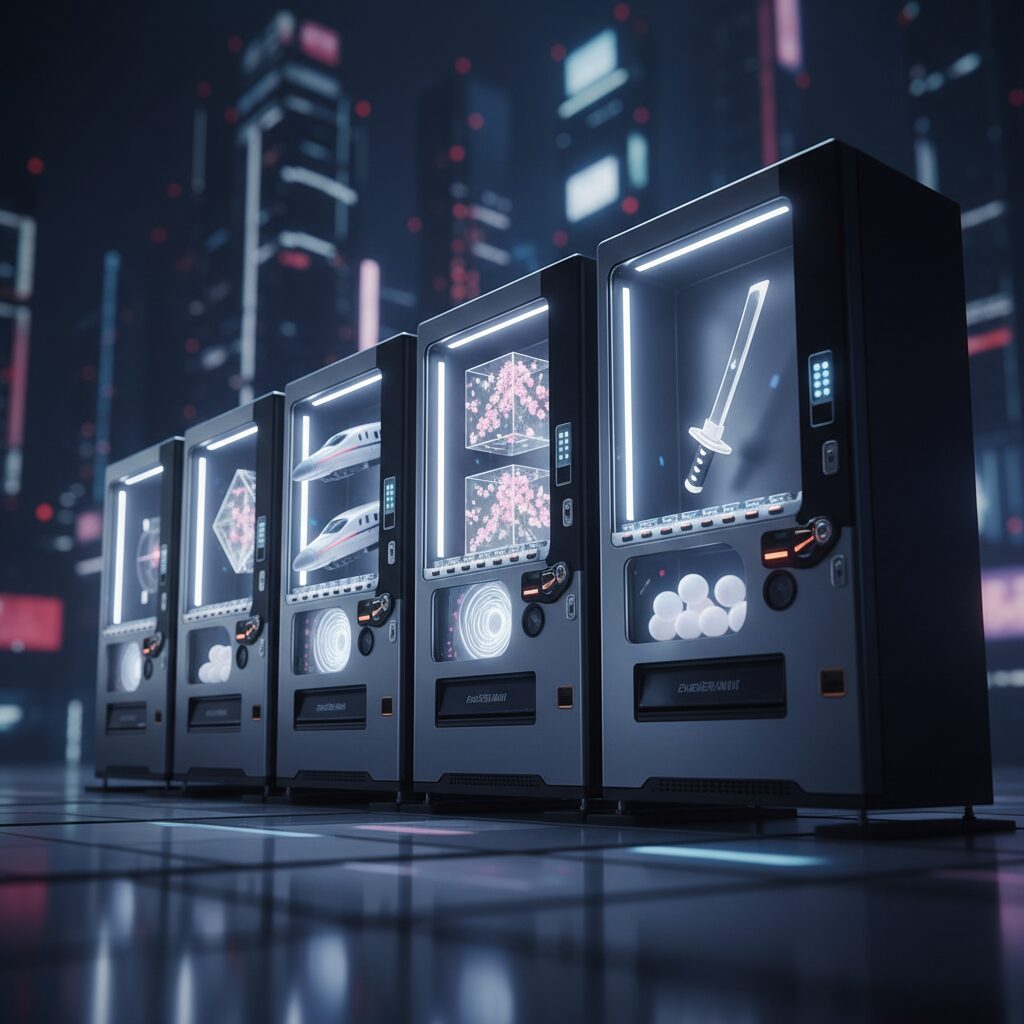
Yo, let’s get real for a sec. You’ve seen the pics, right? The TikToks of that random alley in Tokyo, lit only by the hypnotic, electric glow of a dozen vending machines humming in the dead of night. It’s a whole mood. A vibe. It’s clean, it’s safe, and you can cop a hot corn soup in a can at 3 AM. We love to see it. But have you heard the whispers? The late-night stories shared on Japanese forums, the urban legend that’s been passed around like a well-worn manga? The one that says some of these vending machine corners aren’t just for quenching your thirst. They’re gateways. Portals. Isekai starter packs waiting to transport you to another world. Bet. It sounds like straight-up anime plot, but this story hits different because it feels… plausible. In a place as surreal as Japan, why couldn’t a humble jihanki corner be a door to the Twilight Zone? You press the button for a melon soda, and suddenly you’re in a neon-drenched cyberpunk future or a silent, lantern-lit Edo-period village. It’s a wild thought, but it’s a question that sticks. Is this just a spooky story to tell in the dark, or is it tapping into something deeper about Japan? What’s the tea? Why vending machines? And what does this freaky little legend actually tell us about the heart and soul of this endlessly confusing, endlessly fascinating country? We’re about to unplug from the Matrix and find out. Forget what you think you know. We’re going down the rabbit hole, and it starts with a single coin in a slot. This ain’t your average travel guide; this is a deep dive into the cultural code behind the glow. Let’s get it.
To truly understand this surreal aspect of modern Japan, you might also be intrigued by its equally bizarre love hotels.
Spilling the Lore: The Anatomy of a Paranormal Vending Machine
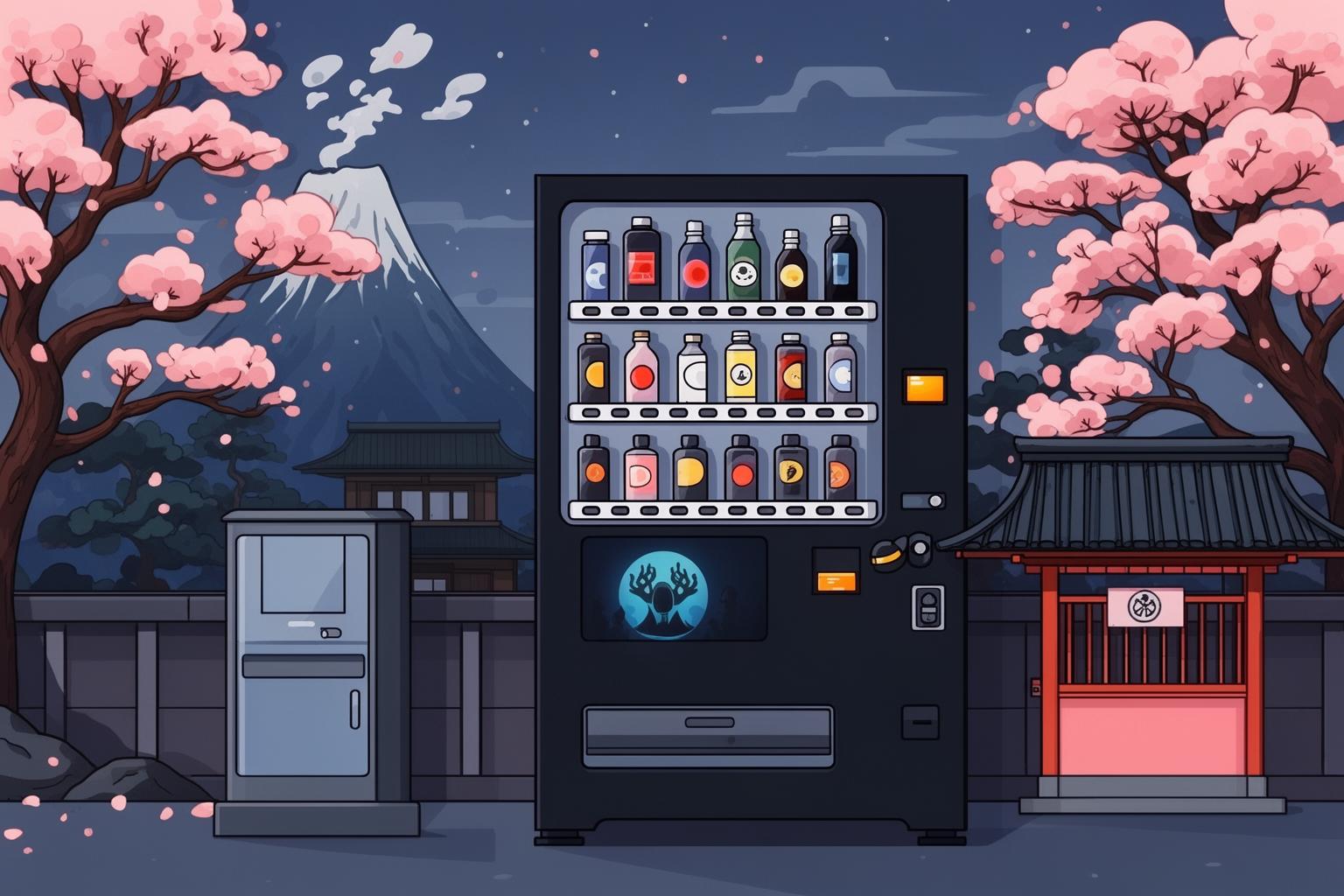
So, what’s the real story here? Like any good urban legend, the details are highly suspect and change depending on who’s recounting it, but the core elements remain fairly consistent. This isn’t just any new, high-tech machine with a giant touchscreen in the middle of Shibuya Crossing. No, the legend focuses on the old-fashioned ones—the forgotten machines. It’s got to be a certain vibe. Imagine this: you’re deep within a residential maze like Setagaya, or wandering the back alleys of Yanaka where the atmosphere still feels somewhat Showa-era. It’s past midnight, the last train long gone, with only the distant city rumble and the electric hum of the machines before you breaking the silence.
The Setting and the Trigger
The legend says it’s usually a bank of them—maybe three to five—clustered under a rusty metal awning, with leaks staining the concrete. One machine is always a bit off. The light flickers. The selection is odd—not just the usual Pocari Sweat and Boss Coffee, but a rare brand of milk tea that’s been discontinued for years, or a generic can with a single, cryptic kanji character on it. The machine itself is a relic, possibly bearing a faded, sun-bleached logo from a long-defunct company. The trigger for the portal opening is never simple. Some versions say you need to buy a specific item at a precise time, like the witching hour between 2:00 and 3:00 AM. Others claim you must insert exact change in a particular sequence. A popular version involves the coin return lever. You purchase your drink, but instead of just a couple of extra coins dropping down, a whole cascade of old, pre-war currency floods the tray. Or maybe, just maybe, a single, strange, unidentifiable coin appears. If you pick it up, that’s when it happens. The machines’ humming deepens into a low-frequency drone, the city sounds fade away, and the alley behind you… is no longer the same alley you came down. The air feels heavy. The path back vanishes. You’ve crossed over. This level of detail is what makes the legend so gripping. It’s not merely a vague “portal”—it’s a process, a ritual that feels just complex and arbitrary enough to be believable in a world ruled by unseen forces.
The Other Side: What Awaits?
And where do you end up? That’s where the lore truly branches out. It’s not a single destination. The “other world” seems tailored to the anxieties and fantasies of modern Japan. Sometimes, it’s a nostalgic paradise—a perfectly preserved Showa period (1926–1989) with warm lantern light, Showa Kayokyoku tunes drifting from noodle shops, and a simpler, pre-internet lifestyle. It’s a beautiful, bittersweet trap, an escape into a past many feel profoundly nostalgic for. Other versions are far more dystopian. You step into a hyper-futuristic Tokyo, even more technologically advanced and alienating than the real one, a world of silent, floating vehicles and holographic ads whispering your name. This version taps into fears about where Japan’s obsession with technology and automation might lead. Then there’s the eeriest version, one rooted in Japan’s oldest fears—the world of kamikakushi, or being “spirited away.” You enter a silent, timeless Japan inhabited by spirits, or yokai. The vending machine lights are replaced by paper lanterns, and the path leads to an endless festival or a quietly unsettling shrine. This links the modern, mundane vending machine directly to ancient Shinto and Buddhist beliefs about the spirit world existing just a hair’s breadth from our own, separated by only the thinnest veil. This connection is crucial. The myth isn’t just a new tale; it’s an old one wearing a new, high-tech disguise.
The Vending Machine as a Modern Totem
Alright, but seriously, why vending machines? Why not a haunted phone booth or a glitching ATM? To understand, you have to realize that vending machines—called jidohanbaiki or jihanki in Japan—are more than just conveniences. They are cultural icons and essential elements of the country’s social fabric, reflecting much about how society functions. Their unique role creates the ideal environment for a myth like this to take root.
A Symbol of Absolute Trust and Safety
First, consider the numbers: over four million vending machines exist in Japan, roughly one for every 30 people. They’re everywhere—from the summit of Mount Fuji to deserted, windswept train platforms, and squeezed into tiny city alleys. This level of ubiquity baffles most visitors. Why? Because in most other places, a glass box full of cash and goods left unattended on a dark street would be broken into and emptied by morning. But in Japan, it almost never is. This reveals the nation’s remarkably low petty crime rates and strong social trust. The jihanki stands as a monument to public safety—a silent, round-the-clock symbol of the belief that people generally respect public property and won’t tamper with it. This deep-rooted safety is so profound it almost seems unnatural, producing a sterile, eerie calm. In such perfect security, the imagination begins to roam. If the threat isn’t from other people, it must come from somewhere else—something supernatural. The machine hums there, vulnerable yet protected by an invisible social contract, feeling less like a device and more like a silent, benign guardian… or a trap.
The Unmanned Store: Convenience and Alienation
A vending machine is a shop without a shopkeeper. It embodies frictionless convenience, a concept Japan has mastered. You want something, you get it immediately, no human interaction needed. No greetings, no thanks, no small talk. Just a straightforward transaction between you and the machine. Though highly efficient, this also feeds a sense of urban alienation that many, especially in large cities, feel deeply. In a society that values the group over the individual and follows strict social rules, the vending machine’s anonymity can be a relief—but it’s also a symbol of a life with minimal human contact. You can spend an entire day interacting only with machines: at ticket gates, ramen vending machines, and self-checkouts. The vending machine represents the purest form of this automated existence. It’s a silent helper, always there, always stocked, never judging. This dehumanized interaction invites eerie tales. The machine is a black box: you insert money, a product emerges. But what really happens inside? Without a human face, it’s easy to imagine some other, non-human intelligence at work—a machine spirit, a glitch in the system leading you somewhere… else.
A Cabinet of Curiosities
Importantly, Japanese vending machines aren’t limited to soda and water. They’re portals to pure novelty. Their vast variety is legendary and a big part of why they feel magical. You can buy hot meals like ramen, udon, and takoyaki. Fresh eggs, bags of rice, and savory dashi soup stock are also vending machine staples. Some sell crepes in glass jars, canned bread, or flying fish soup. In Akihabara, machines offer stag beetles, mystery boxes of otaku goods, and even rare retro video games. This endless imagination turns these machines into cabinets of curiosities. It proves that literally anything can appear behind the glass. If you can buy a hot bowl of oden or an intricate miniature diorama from one, then the idea of receiving a ticket to another dimension doesn’t seem so far-fetched. The mundane has already been crossed. These machines constantly surprise and delight, conditioning the public to expect the unexpected. They’re not just fixtures; they’re stages for commerce and cultural experimentation, making them prime candidates for mythical gateways. The stranger the product, the thinner the veil between worlds feels.
Liminal Vibes: The Power of In-Between Spaces
To truly understand the vending machine myth, you need to zoom out and consider a fundamental concept in the Japanese aesthetic and spiritual worldview: the significance of the in-between. The legend isn’t merely about a machine; it’s about its setting. A vending machine corner exemplifies a “liminal space,” and Japanese culture has a deep fascination with these spaces.
Ma (間): The Significant Void
In Western culture, space is often viewed as something to be filled. In Japan, the empty space between things, called Ma (間), holds as much importance, if not more, than the objects themselves. It’s a foundational principle across art, architecture, music, and flower arranging. Ma is not emptiness; it is a meaningful pause, a pregnant interval. An alleyway where vending machines gather perfectly embodies Ma architecturally. It is neither a destination nor a building or street. It is a transitional space, a gap within the urban fabric. It exists between places. When you linger in this non-space, this pause within the city, culturally, you stand on a threshold. You occupy a place that is neither here nor there, making it a natural weak point in the fabric of reality. The vending machines, with their constant low hum and artificial light, provide the only focus to this void, transforming an empty gap into a charged, expectant stage.
Modern Torii Gates and Twilight Zones
The concept of thresholds is deeply embedded in Shintoism. A torii gate, the iconic red gate at shrines, is more than decoration; it formally marks the transition from the mundane human world to the sacred realm of the kami, or gods and spirits. Bridges, tunnels, and even the raised wooden threshold of traditional houses serve a similar function—they delineate boundaries between worlds. In the hyper-modern, concrete-and-steel environment of cities like Tokyo, where are the new torii gates? The argument suggests they have become places like railroad crossings, pedestrian overpasses, and indeed, the glowing arch of a vending machine corner at night. They act as secular, technological equivalents of sacred gateways. They signify transition. The light emitted by the machines creates a distinct, self-contained zone. Step into this glow, and you leave the ordinary darkness of the street; you enter a different kind of space governed by a different set of rules. This sensation intensifies at specific times, especially twilight. The Japanese term for twilight, tasogare (誰そ彼), poetically means “who is that?” It describes the hour when light fades, and faces of approaching people become indistinct. The world’s outlines blur. Folklore says this is when the veil between the human and spirit worlds thins. It’s a magical time when unusual encounters occur. A vending machine corner, humming and glowing as dusk falls, embodies the tasogare hour in a modern way. It stands as a beacon in the blur, a place where the ordinary may momentarily shift into the extraordinary.
Escapism and the Isekai Generation
Beyond ancient beliefs and aesthetics, the myth of the portal vending machine is strongly driven by contemporary social pressures and one of pop culture’s most popular genres. The story isn’t just eerie; for many, it represents a fantasy of escape.
The Pressure Cooker of Modern Japanese Life
Life in Japan, despite its beauty and efficiency, can be extremely demanding. The social pressure to conform, the exhausting work hours of the “salaryman” culture, the fierce competition in schools, and the strict social hierarchies can all foster a profound sense of confinement. There is a powerful, often unspoken, yearning to break free from these pressures and find a place where the rules don’t apply. This is where the urban legend finds its emotional heart. The portal is not just a random journey; it is wish fulfillment. Picture a young person overwhelmed by exams or an office worker drained by endless overtime and social obligations (nomikai drinking parties). The fantasy of accidentally discovering a secret escape from their life, a complete break into a world governed by different rules, is deeply enticing. The vending machine, a symbol of the automated, impersonal system that often heightens this pressure, becomes the unexpected key to liberation. It’s a beautiful irony. The machine that sustains the system can also, hypothetically, offer a way out. It’s a dream of agency in a world that often seems to offer very little.
The Isekai Trope Made Real
This longing for escape is a cultural phenomenon known as isekai. Isekai (literally “different world”) is one of the most influential genres in contemporary anime, manga, and light novels. The storylines are nearly always similar: an ordinary, often struggling or dissatisfied individual from our world is suddenly transported to another, typically a fantasy or game-like realm, where they are frequently gifted with special abilities and a renewed sense of purpose. Titles such as Re:Zero, That Time I Got Reincarnated as a Slime, and Mushoku Tensei have become global sensations based on this concept. The vending machine portal myth is, in essence, the urban adaptation of the isekai genre. It takes the core fantasy from the pages of manga and places it into the real-world context of Japan. It forges a connection between a popular media trope and a tangible, everyday object. Young people who immerse themselves in isekai stories are predisposed to see the world as full of potential gateways. The legend provides an exciting framework to re-enchant their ordinary daily lives. Every dark alley, every flickering vending machine light, holds a hint of possibility. It’s a way of gamifying reality, of viewing the familiar landscape of their city and imagining the incredible adventures lurking just out of sight. The myth spreads so effectively online because it resonates directly with a generation fluent in the language and logic of isekai narratives.
How to Find a Portal (But Not Really)
Let’s be clear: we’re delving into a myth, a piece of contemporary folklore. But if you set out on a vibe hunt, aiming to find a place that feels like a potential portal, how would you go about it? It’s about chasing a sensation, not concrete evidence. It’s an exercise in urban exploration and cultural detective work.
The Vibe Check: Searching for the Perfect Atmosphere
You wouldn’t start in a shiny, new district. Instead, you’d head to older neighborhoods, the ones that have withstood the wrecking ball of redevelopment. Think of places like Golden Gai in Shinjuku, with its labyrinth of tiny post-war bars, or the residential backstreets of Koenji or Asagaya. You’re seeking a spot where various eras of Tokyo appear to coexist and blur together. You’d go late at night, when the streets are deserted and the city has quieted. You’re listening for the hum, searching for the glow.
Reading the Machine
When you spot a promising corner, you wouldn’t choose the newest machine. You’d go for the oldest one there. Look for signs of age: a little rust, a sun-bleached front panel, maybe a drink selection that feels like a time capsule. Does it offer drinks in glass bottles rather than plastic? Does it feature a clunky, mechanical button system instead of a digital display? The key is anachronism. The machine should feel slightly out of its time, a relic from a bygone era still running today. This temporal dissonance is what gives the “glitch in the Matrix” sensation. Maybe one of the selection labels is handwritten, a trace of a long-gone owner who lovingly maintained this particular machine. These details elevate the atmosphere from merely practical to potentially paranormal. You’d buy a drink, of course. Something unusual. And as you reach for the coin return, you’d allow yourself to feel that spark of possibility, that brief moment of delicious, eerie uncertainty before your drink clinks into the tray.
The Verdict: A Portal to the Japanese Psyche
So, after all this, is the urban legend of the portal vending machine real? Certainly not. Purchasing a can of Georgia coffee won’t transport you to feudal Japan. But to dismiss it as merely a silly ghost story misses the point entirely. The myth isn’t literally true, but it is culturally true. It’s a story Japan tells about itself, and it stands as one of the most brilliant and concise expressions of the modern Japanese experience you could find.
The legend is a rich, layered narrative that intertwines the country’s deepest cultural threads. It speaks to the strong sense of safety and public trust that allows vending machines to be found everywhere. It reflects the double-edged nature of convenience and automation, which brings efficiency yet can also foster urban loneliness. It taps into ancient Shinto beliefs about the thin boundary between our world and the spirit world, reimagining the sacred portal for a secular, technological age. Lastly, it functions as a potent metaphor for the desire to escape the intense pressures of modern life, a fantasy popularized and shaped by the immensely popular isekai genre in pop culture.
The vending machine corner isn’t a portal to another world; it’s a portal to understanding Japan. It’s a place where advanced technology, ancient folklore, consumer capitalism, and quiet alienation converge in a single, humming, glowing spot. It’s a microcosm of the contradictions and complexities that make this country endlessly fascinating. So next time you stand before one on a quiet Tokyo night, don’t just grab your drink and leave. Pause for a moment. Listen to the hum. Notice the light it casts on the pavement. Feel the stillness of the alley around you. You’re not standing at a gateway to another dimension, but you are standing at a cultural hotspot. You’re experiencing the real magic: the feeling that in Japan, the mundane is never merely mundane, and the veil to something more is always, always paper-thin. No joke, that’s a journey worth taking.