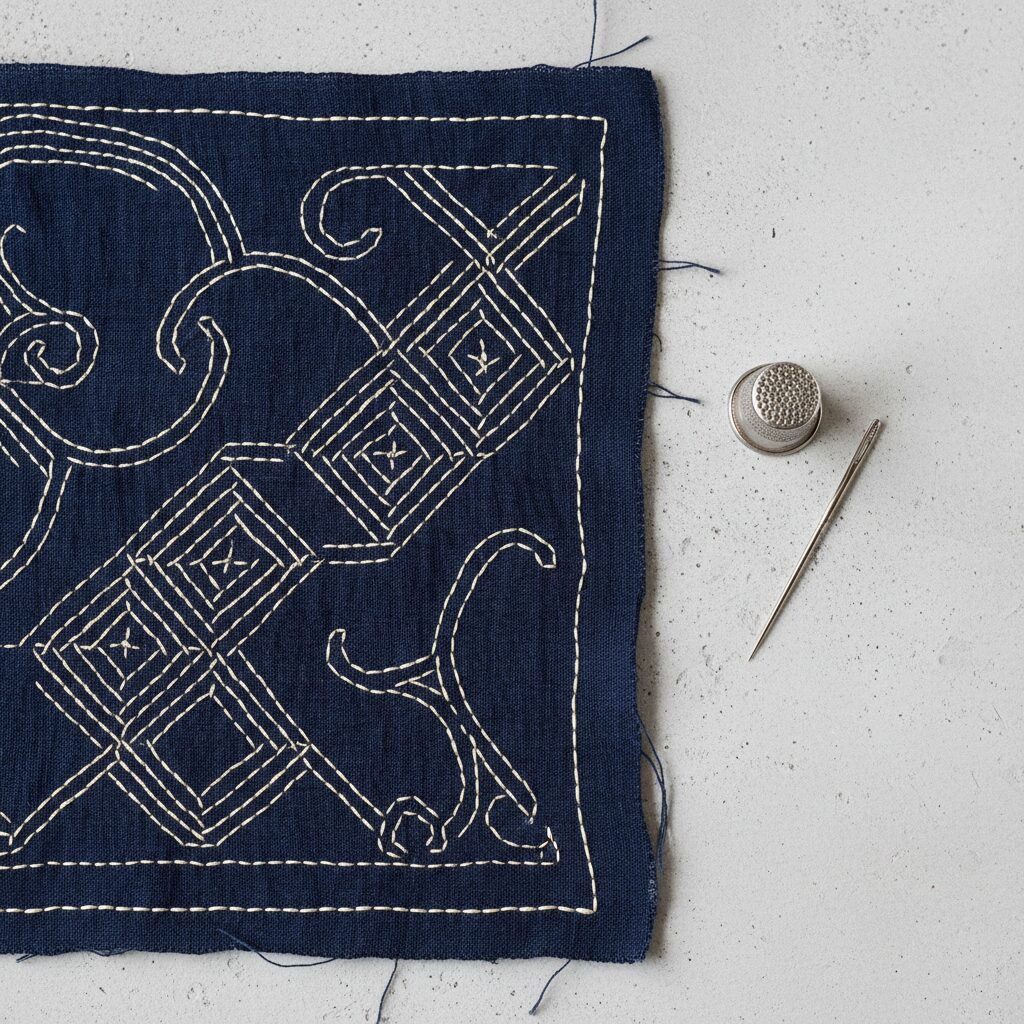
Yo, what’s the deal? Ever been scrolling through your feed, maybe deep in a Pinterest hole of aesthetic fashion, and you see it? That super cool, beat-up denim jacket or a pair of perfectly worn-in jeans, but they’ve got these sick-looking geometric patterns stitched into them, usually in bright white thread on a deep indigo background. It looks kinda like minimalist art decided to have a baby with your favorite pair of jeans. That, my friend, is Sashiko. And let me tell you, it’s way, way more than just some pretty mending. It’s a whole vibe, a legit piece of Japanese cultural history that’s making a massive comeback, and for good reason. You might look at it and think, “Okay, so it’s just fancy sewing, right?” Nah. Not even close. This is a deep dive into a world of sustainability that existed centuries before “eco-friendly” was a buzzword. It’s a lesson in mindfulness, a physical manifestation of an aesthetic philosophy that finds beauty in stuff that’s broken or old. So if you’ve ever found yourself wondering, “Why are people so obsessed with what looks like super-detailed mending?” then you’re in the right place. We’re about to unpack it all. Because learning Sashiko isn’t just about fixing your clothes; it’s about giving them a soul, a new story, and a longer life. It’s a total game-changer for anyone who’s into slow fashion, a bit of zen, and making a statement that’s more than just a brand name. This ain’t your grandma’s quilting circle; it’s a legit cultural flex, and it’s time you got the lowdown.
If you’re drawn to the sustainable and mindful ethos of Sashiko, you’ll likely appreciate the similar philosophy behind Japan’s traditional furoshiki wrapping cloth.
What’s the Real Deal with Sashiko? It’s More Than Just Stitches, Fam.
To truly understand Sashiko, you need to rewind way back—to a time in Japan, mainly during the Edo period (1603–1868), when life for ordinary people was, to say the least, challenging. This was especially true in northern, colder regions like the Tōhoku area, marked by snowy winters and rugged landscapes, where life was closely tied to the land and sea. For farmers, fishermen, and the working class, resources were extremely limited. Fabric, particularly cotton, was not just a material but a precious resource—valuable, hard to obtain, and never wasted. This harsh reality gave rise to the core philosophy behind Sashiko. It wasn’t created as an art form or pastime; it emerged out of sheer necessity. Sashiko was a survival technique aimed at extending the life of treasured materials as much as possible. At its heart, Sashiko embodies practicality, resilience, and profound respect for the materials that clothed and shielded people from the harsh climate.
The “Mottainai” Mindset: Japan’s Original Sustainability Ethic
Before diving into the stitches themselves, it’s important to grasp a key Japanese cultural idea: mottainai (勿体無い). This term resists direct translation into English because it carries deep cultural and almost spiritual significance. The closest approximation is “a strong sense of regret over waste,” but it goes beyond the simple notion of “waste not, want not.” It’s an emotional response to witnessing valuable potential being thrown away—whether food, time, or, in this case, fabric with a hole in it. Mottainai conveys a powerful sense of “what a shame” or “what a waste,” infused with a Buddhist appreciation for the interconnectedness and preciousness of all things. This mindset was woven into everyday life in pre-industrial Japan.
This was the world that shaped Sashiko. When a farmer’s jacket tore at the elbow, throwing it away was unthinkable—that was mottainai. When a fisherman’s trousers wore thin at the knees, buying new ones wasn’t an option—that was mottainai. Instead, scraps of old cloth were patched over the holes and stitched down. As more holes appeared, more patches were added. Over time, garments became layered mosaics of fabric patches. To secure these layers and add strength, people used simple running stitches—the stitches we now call Sashiko. These stitches quilted the fabric layers together, trapping air to keep warmth in and make the garment more durable. It was the ultimate form of upcycling, born from deep respect for materials and an absolute refusal to waste. A single garment could be handed down through generations, each owner adding layers of patches and stitches until the original fabric was almost hidden. This extensively repaired textile is known as Boro, meaning “tattered” or “ragged.” But today, Boro isn’t seen as raggedness; it is regarded as a rich tapestry of history—a tangible record of a family’s resilience and perseverance. This is the true power of the mottainai spirit.
From Workwear to High Fashion: The Remarkable Transformation
Sashiko’s journey from humble mending to high-fashion icon has been extraordinary. For centuries, it belonged solely to the rural working class. Firefighters’ thick stitched jackets (hikeshi-banten) were fortified with Sashiko to resist sparks and embers. Fishermen’s coats (donza) were stitched and layered to protect against cold sea spray. The base fabric was usually hemp or ramie dyed with indigo—a practical choice, as indigo strengthened the fabric and was believed to have antiseptic properties and act as an insect and snake repellent, beneficial for all-day field labor. The stitching thread was typically white or off-white cotton, creating the iconic contrast against the deep blue background.
Within this purely functional world, creativity still found expression. Simple stitches evolved into beautifully geometric patterns that added artistry to functional clothing. These patterns were more than decoration; they often carried symbolic meaning, serving as prayers or good luck charms sewn into daily life. Patterns could appear on a child’s clothing to wish for healthy growth or on a fisherman’s coat for safe returns from the sea. This marked the slow evolution of Sashiko into an art form—a way to seek beauty and express identity amid hardship.
Jump ahead to the 21st century, and the narrative has dramatically shifted. The very elements that once made Sashiko a symbol of poverty—mending, patching, hand-stitching—are now what make it highly desired. In a world overwhelmed by fast fashion and mass production, Sashiko stands for authenticity, craftsmanship, and storytelling. Denim enthusiasts and fashion lovers are captivated by it. Japanese brands like Kapital and Visvim have built entire aesthetics around this artisanal, “wabi-sabi” sensibility, selling Sashiko-stitched jeans and jackets for hundreds or even thousands of dollars. Western designers have also embraced the trend, incorporating Sashiko-inspired stitching into their collections. It has become a global emblem of sustainable fashion and mindful consumption. The ultimate irony is that a technique born out of scarcity is now considered a luxury. But this transformation isn’t just a passing trend—it signals a desire for deeper connections with the things we own and stories we can feel through touch.
Decoding the Patterns: It’s Not Random, It’s a Whole Language.
At first glance, Sashiko might appear to be just a collection of cool, geometric designs—neat, clean, and visually pleasing. However, what you’re truly seeing is a symbolic language, a set of motifs (moyō) rich in history, nature, and folklore. These patterns were never chosen at random; each carries a specific meaning, a wish, or a protective power. Understanding these designs is like learning to read the story of the garment and the intentions of its maker. It offers a connection to the hopes and beliefs of people from a completely different time, demonstrating that although circumstances have changed, our basic desires for health, prosperity, and happiness remain eternal.
The Core Patterns and Their Messages
While countless regional and individual variants exist, a few fundamental patterns form the foundation of the Sashiko vocabulary. Familiarizing yourself with these is the key to unlocking the deeper symbolism behind the stitches. They are often inspired by nature, representing elements central to rural Japanese life.
Asanoha (Hemp Leaf): One of the most recognizable and favored Sashiko designs, it features interconnected six-pointed stars or hexagons that resemble a hemp leaf. In Japan, hemp symbolizes vitality and resilience, as it grows rapidly, straight, and strong with minimal care. Traditionally, Asanoha was stitched onto the clothing of babies and young children, serving as a tangible prayer from parents wishing their child to grow as robust and healthy as the hemp plant—a beautiful protective charm hidden within a geometric pattern.
Seigaiha (Blue Ocean Waves): Composed of overlapping concentric circles layered to resemble ocean waves, this ancient motif appears throughout Asian art and design. For an island nation like Japan, the ocean is a constant, powerful presence. The Seigaiha pattern represents the endless, peaceful rhythm of the waves, symbolizing good fortune, resilience, and a wish for a tranquil life that continues ceaselessly like the boundless sea. It evokes calm and infinite luck, making it a popular design for various textiles beyond clothing.
Shippō (Seven Treasures): Consisting of interlocking circles that create repeating four-petaled shapes in the spaces between, Shippō refers to the seven treasures of Buddhism: gold, silver, lapis lazuli, agate, pearl, coral, and crystal. The infinite, connected circles symbolize harmony, strong relationships, and an unending chain of good fortune and happiness. This pattern highlights the value of connection and the wealth it brings, serving as a powerful emblem of prosperity and joyful unions.
Kōshi (Lattice): Though a simple grid might seem unsymbolic, it carries significant meaning in Japanese design. The Kōshi pattern represents strength and prosperity. In historical Japan, latticework was common in samurai and noble homes, symbolizing power and high status. As a Sashiko design, it conveyed aspirational strength and good fortune to the everyday garments of common folk.
Yabane/Yagasuri (Arrow Feathers): Modeled after arrow fletching arranged in parallel rows, this pattern holds deep cultural significance since an arrow, once shot, never returns. This idea makes the arrow feather motif a symbol of determination and forward movement. It was especially popular for brides, with a Yagasuri wedding kimono symbolizing the bride’s onward journey into married life, never returning to her family home. It was also a favored good luck charm for soldiers, wishing them success and a straight path to victory.
Regional Variations: Every Place Has Its Own Style
It’s important to recognize that Sashiko is not a single, unified craft but rather a family of related stitching techniques that evolved uniquely across Japan, adapting to local climates, available materials, and regional aesthetics. The result is a diverse array of regional styles, each with distinctive characters and names. Exploring these variations reveals the craft’s incredible inventiveness and adaptability.
Tsugaru Kogin-zashi (Aomori Prefecture): A standout from the Tsugaru Peninsula in Aomori, one of Japan’s coldest regions, Kogin-zashi is a robust form of counted-thread embroidery where stitches are counted on the base fabric rather than drawn. It was developed to heavily reinforce and insulate coarse, handwoven hemp fabric, which was the only material peasants could wear locally. The densely packed, intricate diamond-based patterns cover large sections of the garment, especially the shoulders and back. The finished result resembles a woven pattern more than stitching, creating an exceptionally warm and durable fabric—a remarkable transformation of limitation into complex art.
Shōnai Sashiko (Yamagata Prefecture): From the Shōnai region of Yamagata, this style is often what people envision when they think of Sashiko. Characterized by elegant and precise linear patterns stitched on indigo-dyed cotton, the designs are highly geometric, frequently featuring complex maze-like arrangements of straight lines and sharp angles. The stitching is fine and even, reflecting considerable skill and discipline. Compared to the dense coverage of Kogin-zashi, Shōnai Sashiko is more graphic and refined, focusing on the beauty of the line itself.
Hishizashi (Aomori/Iwate Prefectures): Originating from the Nanbu area spanning parts of Aomori and Iwate, Hishizashi is another counted-thread style akin to Kogin-zashi. The main distinction lies in the base pattern unit: while Kogin-zashi uses odd numbers of threads (one, three, five), Hishizashi employs even numbers (two, four, six). This subtle shift produces a look defined by diamond (hishi) shapes. The patterns are bold, graphic, and tend to feel more rhythmic and less dense than Kogin-zashi. Both styles share a common origin: inventive and practical solutions by women to strengthen and beautify their families’ coarse hemp clothing.
The Sashiko Mindset: It’s Basically Meditation with a Needle.
Alright, we’ve explored the history, the practicality, and the patterns. But to truly understand why Sashiko is so popular right now, we need to focus on the feeling. The process of doing Sashiko matters just as much as the finished piece. In our fast-paced, digital-heavy world, people crave analog, hands-on activities that slow them down and connect them to something tangible. Sashiko fulfills that need abundantly. It’s more than just a craft; it’s a practice—a form of active meditation that soothes the mind, sharpens the senses, and lets you create something beautiful and useful with your own hands. This essence is the heart of Sashiko and a big part of its contemporary allure.
The Rhythm of the Stitch: Finding Your Zen.
Imagine this: you’re sitting quietly in a room. Your phone is off. In your hands is a piece of soft, indigo fabric, along with a needle and thread. You start stitching. The needle goes in and out. You thread a few stitches onto the needle—push, pull, smooth. The only sound is the gentle shush of cotton passing through woven fabric. Your attention narrows to the needle’s tip, to keeping your stitches as even as possible, to following the simple pattern line. Your breathing slows. The endless mental to-do list fades away. In, out. Push, pull, smooth. This is the flow of Sashiko.
This simple, repetitive motion is deeply meditative. It’s a mindfulness practice that demands your full presence. You can’t rush Sashiko. If you try, your stitches will be uneven, your thread will knot, and the fabric will pucker. Patience and a gentle, steady hand are necessary. In Japanese culture, entering a spiritual or meditative state by mastering a craft or repetitive action is common. Think of the tea ceremony, calligraphy, or martial arts. It’s a form of training (shugyō) for the mind through bodily discipline. For many today, Sashiko serves a similar purpose—an antidote to modern chaos, a way to quiet mental noise and find peace and focus. The bonus: at the end of your meditation, you have a tangible creation—a beautifully mended pair of jeans or a unique decorative cloth.
Wabi-Sabi in Action: Embracing the Flaws.
Next, let’s consider another fundamental philosophy behind Sashiko: wabi-sabi (侘寂). This iconic Japanese aesthetic concept is difficult to define simply. Essentially, wabi-sabi is the art of finding beauty in imperfection, impermanence, and incompleteness. It celebrates the authentic, the humble, and the unconventional. It’s the charm of a cracked ceramic bowl repaired with gold, moss on an old stone lantern, or the weathered patina of a wooden table. It honors the marks of time, wear, and use.
Sashiko embodies wabi-sabi in textile form. Think about it: its whole purpose is to take something broken—a garment with a hole or tear—and repair it. Unlike many Western mending methods that try to hide repairs, Sashiko does the reverse. It highlights the repair, drawing attention to the scar with striking, contrasting thread. It transforms a point of weakness into one of strength and beauty. The Sashiko patch doesn’t say, “I want to look brand new.” It declares, “I have lived. I have a story. This tear is part of my history, and this repair is the next chapter.”
This mindset stands in stark contrast to today’s consumerist culture, which insists that new is better and that flaws mean something should be discarded and replaced. Sashiko offers a more compassionate, sustainable alternative. It teaches us to cherish our belongings more as they age, to see their imperfections as character, not failure. This philosophy extends to the stitching itself. When you’re new to Sashiko, your stitches won’t be perfect; they’ll be a bit uneven, your lines might wobble. But in the world of wabi-sabi, that’s perfectly fine. In fact, it’s beautiful. Those subtle imperfections reveal the human hand—they distinguish your work from a machine’s and make it uniquely yours. Sashiko isn’t about sterile perfection; it’s about the honest, caring, imperfect act of making and mending.
Getting Your Hands Dirty: The Sashiko Starter Pack.
Alright, so you’re convinced. You appreciate the history, resonate with the philosophy, and now you’re ready to actually try it yourself. The best thing about Sashiko is how incredibly easy it is to get started. There’s no exclusivity here. You don’t need a large, costly sewing machine or an array of fancy tools. At its heart, it’s simply a needle, thread, and fabric. This accessibility contributes to its democratic, folk-art appeal. You can begin with just a few basic, high-quality tools that will make the process smoother and more enjoyable. Think of it as assembling your own little zen kit.
The Essential Tools: No Exclusivity Here.
Though you could technically start with a regular needle and thread, using tools made specifically for Sashiko makes a huge difference. They are designed to help you achieve that iconic look and feel more easily.
Sashiko Needles: These aren’t your typical sewing needles. Sashiko needles tend to be longer and have a larger eye. The length is important because it lets you “load” multiple stitches onto the needle before pulling the thread through, which is key to creating those beautiful, even running stitches. They’re also strong and stiff enough to push through thick layers of fabric like denim.
Sashiko Thread: This is essential as well. Sashiko thread is special—it’s a heavyweight cotton thread that isn’t tightly twisted like embroidery floss. Instead, several fine strands are laid together, giving it a soft, matte finish and allowing it to “plump up” once stitched, filling the needle holes and creating a satisfying, textured line on the fabric. Regular embroidery floss will give a much thinner, less striking effect.
Fabric: The traditional fabric is indigo-dyed cotton or hemp, but beginners can choose any medium-weight, plain-weave fabric such as linen, cotton chambray, or quilting-weight cotton. The key is selecting fabric that isn’t too tightly woven so the thick needle and thread can pass through easily. Denim is a popular modern choice for mending, though it can be tough on your hands!
Sashiko Thimble (Yubinuki): The Japanese thimble changes the game. Unlike Western thimbles that cover the fingertip, the yubinuki is a sturdy ring—often leather and decorated—that you wear around the base of your middle finger. You use the flat plate on the ring to push the needle through fabric from behind, employing the strength of your whole hand rather than just your fingertip, which greatly reduces strain, especially with thick fabrics.
Marking Tools: To create clean, geometric patterns, you need something to draw your design onto the fabric first. Water-soluble or heat-erasable fabric markers are great modern choices. A chalk pencil is a traditional option. For beginners, the easiest way to start is with a pre-stenciled Sashiko sampler called a hana-fukin (“flower cloth”). These are small fabric squares with patterns printed in washable ink. You simply stitch over the lines, then wash the cloth to remove the ink, leaving a perfectly stitched design—an excellent way to practice and build confidence.
Your First Stitches: Easier Than You Think.
The fundamental stitch in Sashiko is, thankfully, the simple running stitch. If you can sew on a button, you can do Sashiko. The special technique is what sets it apart.
First, thread your needle but don’t double the thread—Sashiko is stitched with a single strand. You can start with a small knot at the end of the thread, or if you prefer, secure it traditionally by making a few tiny stitches on the back of the fabric without knotting.
Next, if you’re not using a pre-printed panel, draw your design on the fabric. Begin with something simple like a grid or a series of parallel lines.
Now the main part. Hold the fabric relaxed, not stretched tight in a hoop. Push the needle from the back to the front. Instead of pulling it all the way through immediately, weave the needle in and out along your drawn line, loading several stitches onto the needle shaft. Aim for stitches about the size of a grain of rice, with spaces about one-third the length of a stitch. Consistency matters more than perfection.
Once you’ve gathered a comfortable number of stitches on the needle, lay the fabric flat and gently pull the needle and thread through. Smooth the stitched area with your fingers to prevent puckering. Avoid pulling the thread too tight—that’s the most common mistake beginners make. The stitches should rest gently on the fabric surface. Leave a bit of slack in the thread on the back, especially when turning corners, to allow for shrinkage when washed.
That’s it—the essence of Sashiko. Just repeat the rhythmic cycle of loading stitches, pulling them through, and smoothing the fabric. Start with a small project like a coaster or a patch for your jeans. Muscle memory will come quickly, and soon you’ll find yourself immersed in the meditative flow. Remember the wabi-sabi principle: it doesn’t have to be perfect, it just has to be yours.
Sashiko in the Wild: Where to See It and Experience It in Japan.
Learning about Sashiko is one thing, but experiencing it firsthand in its homeland is an entirely different level of awe. If you find yourself in Japan and want to immerse yourself in this craft, there are remarkable places where you can view historical masterpieces, purchase supplies, and even try it yourself. This isn’t just a standard travel guide checklist; it’s about discovering the true essence of the craft and appreciating its role within the broader context of Japanese folk art.
Museums and Galleries: An Itinerary for History Enthusiasts
To fully grasp the artistry and historical depth of Sashiko, seeing antique pieces is essential. The intricacy and sheer effort poured into these textiles are truly breathtaking.
Sashiko House (Hinohara, Tokyo): Featured on the map at the beginning, this small, private museum and home run by a Sashiko artist is tucked away in a mountain village on Tokyo’s outskirts. It offers an intimate experience where you can closely examine a beautiful collection of historical Sashiko garments and textiles. It provides a personal, human-scale perspective on the craft.
The Concept of Boro: Historical Sashiko discussions are incomplete without mentioning Boro. Although the renowned Amuse Museum in Asakusa, which once held one of the world’s finest Boro collections, has unfortunately closed, its legacy remains. Boro textiles embody mottainai—garments patched and re-patched over generations, with the original fabric barely visible. These complex, stunning webs of indigo scraps and Sashiko stitches resemble abstract paintings but are actually historical records telling stories of poverty, survival, and love. Exceptional Boro examples can still be found in special exhibitions at major museums like the Tokyo National Museum or galleries specializing in Japanese folk art. Keep an eye out for textile exhibitions if you’re visiting Japan.
Japan Folk Crafts Museum (Nihon Mingeikan) (Tokyo): A must-see for anyone interested in Japanese crafts. Founded by philosopher Yanagi Sōetsu, the leader of the Mingei (folk craft) movement, this museum honors the beauty of everyday, utilitarian objects created by unknown artisans. Sashiko and Boro textiles play a significant role in the Mingei philosophy. Viewing them alongside exquisite pottery, woodwork, and metalwork helps you understand Sashiko not as a standalone craft but as part of a broader cultural appreciation for the profound beauty found in humble, handmade items.
Workshops and Shopping: Dive into the Craft
Watching is great, but doing is even better. Handling the tools and learning from a local instructor makes for an unforgettable experience.
Nippori Textile Town (Tokyo): A paradise for fabric enthusiasts, this long street in Tokyo is lined with dozens of fabric and craft stores. You can find all you need for Sashiko here—from specialty needles and a vast array of thread colors to beautiful indigo fabrics and pre-printed hana-fukin kits. It’s an inspiring place to explore and stock up on quality supplies.
Large Craft Stores: Chains like Okadaya in Shinjuku (Tokyo) and Yuzawaya (found in many cities) are large, multi-story craft department stores with dedicated Sashiko sections packed with diverse kits, tools, and books. They’re very accessible and ideal one-stop shops for beginners.
Workshops: The best learning comes from direct instruction. Many small studios and artisans in cities like Tokyo and Kyoto offer Sashiko workshops for tourists, often in English. A quick search on platforms like Airbnb Experiences or local tour websites usually reveals several options. Spending a few hours in a workshop lets you learn proper techniques, ask questions, and connect with the local craft community. Teachers often share personal anecdotes and cultural insights you won’t find in books or YouTube tutorials.
Kyoto’s Textile Heritage: Kyoto has been Japan’s textile hub for centuries. While better known for silk Nishijin-ori and Yuzen dyeing, the city also has shops specializing in cotton and folk crafts. Wandering the old streets of Gion or near Nishiki Market, you might find small stores selling beautiful Sashiko items or supplies. Kyoto’s long-standing respect for craftsmanship creates the perfect setting for a deep dive into Sashiko.
The Final Take: Why Sashiko is So Much More Than a Trend.
So, let’s bring it all together. After exploring the history, philosophy, patterns, and practice, it’s evident that Sashiko is more than just a fleeting aesthetic seen on a mood board. It’s not merely a trendy way to patch your jeans. It’s a craft rich with layers of meaning that feel more relevant today than ever.
At its core, Sashiko represents a tangible connection to a philosophy of profound resourcefulness. It embodies the spirit of mottainai made visible—a quiet yet powerful protest against the throwaway culture of fast fashion. In a world that constantly urges us to buy more, newer, and better things, Sashiko encourages the opposite: to care for what we already own, to extend the life of our belongings, and to find value in the old and worn.
It also serves as a powerful tool for mindfulness. The simple, rhythmic act of stitching links mind and body, drawing you into the present moment and away from the digital noise and anxiety of modern life. It offers a way to slow down, breathe, and create something with your own hands—an incredibly grounding and fulfilling experience.
Finally, it’s a living expression of the Japanese aesthetic wabi-sabi. It teaches us to find beauty not in flawless perfection but in life’s marks and the story of repair. It honors imperfection, resilience, and the quiet dignity of an object that has been loved, used, and mended with care. When you mend clothing with Sashiko, you’re not just fixing a hole—you’re embedding your time, intention, and a new story into its very fabric, transforming a mass-produced item into a unique, personal artifact.
So next time you see those iconic white stitches on a deep indigo background, you’ll know the real story. You’ll see more than just a pattern—you’ll witness a quiet rebellion against waste, a meditative practice for a hectic world, and a piece of living history, all sewn into one. It’s a complete mood, a profound and meaningful vibe, one definitely worth embracing.