What’s up, Japan lovers! Keiko Nakamura here, your go-to curator for all things cool and cultural coming straight outta Tokyo. Let’s talk about a real mood-setter, something that’s basically the soul of Japan captured in a wisp of smoke. You know that scent. You walk into a serene temple in Kyoto, the air thick with history and something woody, spicy, and utterly calming. Or you slide open the door to a traditional ryokan, and a gentle fragrance greets you, instantly washing away the travel stress. That, my friends, is the magic of Kō (香), Japanese incense. This isn’t your dorm room patchouli stick. Nah, this is a centuries-old art form, a spiritual practice, and the ultimate life hack for turning your space into a legit sanctuary. It’s a low-key flex, a way to tell the world you’re serious about your self-care game. From the samurai warriors of old who used it to focus their minds before battle to the trendiest minimalist apartments in Daikanyama today, Kō is an unbroken thread in the fabric of Japanese life. It’s about more than just making a room smell good; it’s about creating an atmosphere, a moment of peace in our chaotic world. It’s about listening, not just smelling. So, if you’re ready to level up your chill and dive deep into the subtle, sophisticated world of Japanese fragrance, you’re in the right place. We’re about to unpack the whole culture, from the rarest aromatic woods to the simple ritual of lighting a single stick. Let’s get this zen session started.
If you’re looking to cultivate a similar sense of mindful focus in your daily life, consider exploring the meditative practice of Japanese journaling.
The Vibe Check: What Exactly is Kō?

First, let’s clarify the terminology. Kō, represented by the kanji 香, literally means “fragrance.” Yet in Japan, it encompasses an entire universe within a single character. It signifies not only the scent itself but also the rich culture and art form surrounding it. This is what immediately distinguishes Japanese incense from what you might be familiar with. It belongs to a completely different realm, embodying a unique philosophy. Forget those thick, overpowering sticks that can cause headaches. The Japanese approach emphasizes subtlety, purity, and profound respect for the raw materials.
More Than Just a Scent
A major shift in understanding Kō is changing your mindset from “smelling” to “listening.” In the realm of Kō, the correct term is mon-kō (香を聞く), which means “listening to incense.” This isn’t merely a poetic expression; it’s a fundamental concept. It involves active, mindful engagement with the fragrance. You’re not passively allowing a scent to fill the air. Instead, you attentively notice the layers as they emerge, appreciating the story the aroma conveys. It’s a meditative practice—quieting your mind and opening your senses to be carried away by the fragrance. It captures the delicate, fleeting quality of the scent, a notion deeply connected to the Japanese aesthetic of mono no aware, the poignant beauty of impermanence. The smoke, the ash, the transient fragrance—they all serve as reminders of life’s ephemeral nature. Profound, isn’t it? This philosophical depth elevates Kō beyond a mere air freshener to a refined art form. Another key distinction is the physical form. Most premium Japanese incense is coreless. Unlike Indian or other types of incense often rolled around bamboo sticks, Japanese sticks (senkō) are generally solid sticks made entirely from aromatic ingredients and binder. This means no burning wood core to cloud the scent. The result is a much cleaner, purer aroma with significantly less smoke—designed to be savored in quiet, enclosed spaces without overwhelming the senses. It’s about crafting a delicate, nuanced atmosphere, not creating a fragrant haze.
A Quick Trip Through Time: The History of Kō in Japan
The history of Kō in Japan is long and captivating, deeply woven into the nation’s religious, artistic, and social fabric. It’s a story that spans from sacred temple rituals to the opulent chambers of aristocrats and the disciplined minds of samurai warriors.
Ancient Beginnings
Like many core elements of Japanese culture, incense first arrived from the Asian mainland. During the 6th century Asuka period, fragrant woods such as agarwood washed ashore on Awaji Island, but it was the introduction of Buddhism from China via Korea that truly ignited its significance. Incense became an essential part of religious ceremonies, where its fragrant smoke was believed to purify sacred spaces and serve as an offering to the Buddha. It was thought to be a medium carrying prayers to the heavens. Visiting ancient temples in Nara, like the majestic Tōdai-ji or Kōfuku-ji, one can still sense the faint, lingering scent of centuries-old incense—a fragrance synonymous with sanctity and reverence. Initially, aromatic woods were simply burned directly as powerful offerings.
The Heian Aristocracy Flex
By the Heian period (794–1185), fragrance culture had evolved into a luxurious art. The imperial court in Heian-kyō (modern Kyoto) thrived on aesthetic pursuits, with incense at the heart of this cultural bloom. Nobles didn’t burn incense solely for religious purposes; they experimented with creating personalized fragrances as expressions of style and status. They hosted elaborate contests called takimono-awase, competing to craft the most exquisite and evocative kneaded incense blends (nerikō). These blends were intricate mixtures of ground aromatic woods, spices, and binders like honey, aged to perfection. Creations were often given poetic names inspired by seasons or literature. This pastime, known as soradaki, was a display of refinement, taste, and wealth. The era’s masterpiece, The Tale of Genji, contains detailed accounts of these incense competitions and the distinctive scents marking its characters. A person’s fragrance choice was a key facet of identity—an original signature scent and subtle status symbol.
Samurai and the Way of Incense (Kōdō)
Following the refined, almost opulent Heian court period, the samurai ascended during the Muromachi era (1336–1573), bringing a disciplined approach to fragrance. This was when Kō evolved into Kōdō (香道), the “Way of Incense.” Deeply influenced by Zen Buddhism, Kōdō became a classical art of refinement, standing alongside tea ceremony (sadō) and flower arranging (kadō). For samurai, Kōdō was more than a leisure activity; it was mental and spiritual training. The focused ritual of preparing and “listening” to incense cultivated discipline, mindfulness, and inner calm—vital traits for a warrior. Aromas from precious woods like agarwood sharpened the senses and centered the mind before battle. Kōdō formalized etiquette and intricate games such as kumikō, in which participants identified different incenses. It transformed fragrant appreciation into a disciplined path of self-cultivation.
Edo Period and Beyond: For the People
During the peaceful and prosperous Edo period (1603–1868), Japanese culture flourished, and many arts once exclusive to aristocrats and samurai became accessible to the merchant class and common people. Incense was no exception. Production techniques improved, making it more affordable and widespread. It became part of daily life—used at home for enjoyment, greeting guests, and marking time with ingenious incense clocks (kōdokei). Renowned incense houses still celebrated today, such as Shoyeido and Baieido, were founded then. Now, in the 21st century, Kō remains highly popular. It’s both a cherished tradition and a modern wellness tool—a way for city dwellers in places like Tokyo and Osaka to create small moments of tranquility amid busy lives. It’s a living connection to a profound cultural heritage, embraced in a thoroughly contemporary way.
The Main Characters: Types of Japanese Incense
Entering the world of Kō is akin to exploring a new cuisine; there are countless forms, flavors, and styles to uncover. From the everyday stick to the ultra-luxe wood chip, each variety delivers a unique experience. Let’s break down the main types you’ll encounter.
The OG Sticks (Senkō)
This is the shape most people imagine when thinking of incense. Senkō (線香), or incense sticks, are by far the most common and accessible type in Japan. They are ideal for daily use, meditation, or simply setting the mood. As mentioned earlier, the key is that most are coreless, which creates a pure scent experience. Crafting them is a true art. Artisans knead a paste made from powdered bark of the tabu-no-ki tree (a natural binder), water, and a blend of powdered aromatic woods, resins, herbs, and essential oils. This dough is then extruded into long, thin strands, carefully cut, and left to dry for several days in a climate-controlled room. The quality of the final stick depends entirely on the blender’s skill and the quality of the ingredients. They come in a vast range of scents, from simple, single-note sandalwood to intricate, poetic blends inspired by the seasons.
Cones and Coils: For a Longer Burn
While sticks are classic, other shapes provide distinct burn experiences. Cones, or ensui-kō (円錐香), are a more modern creation. They use essentially the same incense paste as sticks but shaped into cones. They burn slightly faster than a stick of the same mass but deliver a more concentrated burst of fragrance, making them perfect for quickly scenting a small space. Coils, or uzumaki-kō (渦巻香), are the marathon runners of incense. The incense dough is extruded into a long, spaghetti-like strand, then carefully wound into a spiral. These burn for hours, ideal for long meditation sessions, all-day use in large rooms or entryways, or even outdoors to keep bugs away (usually with citronella-based ingredients). Often hung on special stands, watching the ember slowly trace the spiral path is mesmerizing.
The Raw Materials: Wood Chips and Kneaded Incense
Now we’re getting into the truly high-end, connoisseur-level incense used in formal Kōdō ceremonies, prized for over a thousand years. Unlike sticks or cones, these are not burned directly but gently heated to release their fragrance.
Wood Chips (Kōboku)
This form of incense is the purest and most primal: small chips or slivers of aromatic wood (kōboku, 香木). The two main stars are Sandalwood (byakudan) and the undisputed king, Agarwood (jinkō). To use them, you need a censer (kōro) filled with ash, a special charcoal piece (kōdan), and a small mica plate (gin-yō). The glowing charcoal is buried in the ash, the mica plate placed on top, and the wood chip set on the plate. The gentle, indirect heat releases the wood’s complex aromatic resins without combustion. The scent is infinitely more nuanced and delicate than direct burning. Experiencing high-grade jinkō this way is considered one of the most sublime olfactory experiences worldwide. It’s a slow, deliberate ritual demanding full attention.
Kneaded Incense (Nerikō)
Recall the Heian aristocrats and their blending competitions? This is what they used. Nerikō (練香) is a traditional blended incense, often shaped into small balls. The recipes are ancient secrets passed down through generations. Typically, they include powdered agarwood, sandalwood, cloves, cinnamon, and other spices combined with binders like honey, plum pulp, or seaweed paste. This blend is kneaded and aged, sometimes for years, in ceramic jars, allowing the scents to meld into a deeply complex, harmonious fragrance. Like wood chips, nerikō is heated indirectly on a mica plate, producing a rich, moist, multi-layered aroma that evolves as it warms. It provides a true taste of the elegance and refinement of Japan’s golden age.
Scent Sachets (Nioi-bukuro)
For a flameless, portable fragrance, there are nioi-bukuro (匂い袋), traditional Japanese sachets. These small, beautifully crafted bags, often made from silk brocade (chirimen silk is common), are filled with finely chopped or powdered blends of aromatic woods, herbs, and spices. They offer a very gentle, subtle fragrance. Traditionally, people used them to perfume their kimonos by tucking them in sleeves, or placed them in drawers and closets to scent linens. Today, they’re popular as personal accessories to hang in cars, carry in bags, or keep on desks. They make beautiful, thoughtful gifts, providing a constant, gentle reminder of Japanese aesthetics and fragrance.
Decoding the Scent Palette: The A-List Ingredients

The essence of Japanese incense is found in its ingredients. While Western perfumery frequently depends on floral extracts and synthetic molecules, the heart of Kō is a palette of natural woods, resins, and spices gathered from across Asia. Grasping these fundamental elements is essential to fully appreciating the craftsmanship of the blends. Let’s explore the main ingredients.
The Holy Grail: Agarwood (Jinkō / 沈香)
If there is one ingredient that epitomizes the height of Japanese incense tradition, it is jinkō (沈香), also known as aloeswood or oud elsewhere in the world. But this is no ordinary wood. Jinkō is created through a remarkable, years-long natural process. It develops in the heartwood of certain Aquilaria tree species native to Southeast Asia. When the tree is wounded—whether by lightning, insect boring, or fungal infection—it produces a dark, dense, fragrant resin as a defense mechanism. Over many decades, this resin saturates the wood, forming the precious material known as agarwood. The name jinkō literally means “sinking wood,” since the resin-laden pieces are denser than water. It is extremely rare and, consequently, extraordinarily expensive. Its worth is often compared to gold, with the finest grades being even more valuable.
The scent of jinkō is famously challenging to describe. It is profoundly complex, a symphony of notes that can be woody, sweet, spicy, bitter, and even salty simultaneously. It is dark, mysterious, and deeply meditative, offering a sensory journey. Within the realm of jinkō, there is a classification system called Rikkoku Gomi (“Six Countries, Five Tastes”) used in Kōdō to distinguish subtle aroma differences based on origin and character. The ultimate form of jinkō is a particular type called Kyara (伽羅). Its origins are enveloped in mystery and legend, and its fragrance is deemed celestial—elegant, aristocratic, and unforgettable. Experiencing genuine Kyara is a once-in-a-lifetime event for most, a sacred moment in the fragrance world.
The Crowd-Pleaser: Sandalwood (Byakudan / 白檀)
If jinkō is the rare, enigmatic king, byakudan (白檀), or sandalwood, is the warm and inviting prince. It is perhaps the most familiar and cherished incense scent. Primarily sourced from India (with the Mysore region renowned), Indonesia, and Australia, sandalwood is a parasitic tree requiring decades of growth before its heartwood develops its characteristic aroma. Unlike the reactive process that forms agarwood, sandalwood’s scent is an inherent aspect of the tree’s maturation.
The aroma of byakudan is everything comforting and grounding. It is sweet, creamy, woody, and exceptionally smooth, with a milky softness and gentle warmth that uplifts while calming. It evokes the atmosphere of a serene temple or a quiet moment of reflection. Because it is more accessible and sustainably harvested than jinkō, sandalwood serves as the foundation of many popular daily incense blends. Its clean, enduring fragrance provides a perfect backdrop for other spices and resins, yet is also striking when enjoyed alone. It is the dependable, versatile, and universally adored workhorse of the Japanese incense world.
The Spice Rack Crew: Other Key Players
In addition to the two great woods, Japanese incense blenders, or kōshi, incorporate a broad range of other natural ingredients to craft their unique fragrances. These spices and resins contribute layers of complexity, warmth, and character to the base woods.
Clove (Chōji / 丁子): The dried flower buds of a tree native to Indonesia’s Spice Islands. Clove adds a sharp, sweet, and penetrating spiciness to blends. It has a warming, almost medicinal quality and has been used for centuries for its purifying properties, lending a powerful kick and sense of clarity.
Cinnamon/Cassia (Keihi / 桂皮): Sourced from the bark of the cinnamon tree. Its aroma is instantly recognizable: sweet, woody, and spicy, offering comforting warmth and a hint of sweetness that beautifully complements sandalwood and agarwood. It’s the cozy sweater of the spice world.
Star Anise (Daikō / 大茴香): The star-shaped fruit of an evergreen tree with a distinct licorice-like scent. Sweet, spicy, and slightly pungent, it adds an exotic and intriguing top note to incense blends.
Borneol Camphor (Ryūnō / 龍脳): Not the camphor found in mothballs! Ryūnō is a crystalline compound obtained from a specific Southeast Asian tree. It has a sharp, cool, minty, and refreshing scent that is highly clarifying. It cuts through the richness of other ingredients, bringing a clean, open-space sensation to a fragrance—like a cool breeze for the mind.
Spikenard (Kanshō / 甘松): An aromatic rhizome from a Himalayan flowering plant. Spikenard offers a distinctive earthy, musky, and slightly woody aroma. It is a potent base note that gives a deep, grounding, and ancient quality to blends.
Frankincense (Nyūkō / 乳香): A classic aromatic resin from the Boswellia tree, famed in the West for its biblical ties but long valued in the East as well. It features a bright, piney, and slightly citrusy scent that is highly purifying, adding a sacred and spiritual dimension to fragrances.
Benzoin (Ansokukō / 安息香): Another tree resin, benzoin has a rich, sweet, vanilla-like aroma with a touch of balsamic warmth. It acts as an excellent fixative, prolonging the life of other scents in a blend while adding a smooth, comforting, and almost gourmand quality.
How to Kō: A Practical Guide to Your Zen Sesh
Alright, you’ve grasped the theory. Now it’s time for the enjoyable part: actually lighting up and creating that calming atmosphere. The ritual of burning incense is simple, but bringing some intention to it can turn a routine act into a meaningful moment of mindfulness. Here’s how to begin.
Gearing Up: The Essentials
You don’t need a lot of gear to start your Kō journey, but having the right tools makes the experience safer, cleaner, and far more aesthetic. Let’s put together your starter kit.
The Incense (Kō): The main attraction! Begin with a quality box of sticks (senkō). A great way to start is with a variety pack from a reputable brand like Shoyeido or Nippon Kodo. This lets you sample different scents and find what resonates with you.
The Holder (Kōtate): You’ll need something to hold your incense stick safely while it burns. The simplest choice is a kōtate (香立て), a small holder usually crafted from ceramic, metal, or glass. They come in countless beautiful designs, from simple discs with holes to intricate shapes like flowers, leaves, or animals. Make sure to place your holder on a fireproof tray or dish to catch falling ash.
The Censer/Burner (Kōro): For a more traditional and versatile setup, consider a kōro (香炉). This is a cup- or bowl-shaped vessel, typically ceramic or cast iron, filled with fine ash. You stick your incense directly into the ash, which holds it securely and catches the embers. A kōro is essential if you’d like to advance to burning wood chips or kneaded incense. These objects are beautiful in their own right, featuring styles from rustic Bizen ware to elegant Kutani porcelain.
The Ash (Kōro-bai): If you use a kōro, you’ll need ash to fill it. The most common type is kōro-bai (香炉灰), a fine, white ash often made from rice husks. It’s clean, odorless, and promotes good airflow. Maintaining the ash is part of the ritual; you sift it occasionally to keep it clean and fluffy. For advanced technique, you can use an ash press called a kō-osae to create a perfectly smooth, patterned surface before placing your incense.
The Lighter/Matches: You need a way to light it! A simple lighter works well, but there’s something charming about using long, elegant matches. It adds intentionality to the ritual.
The Ritual: Lighting Up Like a Pro
Here’s a straightforward step-by-step guide for your daily incense moment.
Set Your Space: Find a quiet spot where you won’t be disturbed. Tidy the area a little. A clean space equals a clear mind. Consider dimming the lights or playing some soothing instrumental music.
Prepare Your Tools: Secure your incense stick firmly in the holder or push it into the ash of your kōro. If using a holder on a plate, angle the stick so the ash falls onto the plate, not your furniture.
Light with Intention: Hold the very tip of the incense stick in the flame of your match or lighter until it ignites and shows a small, steady flame.
Extinguish the Flame Gently: Let the tip burn for about five to ten seconds. Then, instead of blowing it out, gently wave your hand or the stick through the air to extinguish the flame. In Japanese culture, blowing with your mouth is seen as somewhat impure or disrespectful. Aim to leave a single glowing red ember at the tip.
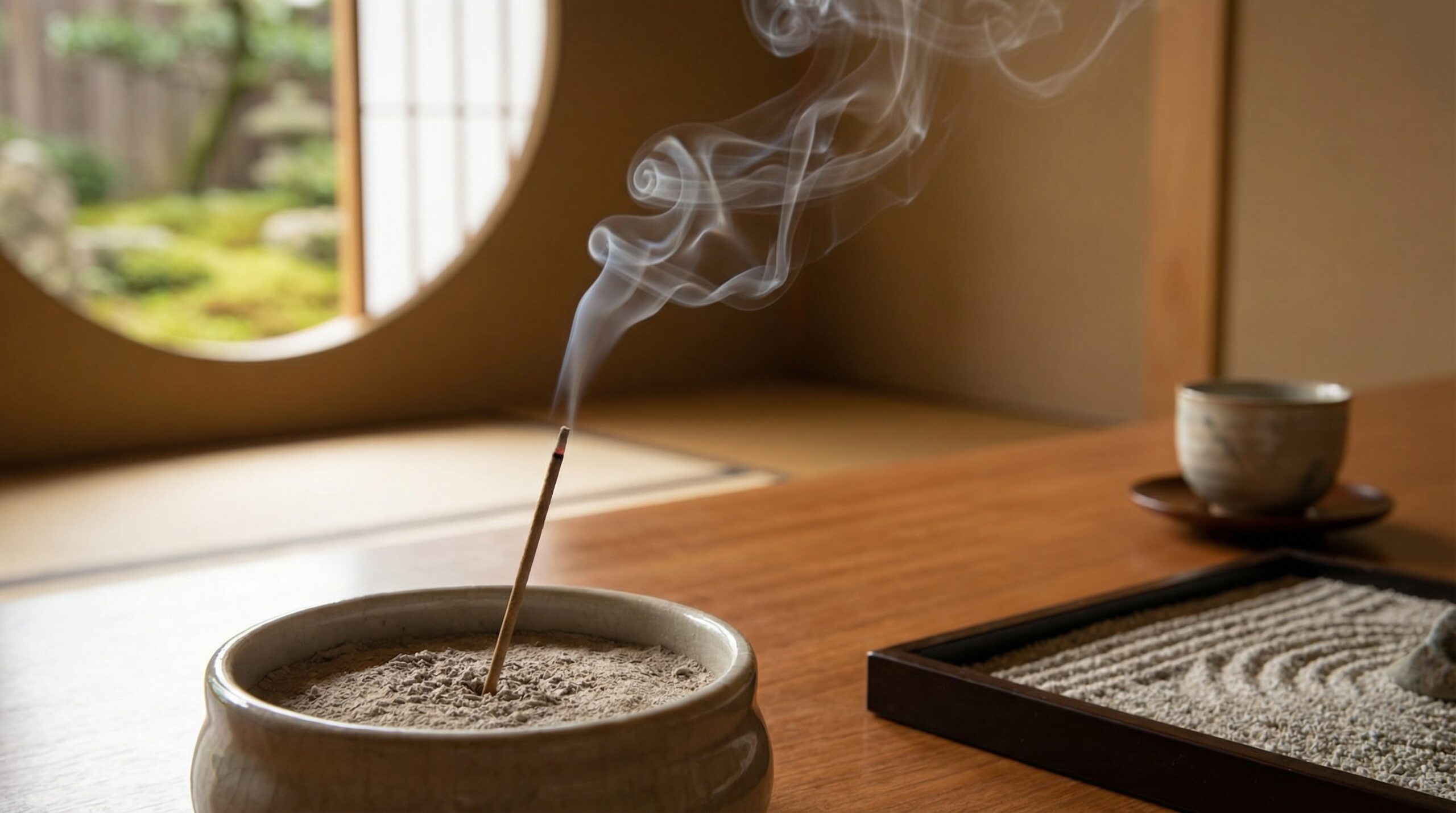
Enjoy the Moment: Return the holder to its safe place. Now, relax. Observe the delicate ribbon of smoke, the kō-en (香煙), as it dances in the air. Close your eyes and “listen” to the fragrance. Notice how it evolves over time. Let it fill your space and senses. This is your ten to fifteen minutes of peace—make it meaningful.
For those interested in the next step—heating wood chips—the process involves carefully preparing a charcoal ember, burying it in ash to regulate temperature, and placing the wood chip on a mica plate above it. It’s a more involved procedure, a true ceremony in itself, and best explored in a workshop or class when you’re ready to dive deeper.
Kōdō: The Way of Incense, The Ultimate Mind Game

We’ve mentioned Kōdō several times, but it deserves a closer examination as a fascinating and highly refined art form. Kōdō, the “Way of Incense,” represents the artistic and spiritual pinnacle of fragrance appreciation. This practice demands years of study, extensive knowledge of literature and history, and an exceptionally refined sense of smell. Simply put, it is the ultimate mental challenge played with scent.
More Than a Hobby: A Way of Life
Kōdō is regarded as one of the three classical Japanese arts of refinement, alongside sadō (tea ceremony) and kadō (flower arrangement). It goes beyond merely identifying aromas; it is a comprehensive discipline dedicated to cultivating one’s inner self. The practice follows a strict and intricate code of rules and etiquette, employing a beautiful array of specialized tools called kōdōgu. There are two primary schools of Kōdō: the aristocratic Oie-ryū and the samurai-founded Shino-ryū, each with its unique styles and traditions. The ultimate aim of Kōdō is to reach a state of mindfulness and tranquility, to appreciate beauty in its most subtle and fleeting forms, and to connect deeply with Japan’s literary and aesthetic heritage. It teaches patience, concentration, and a profound respect for nature.
What Happens During a Kōdō Ceremony?
Taking part in a Kōdō gathering, or kōkai, is a singular and captivating experience. The ceremony is held in a quiet, traditional Japanese room, where participants sit formally in the seiza position while the host, or kōmoto, carefully prepares the incense. Central to many ceremonies is a literary game called Kumikō (組香). In a Kumikō game, the host selects several types of precious aromatic woods, often inspired by classical literature, poetry, or seasonal themes. For instance, a game might revolve around a chapter from The Tale of Genji or a renowned waka poem about cherry blossoms. Small samples of each wood are heated one by one in a censer, which is then passed among the participants. Each person holds the censer in a prescribed way, covering the top with their hands to create a small chamber, and “listens” to the fragrance three times. This is done in silence, as they attempt to memorize and distinguish the subtle nuances of each scent. After handling all the samples, they quietly record their answers on paper using a calligraphy brush. The responses may involve identifying matching samples or arranging them in the correct sequence. The brilliance of Kumikō lies not in winning or losing, but in the shared experience of deep, attentive listening. It links participants with each other and with classical literature through the nonverbal language of scent. This intricate and profoundly meditative art continues to be practiced by devoted enthusiasts today. For travelers, some temples and cultural centers in cities like Kyoto and Tokyo offer introductory workshops, providing a rare, intimate glimpse into this exclusive tradition.
Finding Your Signature Scent: Where to Shop and What to Look For
Ready to start your own collection? Exploring the world of Japanese incense might feel overwhelming at first, but it’s a deeply rewarding journey of discovery. Japan boasts hundreds of incense makers, from large, centuries-old companies to small, artisanal producers. Here’s a guide to help you find your perfect match.
The Big Three: Trusted Legacy Brands
If you’re new to this, the major legacy brands are always a safe bet. They have built their reputations on quality and consistency over centuries.
Nippon Kodo: Established in the 16th century, Nippon Kodo is Japan’s largest incense manufacturer. They offer an extensive range, from affordable daily incense lines like their iconic Mainichi-Kō (“Daily Incense”) and the globally well-known Morning Star series, to luxurious collections featuring rare agarwood. Their Kayuragi line, presented in beautiful paulownia wood boxes, is a great mid-range choice with delightful scents such as sandalwood, aloeswood, and pomegranate.
Shoyeido: With over 300 years in Kyoto, Shoyeido is one of the most respected names in the business. They are recognized for exclusively using natural ingredients and traditional blending methods. Known for producing high-quality, low-smoke incense, their Daily Incense series is an excellent starting point, featuring scents named after famous Kyoto landmarks like Kinkaku (The Golden Pavilion) and Nijo (The Nijo Castle). Their premium Horin series, including fragrances like Hori-kawa (“River Path”), remains popular for its calming and refined aroma.
Baieido: Another venerable company dating back to the Muromachi period, Baieido specializes in traditional agarwood blends. Their signature Kobunboku (“Plum Blossom Tree”) line is a classic, loved for its spicy, traditional, and profound scent profile. Baieido’s offerings are often favored by seasoned incense enthusiasts, presenting deep, complex aromas that truly reveal the character of high-quality aloeswood.
Exploring Boutiques and Department Stores
Once you’ve gotten familiar with the basics, the real excitement begins. Incense is widely available throughout Japan. The basement levels of major department stores (depachika), such as Mitsukoshi, Isetan, or Takashimaya, typically have dedicated incense counters (o-kō-uriba) offering a broad selection from multiple brands. The staff are usually very knowledgeable and happy to provide recommendations. Stationery stores like Ginza Itoya and lifestyle shops like Loft or Tokyu Hands often stock more modern, stylistically packaged incense. For a truly unique experience, seek out specialty boutiques. In Kyoto, the areas near the Imperial Palace and the Teramachi shopping arcade are home to many historic incense shops. In Tokyo, established stores can be found in Ginza, Nihonbashi, and Asakusa. For a contemporary perspective, check out Lisn. A brand by Shoyeido, Lisn offers sleek, minimalist boutiques in Kyoto and Tokyo that showcase incense like a luxury perfume store. They provide hundreds of single-note sticks, enabling you to mix and match to create your own signature scent. It’s a fresh, modern way to experience this ancient tradition.
What to Look for on the Label
When browsing, keep an eye out for these keywords:
- Key Ingredients: Jinkō (沈香) for agarwood, Byakudan (白檀) for sandalwood, and Kyara (伽羅) for the highest-grade agarwood.
- Smoke Level: If you are sensitive to smoke or live in a small space, look for the characters 微煙 (bi-en), meaning “less smoke,” or 無煙 (mu-en), meaning “smokeless.” These varieties use charcoal and other ingredients to reduce smoke output while preserving fragrance.
- Try an Assortment: Many brands offer variety packs, often labeled アソート (asōto). These are the perfect way to start, allowing you to sample a range of scents from a particular line without committing to a full box of something you might not love.
Level Up Your Space: Kō for Every Mood

Japanese incense offers more than just a singular, soothing aroma. It serves as a versatile tool to shape the ambiance of your home and mind throughout the day. By selecting specific fragrances, you can energize your morning, sharpen your focus during work, or relax in the evening. Here’s how to curate your scent collection.
For the Morning Hustle & Focus
To begin your day with clarity and positive energy, choose a scent that is refreshing and uplifting without being overwhelming. Think clean, bright, and clear. A high-quality, pure Byakudan (sandalwood) is an excellent option. Its clean, woody sweetness is grounding yet softly stimulating. For an extra mental boost, seek blends containing Ryūnō (borneol camphor) or mint. These scents provide a cooling, invigorating effect that helps dissipate mental fog and enhance concentration—ideal for burning at your desk before work or study.
For Winding Down & Chilling Out
At day’s end, when it’s time to unwind, select a scent that signals your body and mind to relax. This is where deep, complex, and meditative fragrances excel. A gentle, low-smoke Jinkō (agarwood) blend is the ultimate choice for evening calm. Its profound, mysterious aroma fosters introspection and tranquility. Blends that include lavender, chamomile, or other soothing herbs also work wonderfully to encourage relaxation and prepare for restful sleep. Lighting a stick of calming incense can become a meaningful ritual that helps you shift from the stress of the day to the peace of your personal time.
For Creativity & Inspiration
When creativity feels blocked, the right fragrance can ignite fresh ideas. Choose a scent that is complex and captivating, one that invites you to pause and take notice. Spicy and resinous blends featuring Chōji (clove), Keihi (cinnamon), and Nyūkō (frankincense) offer stimulating warmth and depth. Their complexity awakens the senses and fuels creative energy. A traditional, multi-layered nerikō (kneaded incense) is also highly inspiring, as its evolving scent tells a story as it gradually heats.
For Hosting & Welcoming Guests
When entertaining, aim to create an atmosphere that is warm and refined without being overpowering. This embodies the Japanese spirit of omotenashi, or wholehearted hospitality. The key is subtlety. Choose a high-quality, low-smoke incense with a clean, universally appealing fragrance. A soft sandalwood or a light, elegant floral-woody blend works perfectly. Light it 20 to 30 minutes before guests arrive, allowing the scent to mellow and gently scent the air without visible smoke. It should serve as a pleasant background note that makes guests feel welcomed and cared for—an understated touch that enhances the entire experience.
Exploring Japanese incense is a personal journey. It involves discovering scents that resonate with you, ones that can transport, soothe, or inspire. Begin with a single stick and a quiet moment of focus. Watch the smoke swirl, breathe in the fragrance, and feel the atmosphere of your space—and your mind—shift. In our fast-paced, always-connected world, this simple, ancient ritual offers a meaningful path back to peace. It is more than just a scent; it is a vibe and a daily practice of finding your zen. Stay chill.