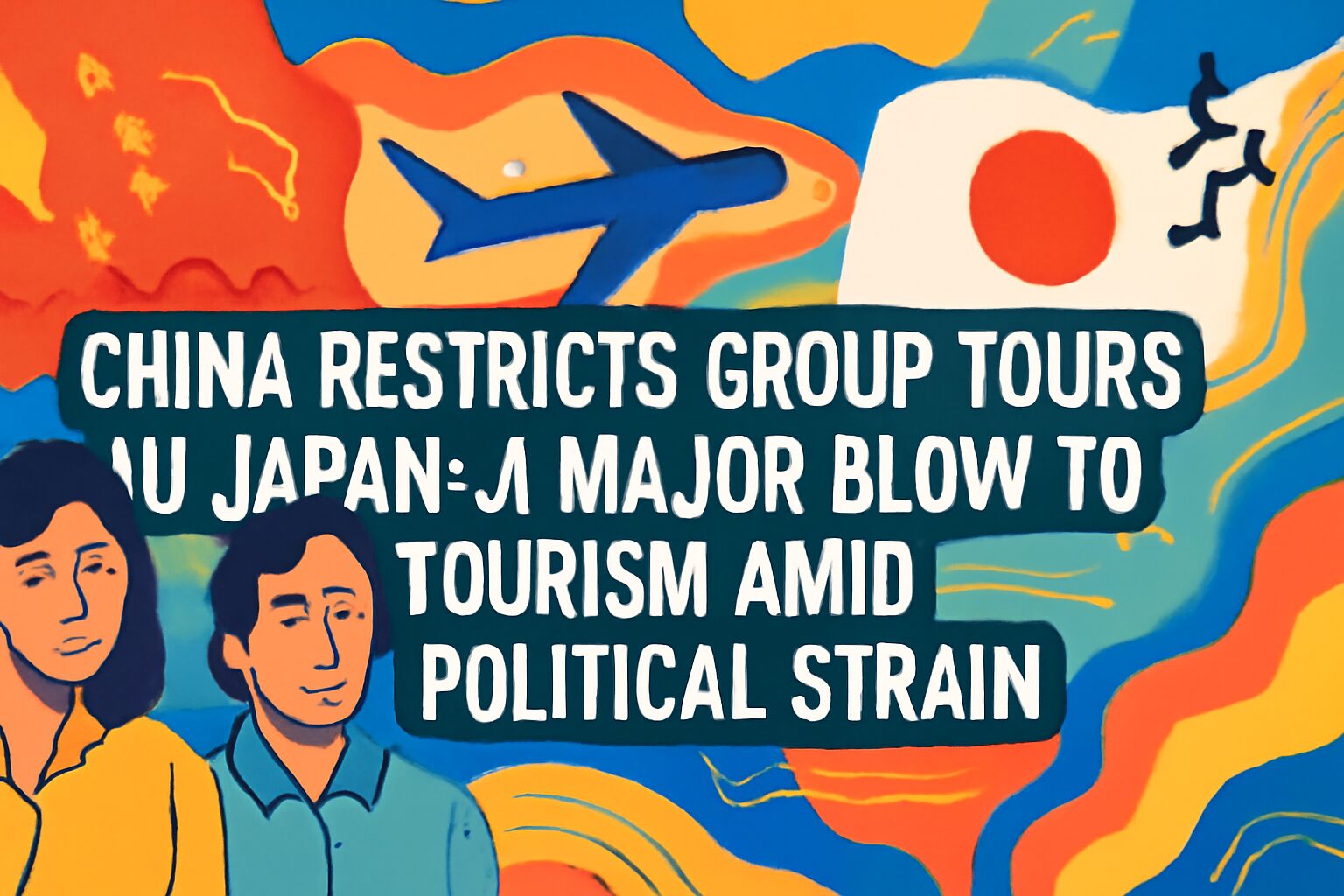
The Chinese government has issued a directive to its domestic travel agencies, ordering a significant reduction in group tours to Japan. This move, widely seen as a response to escalating political tensions, threatens to derail the recovery of Japan’s tourism industry, which has historically relied heavily on the lucrative Chinese market.
Background: Tourism as a Political Barometer
This is not the first instance of tourism being used as a tool in Sino-Japanese diplomacy. Similar restrictions have been imposed during past political disputes, notably during the 2012 conflict over the Senkaku/Diaoyu Islands. The current directive follows intense criticism from Beijing regarding Japan’s decision to release treated radioactive water from the Fukushima Daiichi nuclear power plant into the Pacific Ocean, a move that began in late August 2023.
To understand the magnitude of this decision, one must look at pre-pandemic figures. In 2019, Japan welcomed a record 31.88 million international visitors. Of these, tourists from mainland China were the largest contingent, numbering approximately 9.59 million, which accounted for over 30% of all international arrivals.
More critically, their economic contribution was immense. According to the Japan National Tourism Organization (JNTO), Chinese tourists spent an estimated 1.77 trillion yen (approximately $12 billion USD) in 2019. This figure represented 36.8% of the total spending by all international visitors, making China the single most important market for Japan’s tourism economy.
The Economic Ripple Effect
The directive is expected to have a severe and immediate impact on the Japanese economy, particularly in regions and sectors that had tailored their services to Chinese tour groups.
Heavily Affected Regions and Businesses
Popular destinations for Chinese tourists, such as Tokyo’s Ginza and Akihabara districts, Osaka’s Shinsaibashi, Kyoto, and Hokkaido, are bracing for a sharp decline in revenue. The impact will be felt across a wide range of businesses:
- Hotels and Ryokans: Many accommodations that cater to large groups will face mass cancellations and a sudden drop in occupancy rates.
- Retailers: Department stores, drugstores, and electronics shops that benefited from the “bakugai” (explosive shopping) phenomenon will see a significant sales slump.
- Transportation: Bus companies that specialize in tour group transport and certain domestic flight routes will experience a sharp decrease in demand.
- Restaurants and Local Souvenir Shops: Establishments that rely on the high volume of tour group traffic will be among the hardest hit.
Future Outlook: A Push for Diversification
This development is a major setback for Japan’s tourism industry, which was on a promising recovery trajectory. Chinese group tours to Japan had only just been officially reinstated in August 2023 after a long pandemic-induced hiatus, and expectations were high for a surge in visitors during the autumn travel season and China’s Golden Week holiday in October.
While the current restrictions focus on group tours, the chilling effect on diplomatic relations may also discourage individual Chinese travelers.
In response, the Japanese government and tourism industry are likely to accelerate efforts to diversify their source markets. There has been a growing focus on attracting high-spending tourists from Europe, North America, Australia, and the Middle East. Furthermore, Japan is seeing a strong recovery from other Asian markets like South Korea, Taiwan, and Hong Kong, which will now become even more critical to sustaining the industry.
The duration of these restrictions remains uncertain and will likely depend on the evolution of the political climate between the two nations. For now, Japanese businesses are left to navigate a challenging landscape, once again reminded of the vulnerabilities of being overly dependent on a single international market.