Yo, what’s the deal? It’s Ayaka, comin’ at you from a corner of Japan where the rice fields are gold and the memories are even more golden. Today, we’re time-traveling. Not in a DeLorean, but in a machine that’s way more glittery and arguably more reality-bending: the Purikura photo booth. Specifically, we’re zeroing in on the 90s, the golden era, the genesis of a cultural phenomenon that took over the hearts of every Japanese teen and left a trail of glossy, sticker-backed evidence. If you think you know photo booths, you gotta check your presets. This ain’t your passport photo spot. This was a ritual, a social currency, and our first, clumsy foray into creating an alternate, hyper-cute version of ourselves. We’re talking about Print Club, or as the whole world came to know it, Purikura. It was more than just a picture; it was a statement, a memory sealed in laminate, a tiny piece of proof that you and your squad were, like, totally BFFs. But here’s the tea: looking back at those old prints, with their gigantic, galaxy-filled eyes and skin smoothed into oblivion, it’s not just nostalgic. It’s… weird. Like, seriously, wonderfully, beautifully weird. It’s a full-on trip into the uncanny valley, where cute gets a little creepy, and the results are something you just can’t look away from. This wasn’t just about looking good; it was about transforming into a bizarrely adorable caricature, a version of you that only existed on a tiny, shareable sticker sheet. It’s a vibe that defined a generation, a glitch in the kawaii matrix that, honestly, we need to talk about. So grab your loose socks and your flip phone (in spirit, at least), ’cause we’re about to decode the beautifully bizarre world of 90s Purikura. Before we jump in, get your bearings. Most of this magic went down in the electric-neon jungles of Japan’s game centers. Peep the map below for a classic spot in Shinjuku where the spirit of Purikura is still poppin’ off, a place where the ghosts of 90s trends still echo through the cacophony of modern arcade sounds.
To truly understand the full spectrum of Japan’s kawaii culture that birthed this phenomenon, you should also explore the whimsical world of character cafes.
The Vibe Check: Stepping into a 90s Game Center
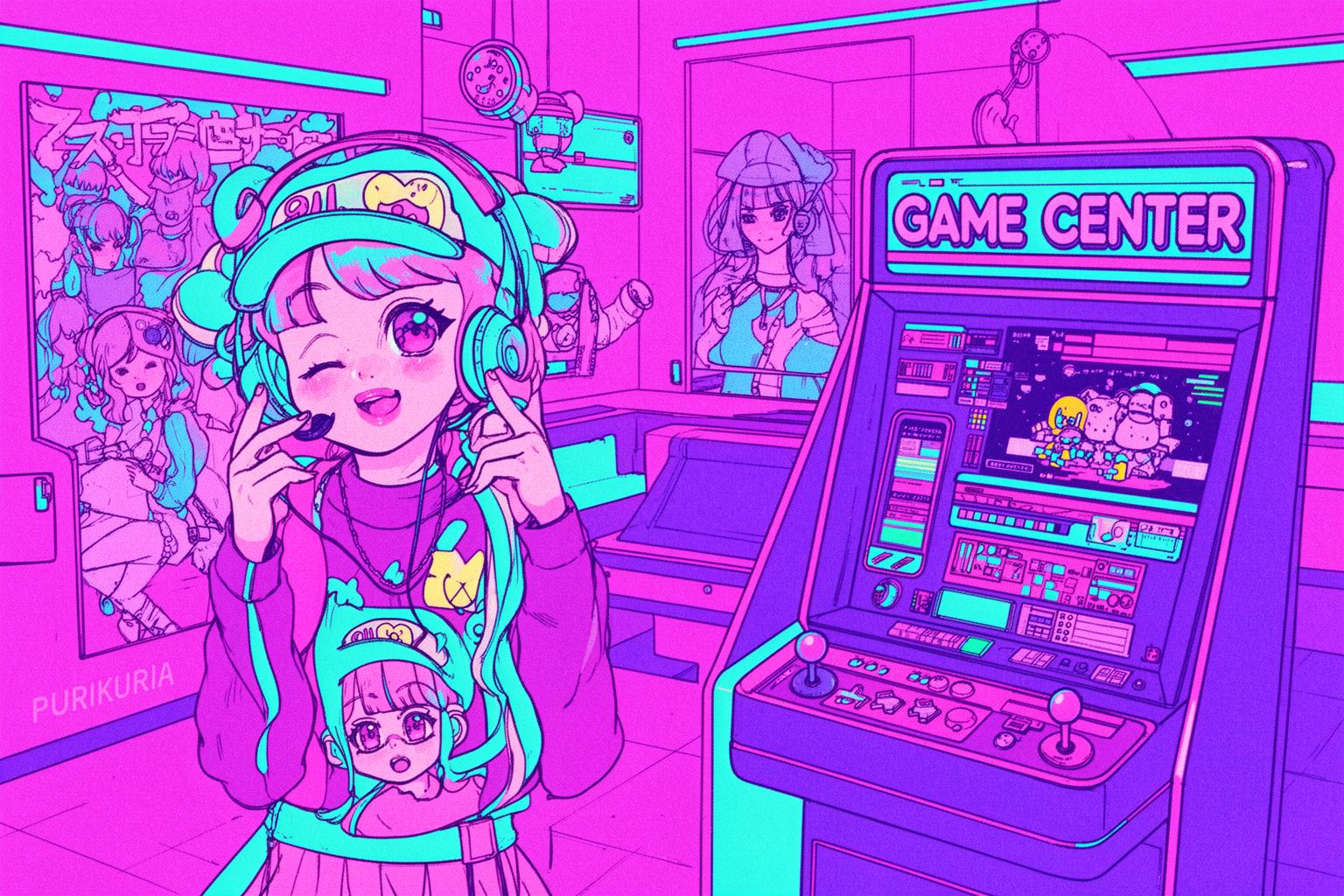
To truly understand 90s Purikura, you first need to envision its natural habitat. These remarkable machines didn’t reside in some quiet, sterile studio. No, they thrived in the absolute chaos of a Japanese game center, or arcade, during the late Heisei era. Picture walking through automatic doors and being hit with a wave of sound so thick it feels tangible. It’s a cacophony of digital explosions, the victorious jingles of a UFO catcher prize, frantic button-mashing from rows of fighting games, and the mesmerizing, looping soundtracks of rhythm games. The air itself was different then—a hazy mix of stale cigarette smoke (yes, you could smoke inside back then, wild, right?), the faintly sweet aroma of nearby crepe stands, and the distinct, electric scent of ozone emanating from hundreds of CRT monitors. Lighting was a constant twilight, pierced by flashing, strobing neon from the game cabinets. It was sensory overload at its finest, a crafted reality meant to make you forget the outside world, your homework, and your curfew.
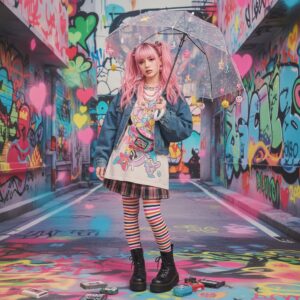
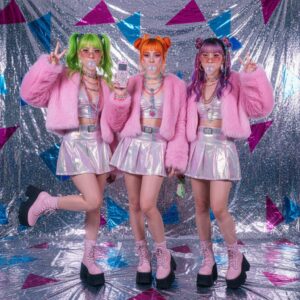
Within this buzzing, electric ecosystem, you’d find the Purikura corner. It was almost always a specific area, often a bit brighter, noticeably pinker, and mostly crowded with groups of schoolgirls. This was their territory. You’d spot them in their uniforms—sailor-style fuku or blazers, with skirts rolled up to impossibly short lengths and loose socks scrunched down around their ankles like fluffy white clouds. Their hair might be feathered, perhaps with chunky highlights, and their school bags adorned with keychains and, naturally, old Purikura stickers. They’d be laughing, planning, comparing the latest machines, their voices cutting through the digital noise. It was a whole scene, a subculture with its own rules and rituals. The energy was contagious. It wasn’t just about snapping a photo; it was about the hangout, the pre-photo ritual of fixing your bangs with a tiny pocket mirror, the post-photo review where everyone would gather around the editing screen, shouting suggestions. The game center was the clubhouse, with Purikura as the main attraction. It was a world apart from today’s curated, quiet Instagram vibe. It was loud, a little grimy, and unapologetically real—even as you stepped into a machine designed to make you look completely unreal.
What Even IS Purikura? The Lowdown on the OG Photo Booth Sesh
So, what was the actual process? Let’s break it down, because it was a whole ritual from start to finish. First, you had to pick your weapon. You and your friends would circle a row of Purikura machines like sharks, sizing them up. Each machine was a giant, brightly colored box covered in photos of models showcasing the specific “vibe” of that booth. The names were always over the top, something like “Angel Heart,” “Kirameki Paradise Vol. 2,” or “Love Love Star.” One booth might promise the dreamiest, softest lighting, another would specialize in giving you super long, skinny legs, and another might boast exclusive new Sanrio character stamps. This was a high-stakes choice. You were dropping 400 yen on this, a serious chunk of a teen’s allowance, so you had to pick wisely. A debate would unfold, weighing the pros and cons of each machine’s features until a decision was reached.
Once the choice was made and the coins were dropped in, the real game started. You’d cram your entire group—sometimes up to five or six people—into a space about the size of a closet. A calm, synthesized female voice would greet you and prompt you to begin. The background was usually a harsh, flat green or blue screen, a primitive form of the tech we see everywhere now. The flash was blinding. It wasn’t a gentle, flattering light; it was an industrial-strength strobe that erased every imperfection and probably left you seeing spots for a few minutes. The camera itself was a low-resolution digital eye, capturing images that were inherently a bit fuzzy, slightly pixelated. The machine would lead you through a series of poses with a timer ticking down ominously for each shot. “Next, a cute pose!” the voice chirped, as you and your friends scrambled to coordinate peace signs, heart hands, or the classic “ulzzang” face tilt. There was no time to think, only to react. It was a chaotic dance of flailing limbs and forced smiles, all caught in a sequence of six to eight brutally honest snapshots.
But the real magic happened after the awkward photo session. You moved to the second part of the machine: the “rakugaki” station. This was the editing bay, where you and your friends would huddle around a small touchscreen with a couple of plastic stylus pens tethered to the machine. These pens were the sacred tools of transformation. This was where you took the raw, flash-blasted images and turned them into bizarre works of art. You had a very limited time, usually just a couple of minutes, to decorate your chosen photos. A frantic, collaborative energy took over as everyone shouted instructions. “Add a star here!” “Write ‘BFFs’ at the top!” “No, use the sparkly pen!” It was high-pressure creativity, a race against the clock to achieve maximum cuteness before the machine abruptly declared “TIME’S UP!” and sent your masterpiece to the printer. This entire process, from choosing the machine to grabbing the warm, freshly printed sticker sheet from the slot, was the heart of the Purikura experience. It was a journey, and the sticker sheet was the memento.
Entering the Uncanny Valley: When “Kawaii” Gets Kinda Creepy
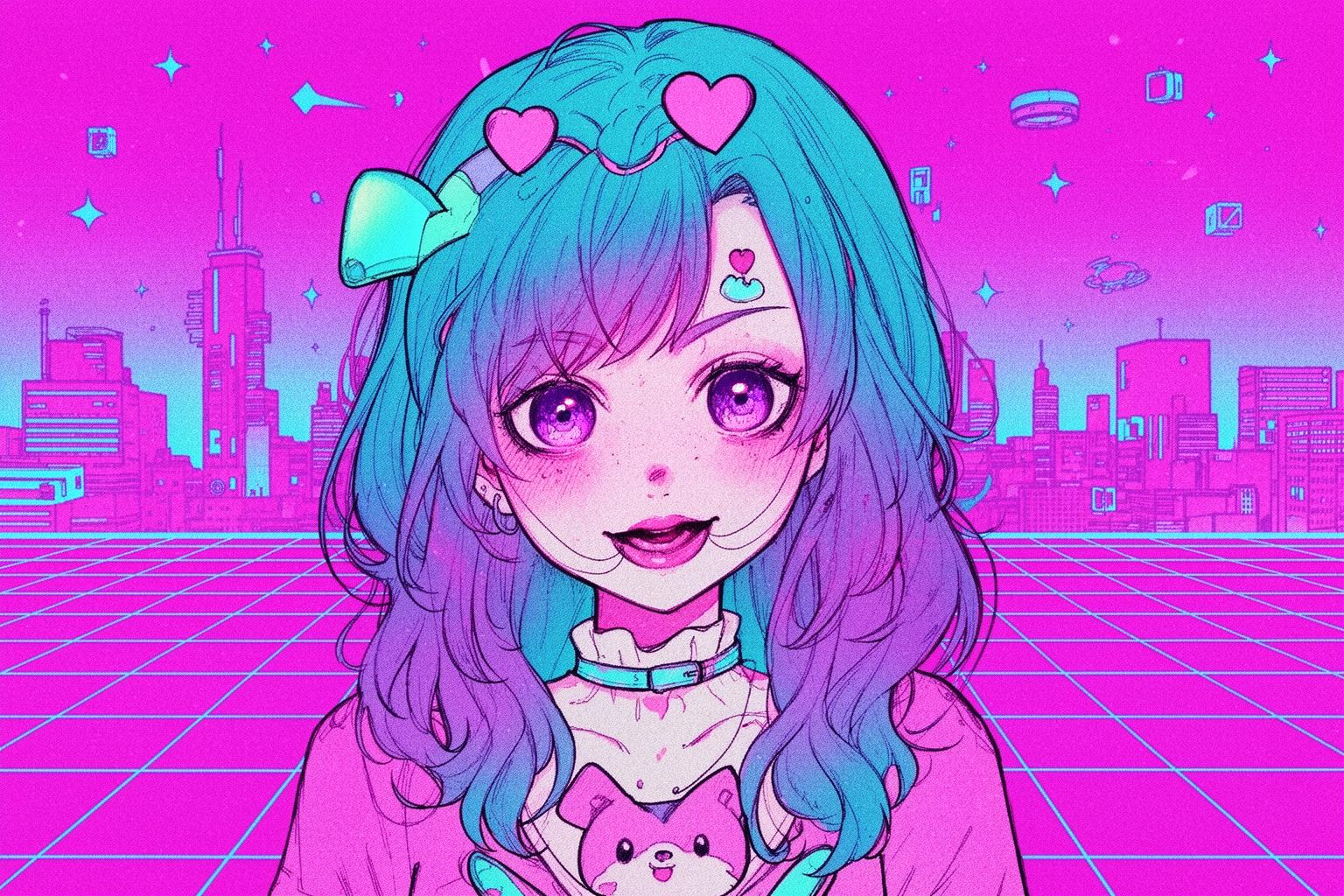
Now we reach the core of the matter: the uncanny valley. This is the space where something looks nearly human, but a few key details are just… off, creating an unsettling feeling. And boy, did 90s Purikura dwell in that valley. It pioneered digital distortion in the name of cuteness, long before Photoshop and filters became household terms. The aim wasn’t to look like a better version of yourself; it was to resemble a better version of a manga character.
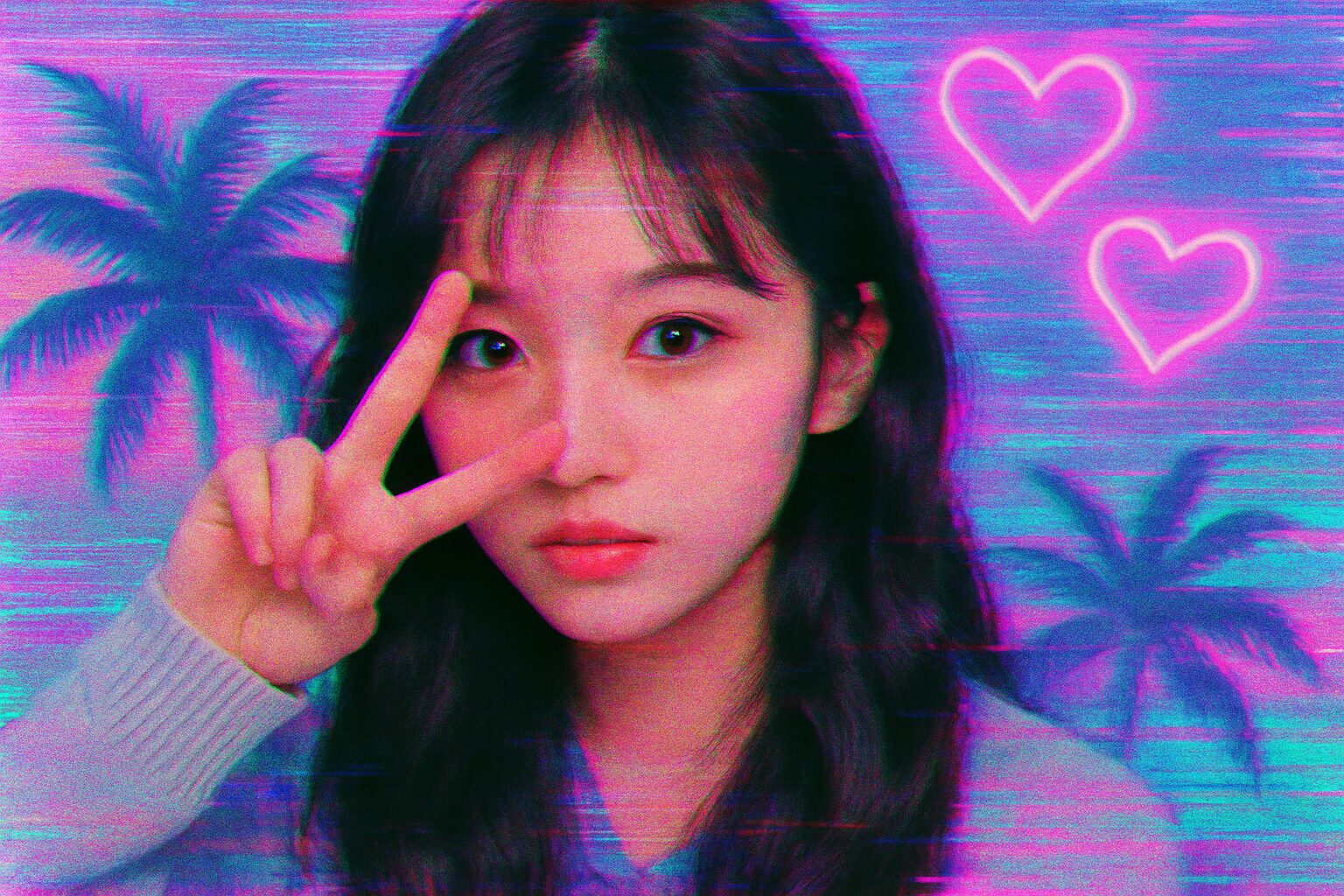
The most striking and defining feature was the eyes. The software in these machines had one main directive: find the eyes and make them huge. It digitally enlarged your irises and pupils to an unnatural extent, giving you the wide, innocent gaze of a baby deer or an anime heroine. But that wasn’t all. It then added layers of “kira-kira” (sparkles). This wasn’t a subtle twinkle—it was a full-on celestial event happening inside your eyeballs. You’d see multiple starbursts, tiny hearts, and shimmering light rings layered onto your pupils. The result was these gigantic, glossy, liquid-like orbs staring back at you from the sticker. They scarcely looked human. They were captivating and deeply, deeply strange. Your own eyes, seen in the mirror every day, suddenly appeared alien—transformed into portals to another dimension of kawaii. It was the first and most powerful step in erasing the real you and replacing it with the Purikura you.
Next came the skin. The 90s machines were relentless in their quest for perfect skin. The software applied an aggressive, one-size-fits-all smoothing filter that completely erased every pore, freckle, blemish, or line. It wasn’t about subtle retouching; it was about total resurfacing. Your face became a smooth, matte, plastic-like canvas. The texture of human skin disappeared, replaced by a flawless, doll-like sheen. Often, this had the side effect of flattening your facial features, making your nose less defined and your face rounder—part of the “kawaii” aesthetic. You didn’t look refreshed; you looked like porcelain. Combined with the enormous eyes, the effect was truly unsettling. You were recognizable, but as a cartoonish, idealized version of yourself—a mascot of you.
Then there were the proportions. While modern machines are known for their leg-lengthening features, the 90s versions were the awkward pioneers. Some booths offered modes that subtly slimmed your face, sharpening your jawline into a perfect V-shape—a feature now standard in many selfie apps. The effect was often jarring, as the software wasn’t very advanced. You might notice slight warping in the background near your face where the digital nip-and-tuck occurred. It was a primitive form of digital body modification that has since become commonplace. The focus stayed on the face rather than the body, creating a top-heavy, cherubic look that emphasized the impossibly large eyes and tiny, pointed chin.
The final layer of unreality arrived during the rakugaki stage. Here, you—the user—became an active part of the uncanny transformation. The limited toolset encouraged a certain aesthetic. The pens were clumsy, resulting in thick, wobbly lines. You’d draw hearts on your cheeks, scribble your name in bubbly letters, and fill empty spaces with a barrage of pixelated stamps. These stamps were a wild mix of preset doodles: generic hearts and stars, odd English phrases like “Happy Every Day” or “Sweet Kiss,” and strange, unidentifiable cartoon animals. By covering the photo with this digital graffiti, you added another layer of artifice, further pulling the image away from reality. The final product was a chaotic collage: a photo of a doll-like human, overlaid with crude digital drawings and sparkling text. It wasn’t a photograph anymore. It had become an artifact of a unique, bizarre digital culture—a perfect snapshot of the 90s uncanny valley.
The Culture of the Cut-and-Stick: Purikura Techo
One key aspect to grasp about 90s Purikura is that it existed before the rise of social media. There was no Instagram to post to, no Facebook to tag your friends in. The output from the machine wasn’t a JPG file; it was a physical, tangible item: a glossy 4×6 sheet of stickers. What you did with this sheet mattered immensely. The experience didn’t end once you left the game center; in fact, the second half of the ritual was just beginning.
After a successful Purikura session, the first task was to divide the spoils. This involved using a pair of tiny, foldable scissors that every high school girl seemed to keep in her pencil case. You’d carefully cut along the perforated lines, splitting the sheet so each person in the photo received a strip with their favorite shots. This act of cutting and sharing was a bonding experience itself, a moment of negotiation and camaraderie. “You can have the one where I’m blinking if I can have the one where we’re doing the heart pose!” It was a small economy of friendship, traded in tiny, glossy squares.
But these stickers weren’t meant to be tucked away. They were meant to be displayed, primarily in the “Purikura Techo.” This was a special notebook or planner, often small enough to fit in a pocket, its pages filled with overlapping layers of Purikura stickers. A Purikura Techo was a living record of your social life—a visual diary of who you spent time with, where you went, and what you did. Flipping through its pages was like scrolling through a physical social media feed. You could witness friendships bloom and fade, observe shifts in fashion and hairstyles, and relive memories from specific days. These books were treasured. Girls would spend hours carefully arranging their stickers, adding handwritten notes, and decorating pages with additional stickers and colorful pens. It was a form of scrapbooking, a personal and highly curated archive of one’s teenage years.
The culture of trading stickers was also significant. You would swap stickers with friends, especially if someone was missing from a group photo. It was a way of saying, “I was thinking of you,” or “You’re part of the group.” The stickers also acted as social currency. You’d stick them on your flip phone, pencil case, textbooks, and letters to friends. They were a way to mark your belongings with your social identity. Seeing a friend’s face smiling from the back of your phone served as a constant, comforting reminder of your bond. This physicality is what truly distinguishes 90s Purikura from modern digital photo culture. You couldn’t just “like” a photo; you had to own a physical piece of it. It had weight, texture, and a tangible place in the real world. Losing your Purikura Techo was devastating, akin to having your hard drive wiped today. It was an irreplaceable log of your life, recorded one sticker at a time.
A Trip Back in Time: Where to Find Retro Purikura Today?
So, you’re captivated by this uniquely quirky aesthetic and eager to try it for yourself. Here’s the somewhat disappointing truth: locating an authentic, working Purikura machine from the 90s is like spotting a unicorn—extremely rare. These machines were built as workhorses, not preserved as museum artifacts. They were heavily used in busy arcades and replaced when they broke down or became outdated with newer, more advanced models. Arcade technology evolves rapidly, and nostalgia alone doesn’t cover costs. Most original machines have long since been retired and discarded.
Nevertheless, all hope is not lost for the retro enthusiast. Your best chance isn’t at the massive, flashy game centers in Shibuya or Shinjuku. Instead, venture off the beaten path. Think of smaller, locally owned game centers in quieter neighborhoods or smaller towns. Occasionally, these spots have an older machine running in a corner, a relic from a past era. Locations celebrated for retro culture, like Tokyo’s Nakano Broadway, might dedicate an entire floor to vintage games, where luck could be on your side. Another possible place is a “dagashiya,” a traditional candy shop, which sometimes hosts a few vintage arcade games. It’s a treasure hunt, with the reward being a truly authentic, low-res, delightfully awkward photo session.
If you can’t track down an original 90s model, don’t lose heart. You can still get a similar experience. Many modern Purikura machines now feature a “classic” or “90s style” filter mode. This pays homage to the old days, mimicking the harsh flash, the subtler eye-enlarging effects, and pixelated stamps of the originals. It’s not quite the same as using a bulky, vintage machine, of course. The interface is smooth, the camera high-definition, and the process much quicker. But it’s a fun way to engage with the aesthetic and get a sense of the original vibe. It highlights just how influential that distinctive, eerie look was—so much so that it’s now intentionally recreated as a stylistic choice.
Visiting a modern Purikura spot remains an experience, even if it’s a different one. The new machines are ultra-sophisticated. They provide everything from makeup filters to try on various lipstick shades and false eyelashes, to hair-styling tools that alter your hair color. The uncanny valley still exists, but it’s a more polished version. Instead of resembling a cute alien, you appear as a flawless, airbrushed supermodel. Witnessing this evolution is truly fascinating. But if you happen upon an old, forgotten machine with faded graphics and a clunky interface, treasure it. You’ve found a genuine time capsule, a gateway back to the glitchy, glittering dawn of digital self-representation.
The Evolution of Uncanny: From 90s Pixels to Modern AI Perfection
The evolution of Purikura from the 90s to the present truly reflects our evolving relationship with the digital self. The uncanny valley has transformed its terrain. In the 90s, the strangeness stemmed from technological constraints. The software was awkward, cameras had low resolution, and editing tools were rudimentary. Creators aimed for an idealized “kawaii” look, but their crude tools produced a charmingly odd, doll-like style. The oversized eyes and plastic skin were their best attempt to mimic shojo manga characters. It was an uncanny valley of approximation, a best guess at perfection that resulted in something beautifully peculiar.
Contemporary Purikura, conversely, dwells in an uncanny valley of hyper-realism. The technology is so advanced that the alterations appear seamless. Today’s machines, powered by sophisticated AI, map your face in three dimensions, enabling subtle or dramatic changes that look eerily real. They can slim your jaw, lift cheekbones, brighten teeth, and add a dewy glow to your skin that seems genuinely there. The aim is no longer to resemble a cartoon but to look like a professionally photoshopped celebrity on a magazine cover. The final image is an impossibly flawless version of yourself—every imperfection erased, every feature enhanced. You look human but as an unhumanly perfect variant of human. This generates a new kind of discomfort: not the shock of seeing yourself caricatured, but the quiet unease of viewing a technically perfect yet emotionally vacant version of yourself. The awkwardness disappears, along with some of the personality.
The original Purikura aesthetic’s impact is undeniable. It served as the training ground for an entire generation’s grasp of digital image manipulation. The central idea—taking a photo and instantly editing it to be cuter, funnier, or more idealized—is the cornerstone of today’s social media. Apps like Snapchat, Snow, and Meitu are direct descendants of the Purikura machine. Face-altering filters, cute animal ears, sparkly overlays, and digital stickers all trace their roots back to that cramped photo booth in a noisy Japanese arcade. Purikura paved the way for Instagram filters to flourish. It normalized the notion that a photograph is not a mere record of reality, but a starting point for creative self-expression and transformation. The 90s kids doodling on touchscreens with plastic styli were pioneers of the selfie culture that now dominates worldwide. They were learning a new visual language, one where reality was optional and cuteness the ultimate aim.
Your First (or Next) Purikura Adventure: A Practical Guide
Feeling inspired to step into a Purikura booth? Bet. Although the 90s are now a memory, the Purikura experience remains a quintessential part of Japanese youth culture and an absolute must for any visitor. Here’s a quick guide to navigating the modern Purikura scene.
First, you need to find your spot. This is the easy part. Almost every game center has a dedicated Purikura floor or corner. Look for major chains like GiGO, Taito Station, or Round1. They’re often located on the upper floors of large department stores or even inside major train stations. The Purikura area is usually designed as a female-friendly space, sometimes with signs restricting single men from entering to ensure a comfortable atmosphere for the main clientele. Don’t be shy, though; tourists and couples are always welcome!
Once inside, you’ll face a dazzling array of machines. Prices are usually clearly displayed, typically between 400 and 500 yen. These machines only accept 100-yen coins, so make sure you have change handy. If not, there’s usually a change machine nearby. Modern booths often follow a theme, like “girly,” “cool,” or “natural.” They advertise features such as “ultra-slimming legs” or “dewy doll skin.” Pick whichever style appeals to you.
The process is lightning-fast, so be ready. After inserting your money, choose your layout and the number of shots. Then, it’s pose time. A model on screen often suggests poses. My advice? Just have fun—be silly. The timer between shots is short, so move quickly. After the photo session, you’ll head to the two rakugaki stations—most modern machines have two editing screens to save time—where you’ll decorate your shots. The clock is ticking! You’ll find a huge selection of pens, stamps, and filters. Collaborate with your friends to embellish your favorite photos. When time’s up, you’ll be prompted to enter your email address. Do it! Many machines will send you a digital copy of your photos, which is a great bonus. Finally, go to the machine’s exit slot and wait for your sticker sheet to print. It comes out warm, and the reveal is always the best part.
A few tips for first-timers: Many Purikura corners have a “makeup space” with mirrors and sometimes even free hair straighteners or curling irons for last-minute touch-ups. Also, don’t hesitate to go all out with your poses—the crazier, the better. Purikura isn’t about looking serious and composed; it’s about capturing a moment of pure, unfiltered fun. It’s just as much a cultural experience as it is a photo opportunity—a vibrant slice of modern Japan waiting for you to step inside.
A Final Thought: Cherishing the Awkwardly Adorable
Looking back at those old, faded Purikura stickers from the 90s, it’s easy to laugh at the odd proportions and over-the-top sparkles. Yet, there’s a genuine warmth to them that goes beyond the strange aesthetic. They capture a specific moment in time: a pre-internet era when memories were tangible objects you could hold and stick in a book. The uncanny vibe wasn’t a flaw; it was the essence. It offered a playful escape, a way for teenagers to see themselves through the lens of cute, carefree characters from magazines and anime.
In a world now saturated with hyper-polished, AI-enhanced images, there’s something incredibly refreshing about the clumsy, awkward charm of 90s Purikura. It was a shared experience, a loud, chaotic ritual with your best friends in a bustling arcade. The aim wasn’t just to get a perfect picture, but to create a perfect memory. So next time you’re in Japan, I challenge you to find a Purikura booth. Whether a sleek modern machine or a rare retro find, step inside. Embrace the weirdness, laugh at the awkward poses, and go wild with the digital stickers. Make a memory that’s not just for social media, but for you—a tiny, glossy, and maybe slightly uncanny keepsake of your time here and a testament to the enduring, ever-evolving, and always adorable culture of kawaii.