Yo, what’s up, art lovers and travel junkies! Keiko here, coming at you straight from the heart of Japan’s creative scene. Today, we’re ditching the neon glow of Tokyo and sliding into a whole different dimension of cool. We’re talking about a place where the earth itself is the main character, a spot so authentic it practically breathes history. Get ready to roll up your sleeves, because we’re diving deep into the world of Bizen-yaki, the legendary pottery from Okayama Prefecture. This isn’t your average, run-of-the-mill souvenir hunt. Nah, this is a full-on sensory experience—a chance to connect with a craft that’s been fire for over a thousand years. Bizen isn’t just about looking at pretty ceramics in a gallery; it’s about feeling the clay, shaping it with your own hands, and becoming part of an ancient tradition. It’s a low-key town with a high-key artistic soul, a place where every winding lane and smoking chimney tells a story. Forget just buying a piece of Japan; we’re about to make one. This is where you get to leave your mark, literally, on a piece of Japanese earth and watch it transform into something timeless. The vibe is immaculate, the history is legit, and the experience? It’s about to change your whole perspective on what ‘handmade’ really means. So, let’s get this show on the road and explore the rustic, raw, and ridiculously cool world of a Bizen pottery workshop.
After immersing yourself in the earthy craft of Bizen-yaki, you can further explore Okayama’s authentic local culture by sampling the region’s famous wild boar cuisine.
The Bizen Aura: More Than Just a Town, It’s a Mood

Stepping off the train at Imbe Station, the heart of Bizen, feels like entering another era. The air itself seems different—heavier, imbued with a faint, earthy scent of clay and the subtle fragrance of pine wood smoke that appears to seep from the town’s very pores. This isn’t a place that clamors for attention with flashy signs or loud announcements. Bizen’s charm unfolds slowly, a quiet confidence radiating from its very foundations. The streets form a maze of narrow, winding paths, lined with traditional wooden houses topped with heavy, charcoal-grey roof tiles. Pottery is everywhere—not just in shops, but woven into the architecture. Ceramic shards are embedded in the walls, kiln remnants pave the walkways, and the local Shinto shrine, Amatsu Shrine, is guarded by striking Bizen-ware statues instead of the usual stone komainu (lion-dogs). It’s a town quite literally built from its own artistry.
The skyline’s defining feature is the chimneys—not sleek industrial stacks, but stout brick-and-clay structures rising organically amid the rooftops. These serve as gateways to the magic at Bizen’s heart: the kilns. When one of the huge traditional climbing kilns, or noborigama, is fired—a rare event occurring only a few times a year and lasting over a week—the town buzzes with a quiet, focused energy. You can feel the heat, see the glow against the night sky, and sense the collective anticipation of the potters who entrust their work to the flames. It is a communal ritual, a testament to a craft far from solitary. The atmosphere is one of deep respect for tradition, a shared understanding of their role as guardians of something precious. Yet it’s not a stuffy museum piece. You’ll see children riding bikes past kilns used for centuries, and hear the modern hum of a radio from a studio where a young artist gives new life to an ancient craft. It’s a living, breathing workshop on a town-wide scale.
The History Drip: Why This Pottery is a Big Deal
To truly appreciate the Bizen experience, you need to know its backstory. This isn’t just a modern craft trend; Bizen-yaki is one of Japan’s original Six Ancient Kilns, with roots tracing back to the Heian period (794–1185). That means over a thousand years of potters sourcing the same local clay and firing it to perfection. What makes Bizen pottery so iconic and revered is its unwavering dedication to naturalism. It perfectly embodies the Japanese aesthetic of wabi-sabi—finding beauty in imperfection, impermanence, and the organic. There’s no glaze, no elaborate decoration, no artificial additions. The essence of a Bizen piece comes entirely from three elements: the clay, the fire, and the potter’s hands.
The clay itself is legendary. Harvested from the rice paddies around Bizen, it is prized for its high iron content and fine texture, though it’s notoriously challenging to work with. Potters age the clay for years, sometimes decades, allowing it to mature and develop its unique traits. This extraordinary raw material is what gives Bizen-ware its signature warm, reddish-brown, almost metallic surface. During the Momoyama period (1573–1615), the golden era of the tea ceremony, Bizen-yaki was tremendously fashionable. The renowned tea master Sen no Rikyū cherished Bizen tea bowls for their simple, unassuming beauty. He recognized that their rustic, earthy forms made them ideal vessels for the mindful tea practice, enabling a direct connection with nature. Samurai warriors were also ardent admirers, valuing the pottery’s strength and subtle power. Owning Bizen-ware was a status symbol, reflecting refined taste and a deep appreciation for genuine craft.
The true magic unfolds in the kiln. Potters use traditional noborigama—long, sloped kilns built into hillsides—fired exclusively with red pine wood for ten to fourteen days, reaching temperatures above 1200°C (2200°F). During this intense heat, remarkable transformations take place. Falling pine ash melts onto the pottery, forming a natural glaze called goma, resembling sesame seeds. Pieces wrapped in rice straw before firing develop vivid scarlet or brown streaks, a technique known as hidasuki. Where oxygen is limited and pottery is buried in charcoal, chemical changes create stunning grey, blue, and black patterns called sangiri. Placing each piece in the kiln is a masterful skill, as the potter must anticipate how flames and ash will interact with it. The outcome is never certain. Every piece that comes out is a unique collaboration between the potter, the clay, and the kiln’s unpredictable fire. For this reason, Bizen-yaki is often referred to as “pottery of the earth and flame.” It captures a dramatic natural process, forever preserved in time.
Your Main Character Moment: The Workshop Experience
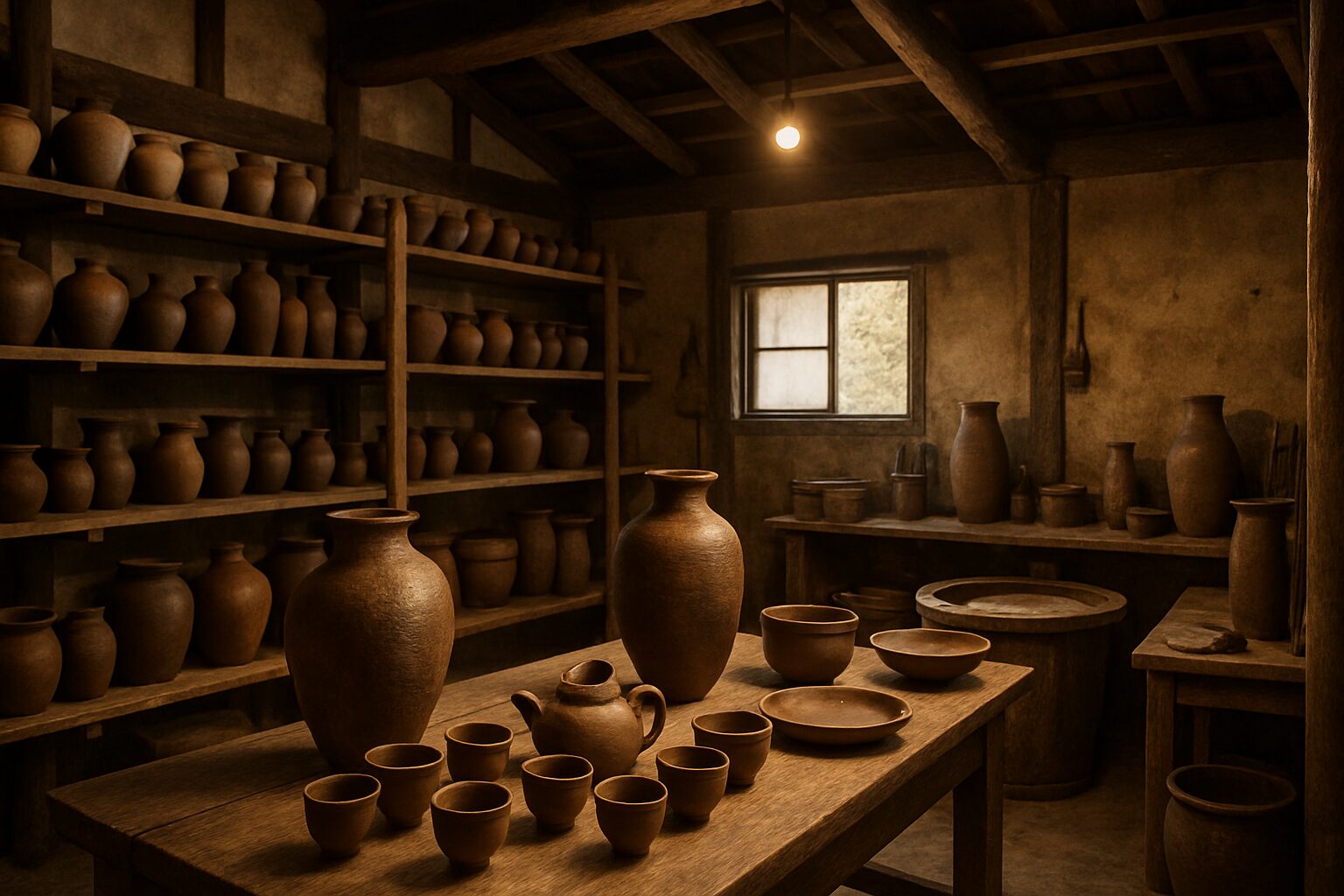
Alright, history lesson complete. Now, let’s move on to the exciting part: creating your own masterpiece. Stepping into a Bizen pottery studio immediately shifts the atmosphere. You leave the quiet street behind and enter a space devoted to creativity. The air is cool and carries the scent of damp earth. Shelves display works-in-progress at various stages of drying, ranging from wet, grey forms to dusty, bone-dry pieces waiting for the kiln. You’ll be welcomed by your sensei, the master potter. These artisans are genuine experts. Their hands, stained with clay and hardened from years of labor, move with a captivating efficiency and grace. But don’t be intimidated; they are incredibly patient and welcoming teachers, eager to share their craft.
First, they’ll introduce you to the clay. You’ll receive a lump of that famed Bizen earth. Your teacher will show you how to wedge it—a kneading and rolling process called kiku-momi (chrysanthemum kneading), named for the folded clay’s resemblance to the flower. This step removes air bubbles and aligns the clay particles, making it uniform and ready for the wheel. This part alone is a workout and a lesson in concentration. You need to push and fold with a steady rhythm, feeling the texture of the clay change under your palms.
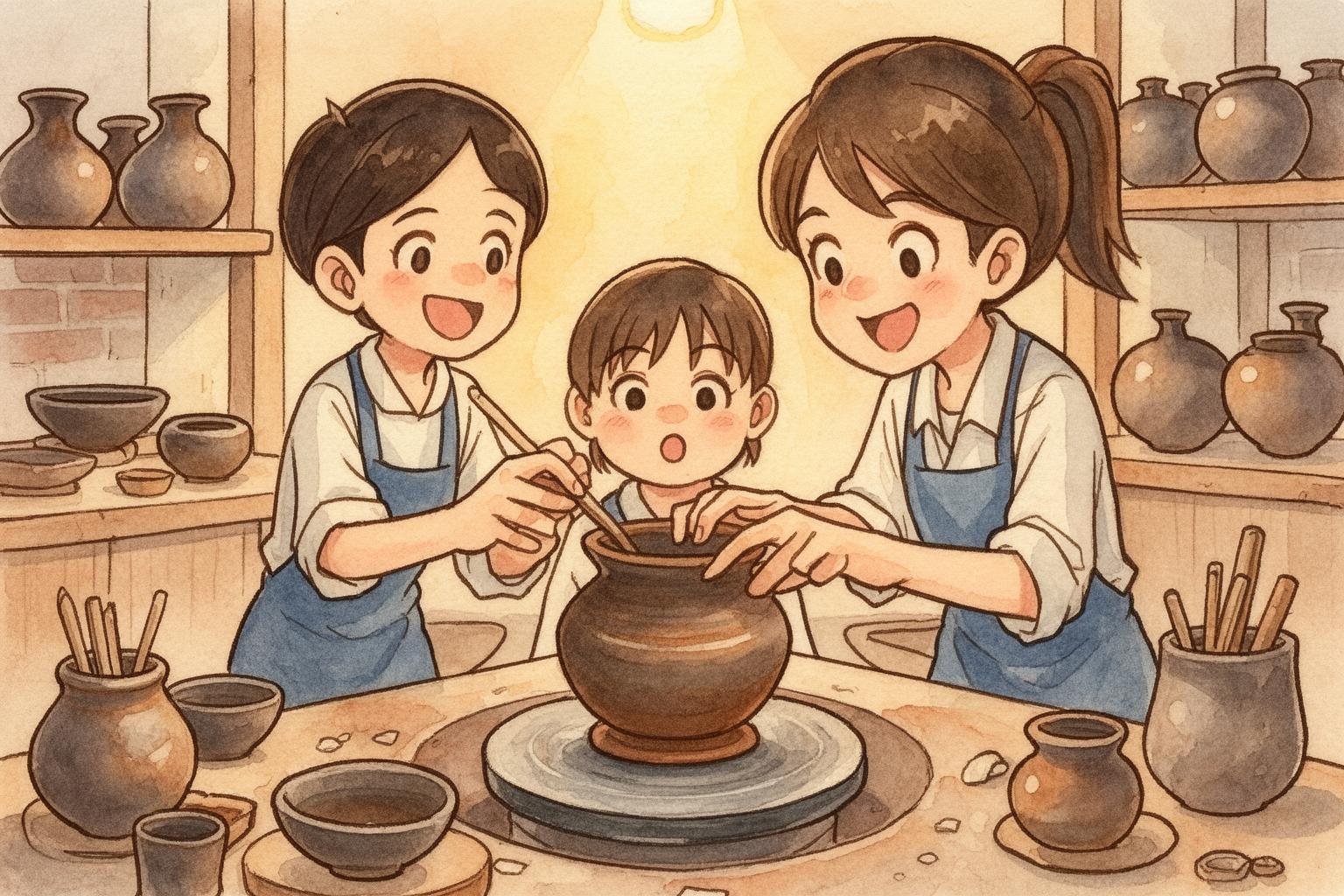
Next, it’s time for the pottery wheel. This is where the real challenge and excitement begin. Sitting at the wheel, you’ll experience a mix of excitement and nervous energy. The sensei will demonstrate first, their hands moving with seemingly magical ease as a lump of clay effortlessly takes shape. Then, it’s your turn. The first and most crucial step is centering the clay. You must steady your arms, lean in, and apply consistent pressure to the spinning mound until it’s perfectly centered on the wheel. This is much harder than it appears. Your initial attempts will likely result in a wobbly, uneven mess—and that’s perfectly normal! It’s part of the process. Your instructor will be right there, gently guiding your hands, showing you how to sense the clay and respond to its movements. Their guidance is often wordless; a slight shift in your hand pressure, a tap to adjust your posture. It’s a dialogue with the clay, and they act as your interpreter.
Once your clay is centered, you’ll learn to open it up, forming the base of your vessel. Then comes the most exhilarating moment: pulling up the walls. With one hand inside and the other outside, you gently yet firmly squeeze and lift the clay upward. You can literally feel the pot growing beneath your fingertips. The wheel spins, your hands hold steady, and the world seems to melt away. It’s an incredibly meditative experience. All that matters is the connection between you and the spinning earth. You choose the shape. Do you want a small cup (yunomi) for green tea? A wider bowl (chawan) for rice or matcha? A small plate for snacks? The sensei will assist you in achieving your vision, but the final character of the piece—its subtle curves and the texture of its rim—will be uniquely yours. Any little wobble or fingerprint isn’t a flaw; it’s what makes it personal. It’s your story embedded in the clay.
For those who find the wheel intimidating or want to explore something different, many studios also offer hand-building (tebineri) workshops. This is a more freeform method where you shape the clay using your hands and simple tools. You can pinch, coil, or flatten slabs of clay to create more organic, sculptural forms. It’s a wonderful way to engage with the material on a direct, tactile level, and it’s especially great for crafting items like chopstick rests, small decorative objects, or uniquely shaped dishes.
The Great Wait: From Your Hands to the Fire Gods
So, you’ve crafted your masterpiece. It rests there on the board, a perfect, damp, gray testament to your effort. But your journey with it isn’t finished—in fact, the most dramatic phase is still ahead. You can’t take your piece home on the same day. That would be like writing a novel and never printing it. Now, it must endure the kiln. First, your piece needs to dry fully, a process that can take several weeks depending on its thickness and the humidity. Once it’s bone-dry, it’s ready for its fiery transformation.
This is when you entrust your creation to the care of the potter and the kiln. Loading the noborigama is an art form itself, a three-dimensional puzzle of great complexity. The potter must carefully arrange hundreds, sometimes thousands, of pieces inside the kiln’s multiple chambers. Each pot’s placement determines its fate. Will it be near the firebox, where it will be showered with ash and develop a heavy goma glaze? Or tucked away in a corner, protected inside a clay container called a saya, emerging with a smooth, clean surface? Or placed where the glowing embers will create a dramatic sangiri pattern? The potter anticipates the path of the flame—a river of fire that will flow through the kiln for nearly two weeks—and positions each piece with intention.
Then, the firing begins. A small fire is kindled at the kiln’s mouth and tended around the clock. The temperature is raised painstakingly slowly at first to prevent cracking. Then, for days on end, teams of potters feed massive logs of red pine into the firebox, keeping a relentless, exhausting rhythm of labor. The kiln roars to life, consuming wood with insatiable hunger. The temperature climbs higher and higher, and the pots inside start to glow—first a dull red, then a brilliant orange, and finally a white-hot incandescence. After maintaining peak temperature for several days, the kiln is sealed and left to cool for a week or more. The tension and excitement during this time ripple throughout the town.
Next comes the unloading, or kamadashi. It’s like opening a giant treasure chest. The potters, faces smudged with soot and filled with anticipation, carefully remove the bricks sealing the kiln door. Piece by piece, the transformed ceramics are brought into the light. The results are always a surprise. Some pieces turn out exactly as the potter envisioned, while others bear unexpected markings from the flame—beautiful accidents that could never be replicated. And somewhere in this incredible mix is your piece. It will be transformed. The soft, gray clay you last saw will now be as hard as stone, imbued with the rich, earthy hues of Bizen. It will carry the marks of its fiery journey—a sprinkle of ash here, a flash of red there. Your name or mark, carved on the bottom, is now permanently fired into its base. A few months later, a carefully packed box will arrive at your home. Unwrapping your piece is a truly special moment. You’re not just holding a souvenir; you’re holding a memory, a tangible piece of your journey, a collaboration among you, an ancient tradition, and the wild, beautiful power of fire.
Beyond the Wheel: Soaking Up the Bizen Vibe

Creating your own pot is the main highlight, but be sure to allocate time to simply wander and explore Bizen. The entire town feels like a gallery. Begin your journey at the Bizen Ware Traditional and Contemporary Art Museum, conveniently located near Imbe Station. It serves as an excellent introduction, providing a comprehensive overview of Bizen-yaki’s history and displaying a stunning array of styles, from historical masterpieces to innovative contemporary works. Witnessing the vast diversity achievable with just clay and fire will deepen your appreciation for the craft.
From there, let your feet lead the way. The main street is dotted with dozens of pottery shops and galleries, each exuding its own distinctive charm. Some are sleek and modern, showcasing the work of individual artists, while others are rustic, family-run establishments that have stood for generations, with shelves brimming with an eclectic mix of ceramics. Don’t hesitate to step inside. The shopkeepers are often the potters themselves or their family members, usually happy to share stories about their craft. This is the best way to find a piece that truly resonates with you, whether it’s a perfectly balanced sake cup, a ruggedly beautiful vase, or a humble rice bowl that feels just right in your hands.
For a closer look, venture beyond the main street into the back alleys. This is where the kilns are located. While you can’t simply walk into a private kiln, you can visit the ruins of the “Great Kilns” from the Momoyama period, now preserved as historical sites. Standing near these massive ancient structures, you can almost sense the presence of centuries of potters who worked here. Watch for signs directing you to the Bizen Pottery Traditional Industry Hall (Bizen-yaki Dento Sangyo Kaikan), a great place to view and purchase a wide range of works from various local potter cooperatives. If your visit coincides with the third weekend of October, try to attend the Bizen Pottery Festival. The town comes alive with streets closed to traffic and stalls offering pottery at discounted prices. It’s a vibrant, bustling event where you can meet the artists, enjoy local cuisine, and hunt for ceramic treasures. This lively celebration perfectly captures what makes the town so unique.
The Lowdown: Practical Sesh & Pro Tips
Reaching Bizen is quite simple. The main access point is Imbe Station, located on the JR Ako Line. If you’re traveling from a major city, the easiest route is to take the Shinkansen (bullet train) to Okayama Station. From there, it’s a scenic local train ride of about 40 minutes to Imbe. The journey itself adds to the experience, as the urban scenery gradually transitions to rolling hills and rice paddies.
Booking your workshop in advance is essential, especially during busy seasons like spring or autumn. A quick search for “Bizen pottery workshop” or “備前焼体験” (Bizen-yaki taiken) will reveal several studios. Some offer English-speaking staff or websites, though many do not. Don’t be discouraged by this; with the help of a browser’s translate tool or your hotel concierge, making a reservation is straightforward. Pottery is a largely visual and hands-on activity, so language barriers rarely pose a significant problem once you’re in the studio. Workshops usually last between 60 and 90 minutes and cost around 3,000 to 5,000 yen, plus shipping fees for your finished piece, which vary based on size and destination.
When attending, wear comfortable clothes that you don’t mind getting dusty or splattered with clay. Aprons are provided, but it’s wise to avoid your favorite white shirt. Also, trimming your fingernails beforehand is recommended, as long nails can make wheel work difficult and leave unwanted marks on your piece. Most importantly, bring an open mind and a readiness to get messy. Release any desire to craft a “perfect” pot. The charm of Bizen-yaki is found in its flaws. Embrace the irregularities, asymmetry, and fingerprints—they are what make your creation uniquely yours.
One final tip: while in Bizen, don’t miss the chance to experience the pottery in use. Visit a local café and order a coffee or tea. Likely, it will be served in a beautiful Bizen-ware cup. Local lore (and many enthusiasts) claim that the slightly porous, unglazed surface of Bizen-yaki enhances the flavor of beverages. Beer is said to have a richer, creamier head, sake supposedly mellows, and water purportedly stays fresher longer. Holding a warm, earthy cup and savoring your drink is the perfect way to connect this art form to everyday life—a small but profound insight into why this pottery has been treasured for over a thousand years.
Leaving Your Mark on a Legacy

A trip to Bizen is far more than just a day excursion. It’s a journey into the heart of Japanese craftsmanship. It offers a chance to slow down, disconnect from the digital world, and reconnect with something primal and real: the earth. When you sit at the wheel, your hands covered in cool, wet clay, you’re not merely a tourist taking part in an activity. You’re engaging in a conversation that has continued for over a thousand years. You’re learning a language expressed not through words, but through touch, pressure, and intuition. The piece you create is more than a souvenir; it becomes a vessel for your memories of this special town, a tangible link to its history, and a testament to your own creativity. Months later, when it arrives at your door, transformed by fire and time, it will carry the quiet, powerful spirit of Bizen into your home. So go ahead—get your hands dirty. Center yourself, center the clay, and craft something honest, imperfect, and beautiful. Create something that is completely and utterly you. It’s an experience you’ll never forget.